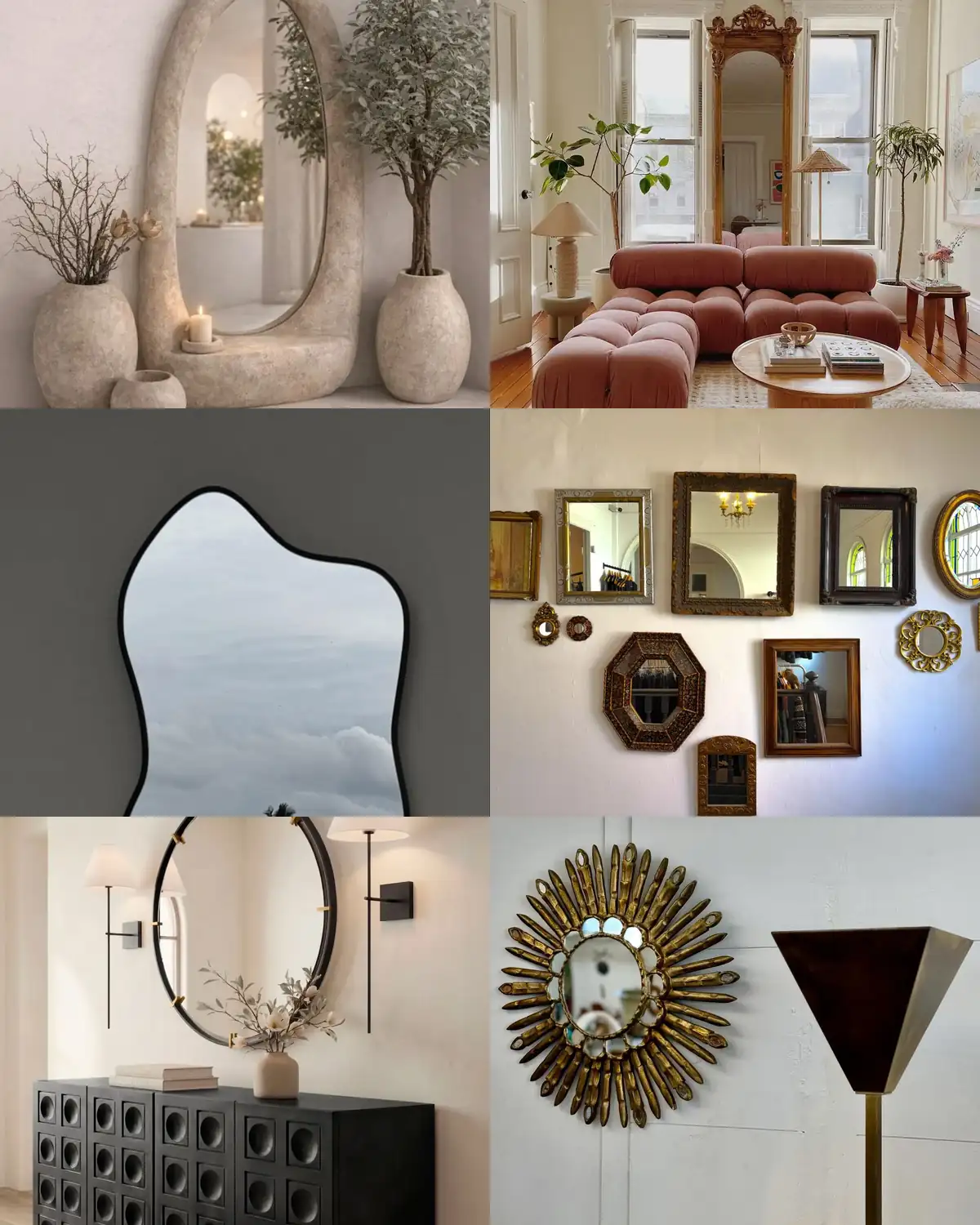
A mirror is the cheapest square footage you will ever buy. It adds no floor space, needs no building work, and yet a well placed one can double the light in a room and make a small apartment feel twice as open. The catch is placement. A mirror hung at random reflects a random view, often the messiest corner of the room, and does nothing for the space at all. These 23 mirror decor ideas show the shapes people are actually searching for right now, from wavy and arched mirrors to sunbursts and full gallery walls, and every photo comes with the working details: the size to buy, the height to hang it, and what it should face. Start with the five basics below, because they explain why some mirrors transform a room and others just hang there. If making a small room feel bigger is your main goal, the mirror rules here pair well with the layout plan in this guide to how to make a small room look bigger. Pick two or three ideas, measure before you buy, and let the reflection do the heavy lifting.
Table of Contents
- Mirror Basics: The Five Rules
- 1. Let a Wavy Mirror Soften a Hard Room
- 2. Build Mirrors Into a Sculpted Wall
- 3. Hang One Big Round Mirror Over a Sideboard
- 4. Go Floor to Ceiling With a Framed Mirror Wall
- 5. Panel a Wall With Mirror Tiles for a Glamorous Room
- 6. Choose an Antiqued Mirror When New Feels Too Cold
- 7. Turn Old Mirrors Into a Gallery Wall
- 8. Cluster Small Sunbursts Into One Big Statement
- 9. Let One Sunburst Mirror Work Like Wall Art
- 10. Try a Trio of Small Mirrors by the Door
- 11. Mix One Plain Mirror With One Decorative Mirror
- 12. Hang an Ornate Gold Mirror Over a Plain Console
- 13. Lean a Tall Mirror Beside the Fireplace
- 14. Stand a Tall Gold Mirror Between Two Windows
- 15. Tuck an Arched Mirror Into a Cozy Corner
- 16. Put an Oval Mirror Over the Entryway Console
- 17. Use a Decorative Mirror Panel Instead of Art
- 18. Rest a Wavy Mirror on the Dresser
- 19. Run One Wide Mirror Along a Dressing Table
- 20. Hang an Octagonal Mirror for a Polished Bathroom
- 21. Keep the Bathroom Mirror Simple in a Calm Scheme
- 22. Match a Bold Bathroom With a Bamboo Gold Mirror
- 23. Use a Backlit Mirror Where the Room Has No Window
- 5 Mirror Mistakes That Waste the Glass
- Mirror Questions, Answered
- Final Thoughts
Mirror Basics: The Five Rules
Reflect something worth seeing. A mirror shows whatever stands opposite it, doubled. Face it toward a window, a plant, a lamp or your best piece of furniture and the room gains light and a second view of something good. Face it toward a laundry pile or a bare wall and you have simply framed the problem twice. Before any mirror goes up, stand where it will hang and look at what it will show.
Match the mirror to the furniture. Over a sofa, console, mantel or vanity, the mirror should span about two thirds to three quarters of the furniture width below it. A small mirror floating over a long sofa looks lost, and one wider than the furniture looks top heavy. For a full wall with no furniture, buy the biggest mirror the budget allows, because scale is what creates the spacious feeling.
Hang the center at eye level. For most rooms the center of the mirror belongs 57 to 60 inches (145 to 152 cm) from the floor. Over furniture, leave 6 to 8 inches (15 to 20 cm) between the furniture top and the mirror bottom. Too high is the most common hanging mistake: a mirror near the ceiling reflects the ceiling, which helps nobody.
Borrow light on purpose. The brightest setup is a mirror opposite or at a right angle to a window, so it catches daylight and throws it deeper into the room. In the evening the same trick works with a lamp placed in front of it. A mirror in a dark corner with nothing to reflect stays dark, so pair small or windowless rooms with a mirror near the best light source they have.
Renters, lean and layer first. A tall mirror leaned against a wall needs no holes at all, and a mirror on a picture ledge or dresser top needs none either. When you do hang, use two hooks rated for the weight, or heavy duty adhesive strips only for mirrors under about 7 lb (3 kg). Whatever the method, a leaning mirror in a walkway or a child’s room gets a safety strap or anti-tip kit at the top. Glass is heavy, and gravity is patient.
1. Let a Wavy Mirror Soften a Hard Room

Most rooms are built from straight lines: square walls, straight shelves, a rectangular rug, a boxy sofa. This wavy mirror breaks every one of them. The soft, uneven outline reads like art first and a mirror second, and the thin black frame keeps it modern rather than playful. It works best on a plain wall with nothing competing beside it, exactly as shown here, where the grey paint and the sky reflection do all the talking.
Size matters with organic shapes. Go at least 24 inches (60 cm) wide, because a small wavy mirror reads as a mistake while a large one reads as a decision. Hang it where it catches a window reflection if you can; the moving clouds and daylight inside an irregular frame are the whole effect. Renters can lean a smaller version on a dresser instead.
One organic mirror per room is the statement. Pair it with straight, simple furniture and let the outline be the only curve at eye level.
2. Build Mirrors Into a Sculpted Wall
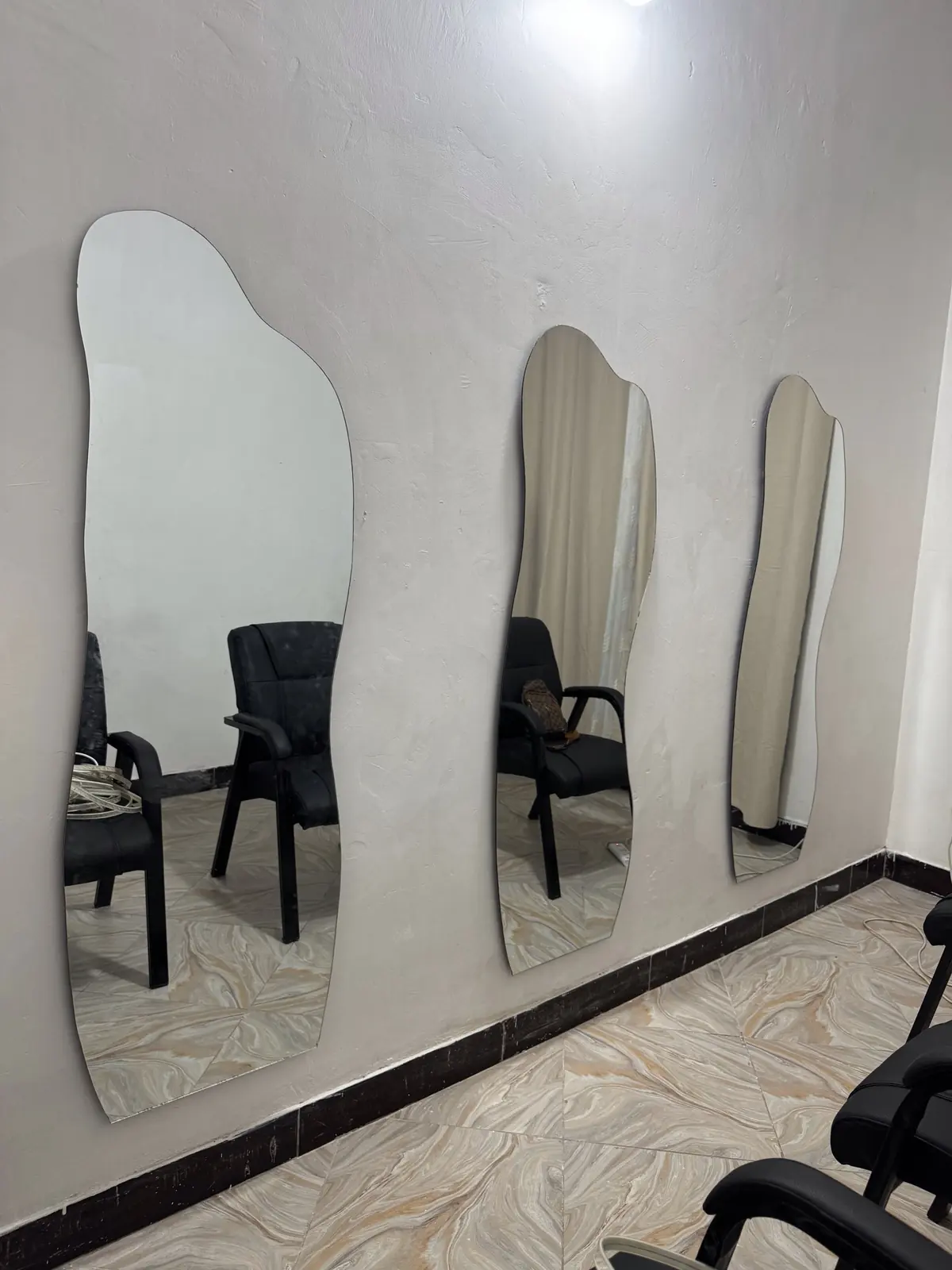
This room takes the wavy idea all the way: the wall itself curves, and long organic mirrors are set into it like windows into another room. Nobody is asking you to rebuild a wall, but the lesson inside the photo is useful anywhere. Several tall, narrow mirrors in a row stretch a wall sideways and make a narrow room feel wider, the same trick a single wide mirror cannot do.
Copy the effect with two or three matching irregular mirrors hung in a line, 2 to 3 inches (5 to 8 cm) apart, at the same height. Hallways and dining rooms take this treatment well because people see the row from an angle as they walk, and the reflections keep changing. Keep frames thin and identical so the group reads as one artwork.
3 tall mirrors, each 12 to 16 inches (30 to 40 cm) wide, hung in a line with even gaps. Total width should cover about two thirds of the wall length for the stretched effect.
3. Hang One Big Round Mirror Over a Sideboard

A big circle over a long, low piece of furniture is the most reliable mirror formula in this whole list. The round shape softens the rectangle of the sideboard, the black frame ties in with the cabinet below, and the two sconces frame the mirror so the whole wall looks planned rather than filled. The vase and books under it finish the scene the mirror reflects.
Follow the two thirds rule: this mirror is roughly two thirds the width of the sideboard, and its center sits at eye level. Leave 6 to 8 inches (15 to 20 cm) between the cabinet top and the mirror’s lower edge. If there are no sconces, a plant on one side and a stack of books on the other gives the same balanced feeling, and it is the fastest upgrade in this article for a dining room or living room wall. It is also a core move in most small room makeover plans, because the circle pulls the eye up and out.
Mirror width = 2/3 of the furniture width. Gap below = 6 to 8 inches. One tall item on one side, one low stack on the other.
4. Go Floor to Ceiling With a Framed Mirror Wall

In this bright living room the mirror is not an accessory, it is the wall. A full height gold framed mirror behind the seating doubles the windows, the garden view and the light, and the room reads twice its real size. This is the boldest idea in the list and the one that changes a room the most, which is why it suits a living room you plan to stay in for a while.
Most homes can borrow the effect at a smaller scale: one oversized framed mirror, 60 inches (150 cm) tall or more, hung or leaned where it faces the main windows. Renters should lean it and strap it. Owners can hang two large mirrors side by side with a thin gap to fake the full wall. Either way, keep the furniture in front of it low, as this room does, so the reflection stays open.
A mirror starts to feel like a wall at about 60 inches (150 cm) tall. Below that it is decor. Above it, it is architecture, and the room feels bigger instead of just prettier.
5. Panel a Wall With Mirror Tiles for a Glamorous Room

Mirror panels cover whole sections of this living room wall, broken into sections by the room’s trim, and the result is glamorous rather than cold because everything reflected is warm: patterned upholstery, flowers, lamplight. Panels bounce light in several directions at once, so a room with one small window gains more from panels than from a single mirror.
The renter version of this idea is peel and stick mirror tiles or lightweight acrylic mirror sheets on one section of wall, tested in a hidden spot first. Acrylic is lighter and safer than glass and can be cut to fit a panel shape. Limit panels to one wall, keep furniture against it simple, and let the reflections supply the decoration. One warning from this photo: panels reflect everything, so the room they face needs to be the tidy version of itself.
One wall only. Acrylic or peel and stick mirror for renters, glass for owners. Test adhesive on a hidden corner for a week before the full wall.
6. Choose an Antiqued Mirror When New Feels Too Cold

The glass in this gold mirror is foxed and cloudy at the edges, and that is the point. Antiqued mirror reflects a softer, dimmer image, so it adds the light and depth of a mirror without the sharp, bathroom feeling of perfect glass. In a room full of straight modern furniture, one aged piece like this supplies all the history the room needs.
Use antiqued glass where you want glow rather than a clear reflection: over a mantel, behind a dining table with candles, or above a console. It is a poor choice over a bathroom sink, where you need to see your face. The ornate frame does the decorating, so keep what stands in front of it simple. A vase of dried grasses and a plain stool are enough here, and the spotted glass turns their reflection into something that looks painted.
Antiqued mirror for mood: mantels, dining rooms, consoles. Clear mirror for tasks: bathrooms, dressing areas, gyms. Never pay task prices for mood glass or mood prices for task glass.
7. Turn Old Mirrors Into a Gallery Wall

A gallery wall of mirrors solves two problems at once: it fills a big blank wall, and it is far more forgiving than a gallery of art, because mirrors do not need a theme, a color palette or matching subjects. This collection mixes gold, dark wood and carved frames, round and rectangular, and it works because the spacing stays tight and the overall outline stays roughly level at the top.
Thrift stores and flea markets are the supply line; five to nine small mirrors cost less than one large new one. Lay the group on the floor first, inside a tape outline the size of the wall area, and photograph two or three arrangements before hanging anything. Keep gaps at 2 to 3 inches (5 to 8 cm). One mirror in the group should be large enough to actually use, around 16 inches (40 cm) across, so the wall is not only decoration.
5 to 9 mirrors. 1 large (16 in / 40 cm +), the rest small. Mixed frames, one shared finish repeated at least twice. Gaps of 2 to 3 inches. Tape the outline on the wall before the first hook.
8. Cluster Small Sunbursts Into One Big Statement
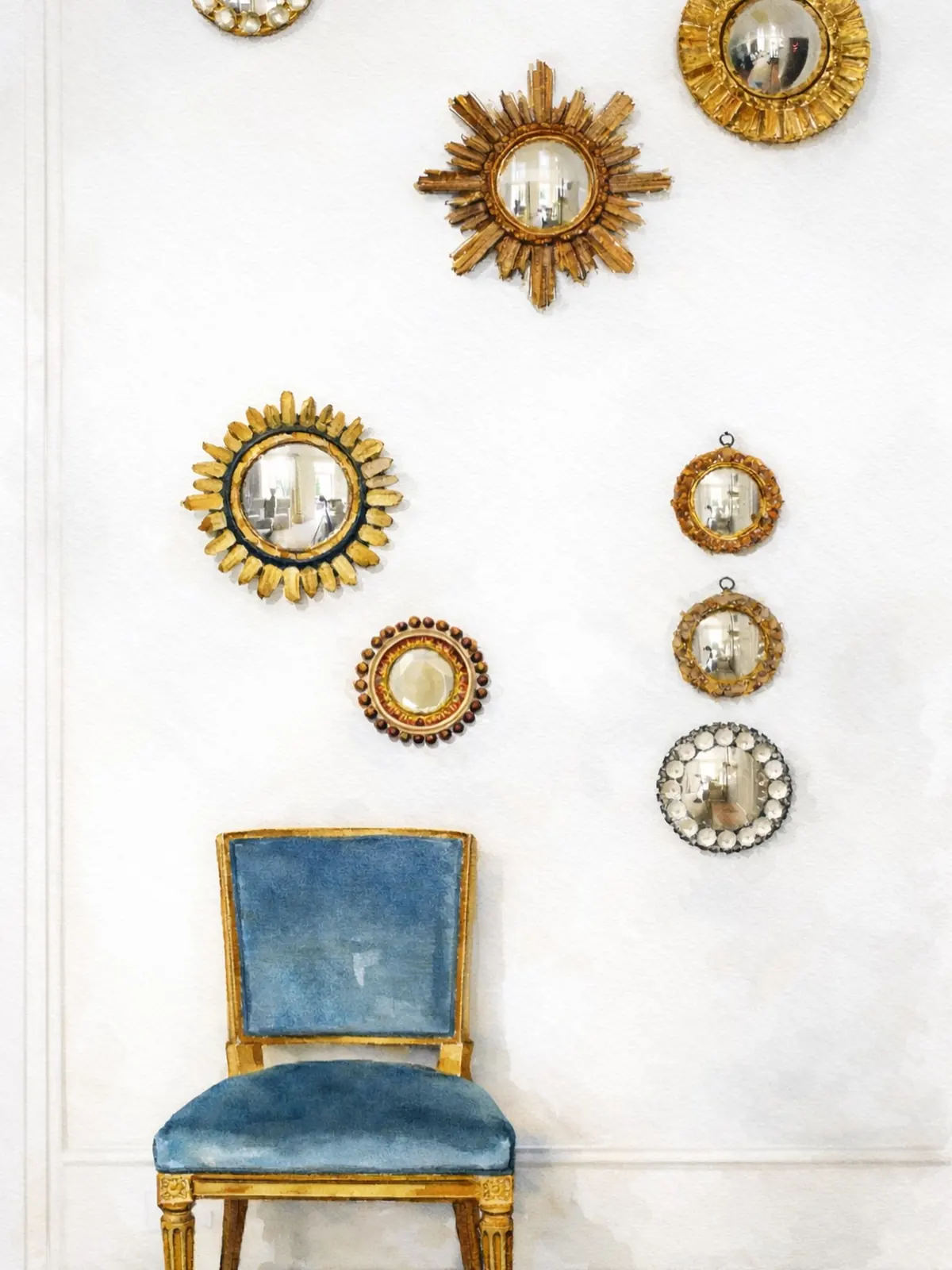
A single small sunburst mirror can look lonely, but a group of them becomes a constellation. This wall mixes one larger sunburst with three smaller round mirrors and lets them drift down the wall like bubbles. The trick is the shared finish: every frame is gold or bronze, so the different shapes read as one family.
Start with the largest mirror at eye level, then place the smaller ones up and to one side, as if they are rising. Paper templates taped to the wall save a lot of rehanging here. This arrangement suits the wall above a sofa or a bed’s headboard wall, where a single wide mirror would fight the furniture shape. Total spread should be about as wide as the furniture below, even though each piece is small.
Hang the biggest piece first at eye level. Add medium pieces second, smallest last, filling gaps. Step back after each one; clusters go wrong by adding, never by pausing.
9. Let One Sunburst Mirror Work Like Wall Art

Hung alone, a large sunburst is less a mirror and more a metal sculpture that happens to reflect. The center glass here is small compared with the rays, so nobody will check their teeth in it; its job is to catch lamplight and throw bright points around the room. That makes it the right choice for walls where a normal mirror would reflect something dull, like a hallway wall facing a door.
Give it room to breathe, with at least 12 inches (30 cm) of empty wall around the rays, and pair it with one strong neighbor, the way this dark lamp stands beside it. Sizes from 24 to 32 inches (60 to 80 cm) across are the sweet spot over consoles and mantels. In a rental, a sunburst is light for its size, so it is one of the safer big statements to hang on picture hooks.
Judge a sunburst by its frame, not its glass. If the rays look good in the shop with the glass covered, it will look good on your wall.
10. Try a Trio of Small Mirrors by the Door
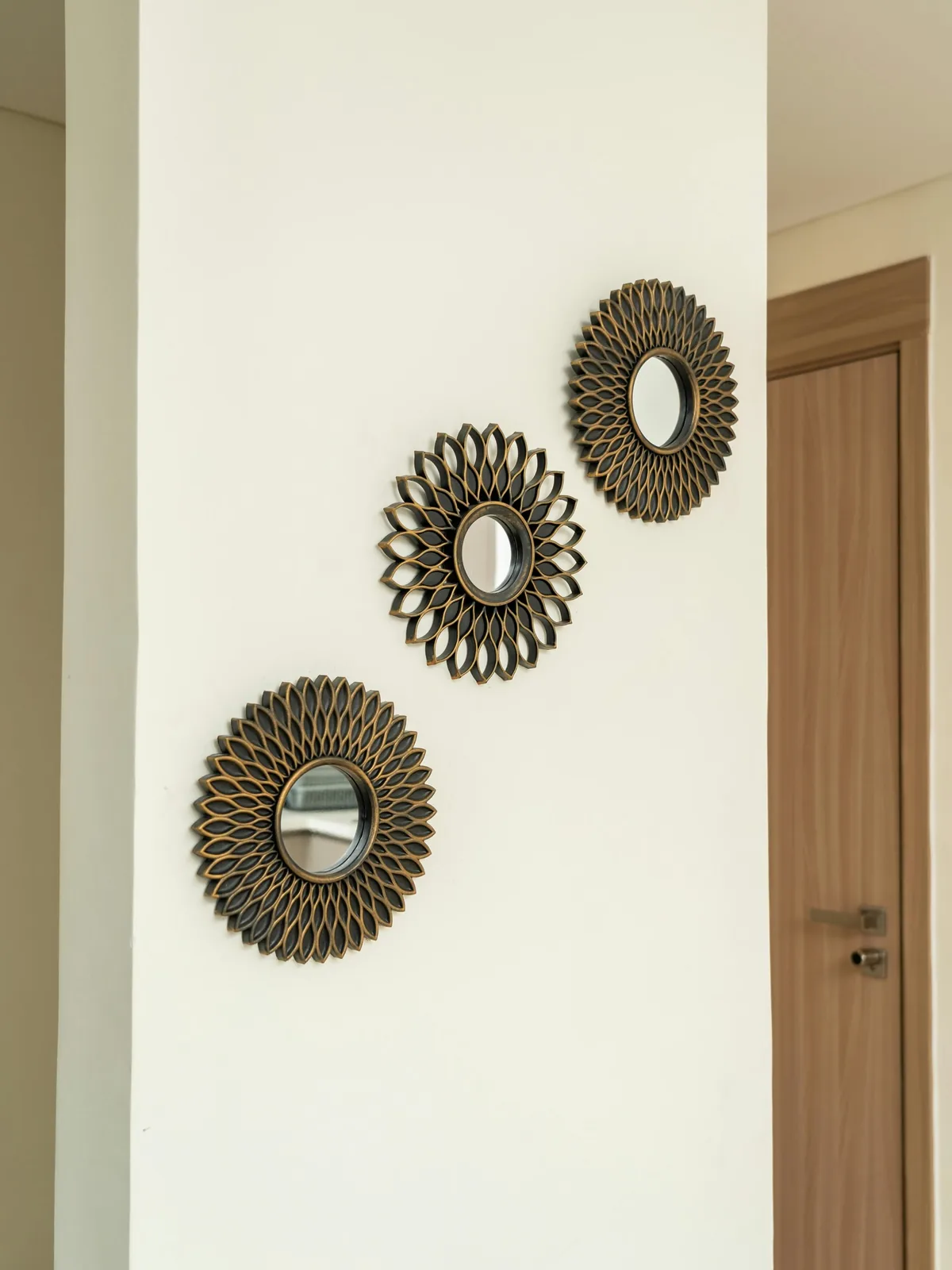
Not every mirror needs to be a project. These three small sunbursts beside a door took minutes to hang, cost little, and give the plainest wall in the house a finished corner. Diagonal placement keeps it lively; a straight row of three small mirrors tends to look like a shop display.
This is the entryway version of the cluster idea, scaled for the tiny wall most apartments actually have next to the door. It also passes the last look test on the way out, which is more than decoration. Small mirrors under 12 inches (30 cm) hang happily on adhesive strips, so this is a true no drill idea. Repeat the finish somewhere else in sight, a brass hook rail or a gold frame, and the corner looks designed.
3 small mirrors, 8 to 12 inches each, diagonal line, centers about 10 inches apart. Total cost usually less than one medium mirror, total holes: zero to three.
11. Mix One Plain Mirror With One Decorative Mirror
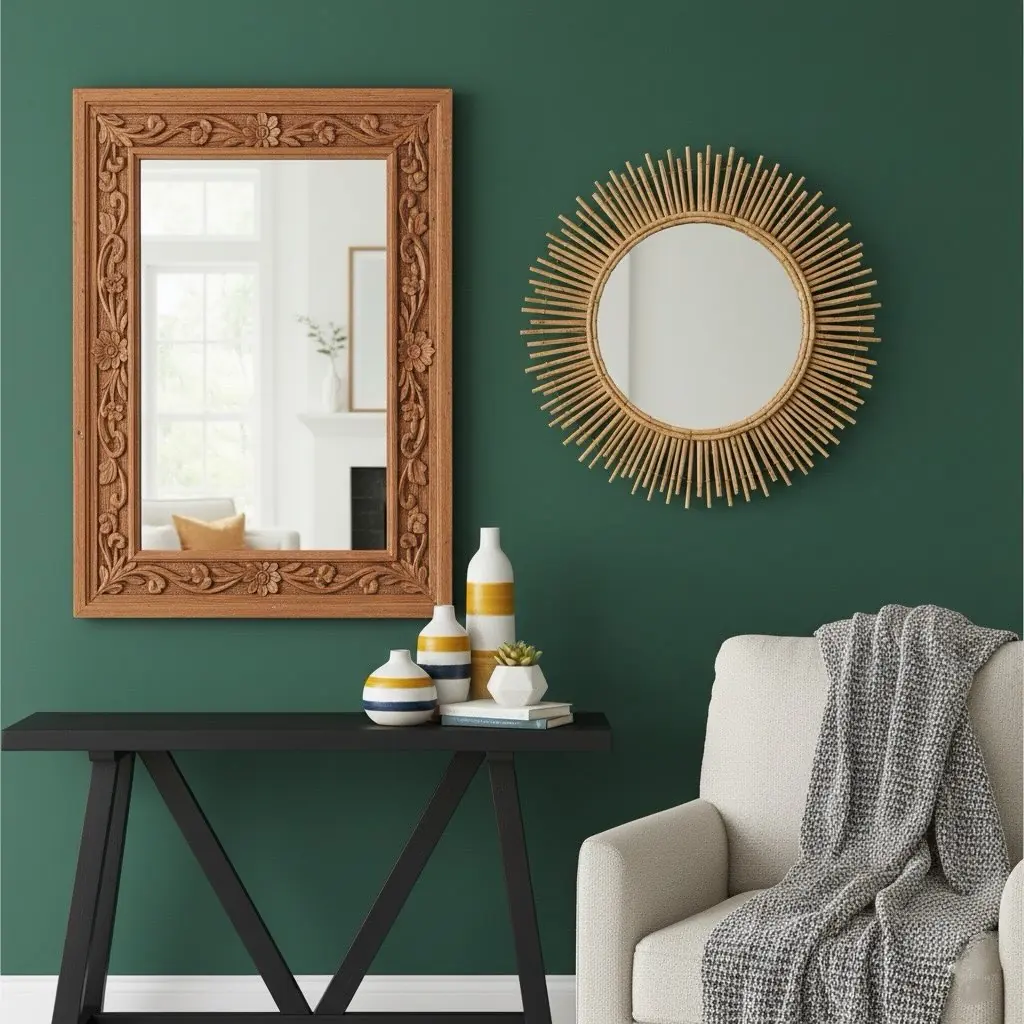
This deep green wall carries two mirrors that do different jobs. The tall carved wood mirror is the useful one, big enough to reflect the windows and check an outfit. The round sunburst beside it is pure decoration. Together over one console they look like a collected pair instead of two purchases, and the dark wall makes both frames glow.
The pairing rule is simple: one mirror for looking, one for looking at. Keep them at different heights and sizes so they do not compete, and overlap their zones slightly so they read as a group. A console, dresser or mantel gives the pair a natural home. If your walls are white rather than green, use darker frames to get the same contrast.
Different shapes (rectangle + round). Different sizes (one clearly bigger). Same warmth of finish. One shared piece of furniture below them.
12. Hang an Ornate Gold Mirror Over a Plain Console
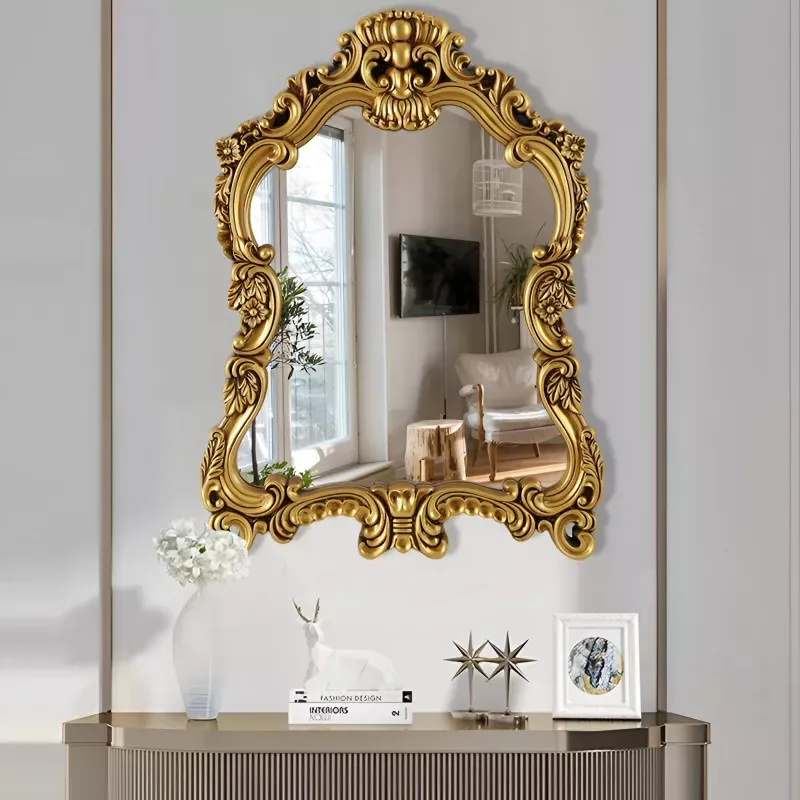
Here the mirror is the fanciest object in the room by a long way, and everything else stays quiet so it can be. A plain console, one vase, two small objects. The rococo style gold frame reflects the window light and turns a white wall into the room’s feature without paint, paper or any other change.
Ornate frames are the easiest mirrors to buy secondhand, because they were made in huge numbers and often sell cheap with dull glass that a glass shop can replace. When you hang one, center it over the furniture, keep the styling under it low and few, and let the frame touch nothing else at the same height. If the gold is too bright for your room, a light rub of dark wax in the crevices calms it down in ten minutes.
An ornate mirror counts as the room’s one star. If the furniture beside it also shouts, move one of them. Stars do not share walls well.
13. Lean a Tall Mirror Beside the Fireplace
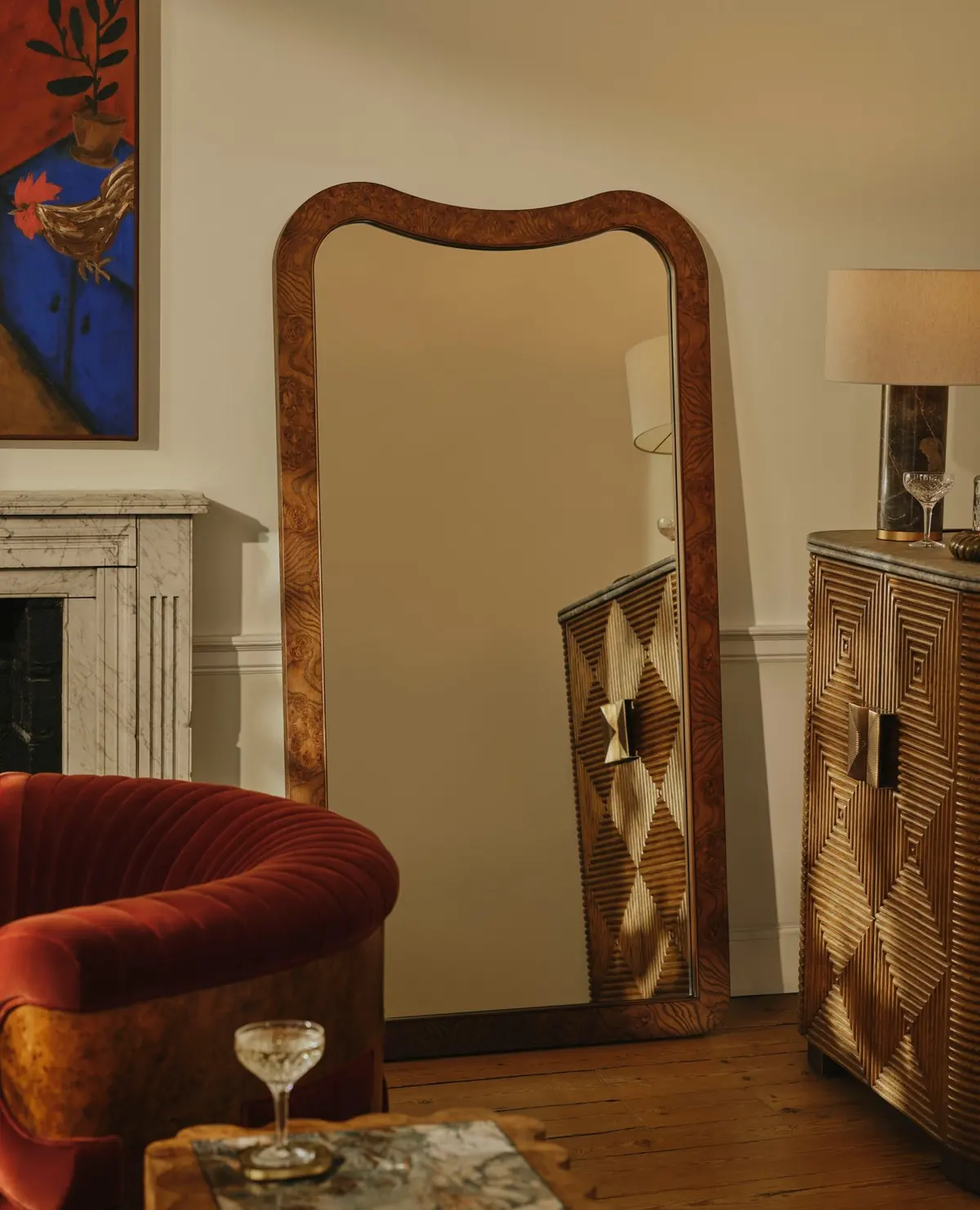
Leaning a tall mirror beside a fireplace, instead of hanging a smaller one above it, changes the whole balance of the room. The mirror stands at floor level, so it reflects the seating and the firelight rather than the ceiling, and its soft shaped top echoes the curves of the armchair. A lean also means zero holes and a move that takes one minute when you want the corner back.
Leaning mirrors need two safety habits. First, the bottom edge sits on a grippy surface or a small stop block so it cannot slide. Second, the top gets a discreet strap or anti-tip kit fixed to the wall in homes with children, pets or earthquakes. Place it beside the fireplace rather than in front of a heat source, and style the floor in front with one low object at most, so the reflection of the room stays clear. The same corner thinking that works for sofa corner decor applies here: one tall piece, one seat, one light source.
1) Non-slip pad or stop block under the bottom edge. 2) Anti-tip strap at the top, fixed to a stud or strong anchor. 3) Keep the slide path clear of rugs that bunch.
14. Stand a Tall Gold Mirror Between Two Windows

Two windows already give this room plenty of light, and the tall gold mirror between them collects it and pours it into the middle of the seating area. Standing a mirror in the gap between windows is a placement most people never consider, because the gap looks too narrow, but a tall narrow mirror is made for exactly that strip of wall.
Measure the gap and buy a mirror 2 to 4 inches (5 to 10 cm) narrower, no wider. Floor standing suits this spot because the mirror can sit slightly forward of the wall and angle the light down into the room. The frame style can be grand, as here, because the windows keep the wall busy anyway. In a rental living room this is the single fastest way to make the main wall feel designed without touching the paint.
Gap 16 to 24 inches wide: choose a 14 to 20 inch mirror. Gap over 24 inches: go as tall as the budget allows and let width follow the two thirds rule.
15. Tuck an Arched Mirror Into a Cozy Corner

Corners are where small rooms go to waste, and this one shows the fix: an arched mirror leaning in the corner, baskets and pampas softening the floor line, and daylight from the side window doubling inside the glass. The arch shape matters here. Its curve echoes the soft textiles and keeps the corner gentle, where a sharp rectangle would look like storage.
Choose a corner that receives light from the side rather than head on, so the mirror glows instead of glaring. A floor mirror of 55 to 65 inches (140 to 165 cm) is tall enough to use for outfits and short enough to lean safely. Add one plant or basket at its base to hide the bottom edge line. Plant lovers can push this further with the leafy styling in these greenery bedroom ideas, where mirrors and plants share the same corner happily.
1 arched floor mirror, 55 to 65 inches tall. 1 basket or plant at the base. 1 soft layer (throw, cushion or dried grasses). Side light only, no direct glare.
16. Put an Oval Mirror Over the Entryway Console

An entryway mirror has two jobs: it gives you a last look before the door, and it tells guests the home is cared for the second they arrive. This dark oval over a slim iron console does both in a corner barely wider than the table. The oval shape is the space saver here, because its narrow top and bottom fit walls where a rectangle would crowd the door swing.
Hallway and entry mirrors should hang slightly higher than living room mirrors, with the center around 60 inches (152 cm), so people standing close still see their face rather than their chest. Keep the console surface almost empty, one tray for keys at most, because the mirror will show any pile twice. More small passage ideas live in this guide to narrow hallway decor for renters, and this mirror is the piece that starts most of them.
Mirror center: about 60 inches (152 cm). Console depth: 10 to 12 inches (25 to 30 cm) in a hall. Walkway left clear: at least 30 inches (76 cm).
17. Use a Decorative Mirror Panel Instead of Art

Some mirror decor barely reflects at all, and that is fine. This white lattice panel works like carved wall art, with small mirror sections behind the pattern that flash light as you pass. It suits rooms where a full mirror would reflect a view you do not want doubled, like a television or a kitchen counter.
Panels and fretwork mirrors sit well beside cabinets and bookcases, where their pattern continues the furniture’s detail. Hang them at art height, center around 57 inches (145 cm), and group them with the same spacing rules as framed prints. Because the glass area is small and divided, these pieces are light for their size and hang on single hooks, which makes them one of the easiest large looking pieces a renter can own.
The opposite wall is busy or messy. The room needs pattern more than reflection. The piece must be light enough for one hook. Two of three means panel, not mirror.
18. Rest a Wavy Mirror on the Dresser
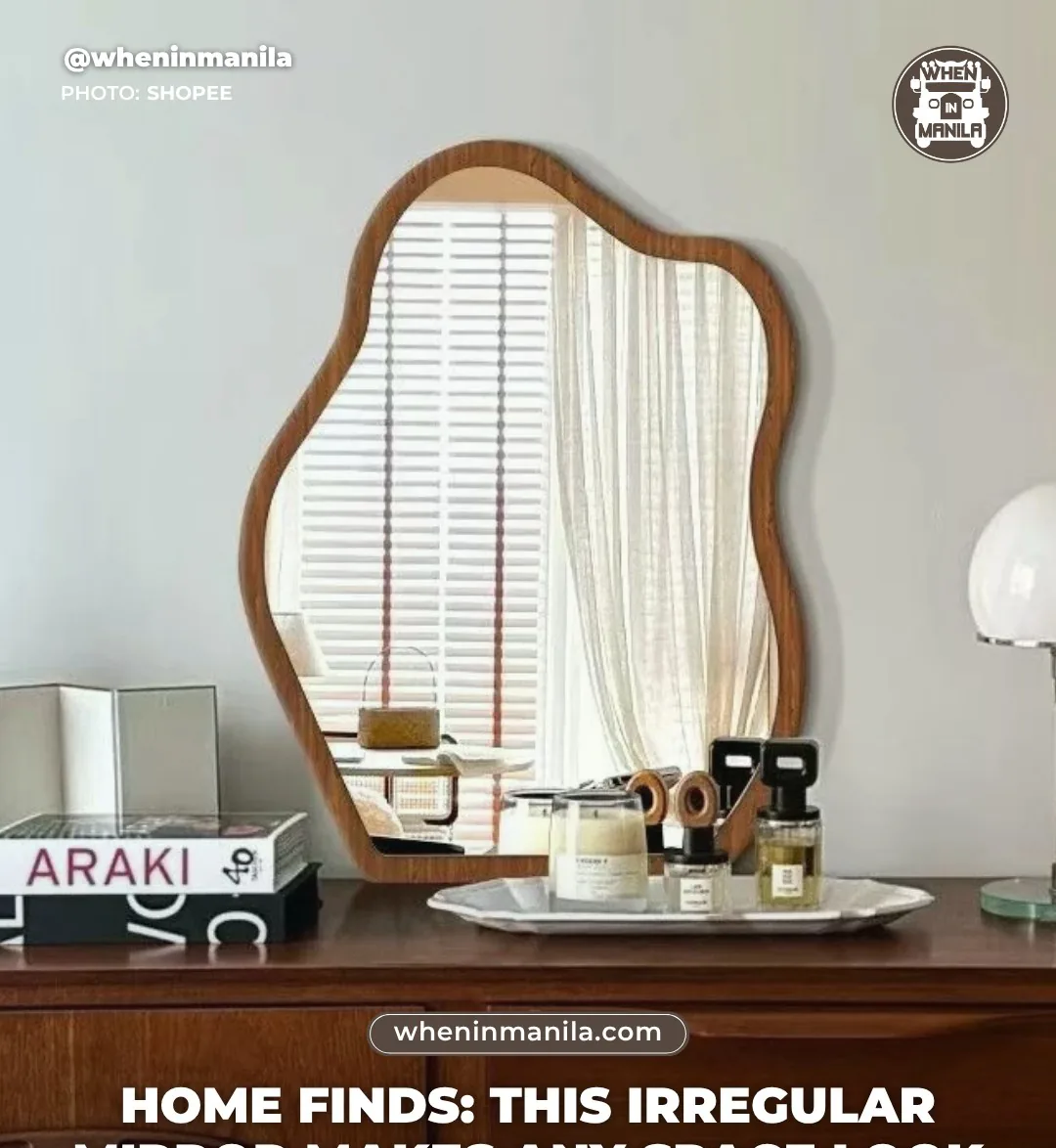
A mirror does not have to hang to work. This wavy edged mirror simply rests on the dresser, leaning back against the wall, and the low placement suits a dressing area where you sit or stand close. Resting mirrors are the renter’s best friend: move them in seconds, angle them by hand, and take them to the next home without a single repair.
Keep the styling in front low and grouped to one side, the way the tray gathers the small bottles here, so the usable glass stays clear. A resting mirror on furniture needs the same anti-slide habit as a floor leaner: a strip of non-slip mat under the frame’s bottom edge. Swap the frame shape to change the room’s mood; this soft wave makes a plain dresser look collected rather than matched.
Mirror resting at a slight back angle. Non-slip strip under the frame. Small items on one tray, one side only. Working glass: the lower center two thirds.
19. Run One Wide Mirror Along a Dressing Table

A dressing area with a wide mirror feels like a boutique hotel corner, even when it is one desk and a chair in a bedroom. The mirror here runs the full width of the built in table, and the small round bulbs along the side give the even, shadow free light that makes mirrors useful rather than just pretty.
Copy it without building anything: a desk or narrow console, one wide rectangular mirror hung low so its bottom edge sits 4 to 6 inches (10 to 15 cm) above the desk surface, and a pair of small lamps or a simple bulb strip at the sides. The wide shape beats a tall one at a dressing table because two people can share it and it reflects the whole styled surface. Keep the surface itself spare, two vases and a tray as shown, since the mirror doubles whatever you leave out.
Mirror width: match the desk, edge to edge. Bottom edge: 4 to 6 inches above the desk. Light: two sources, one each side, at face height.
20. Hang an Octagonal Mirror for a Polished Bathroom
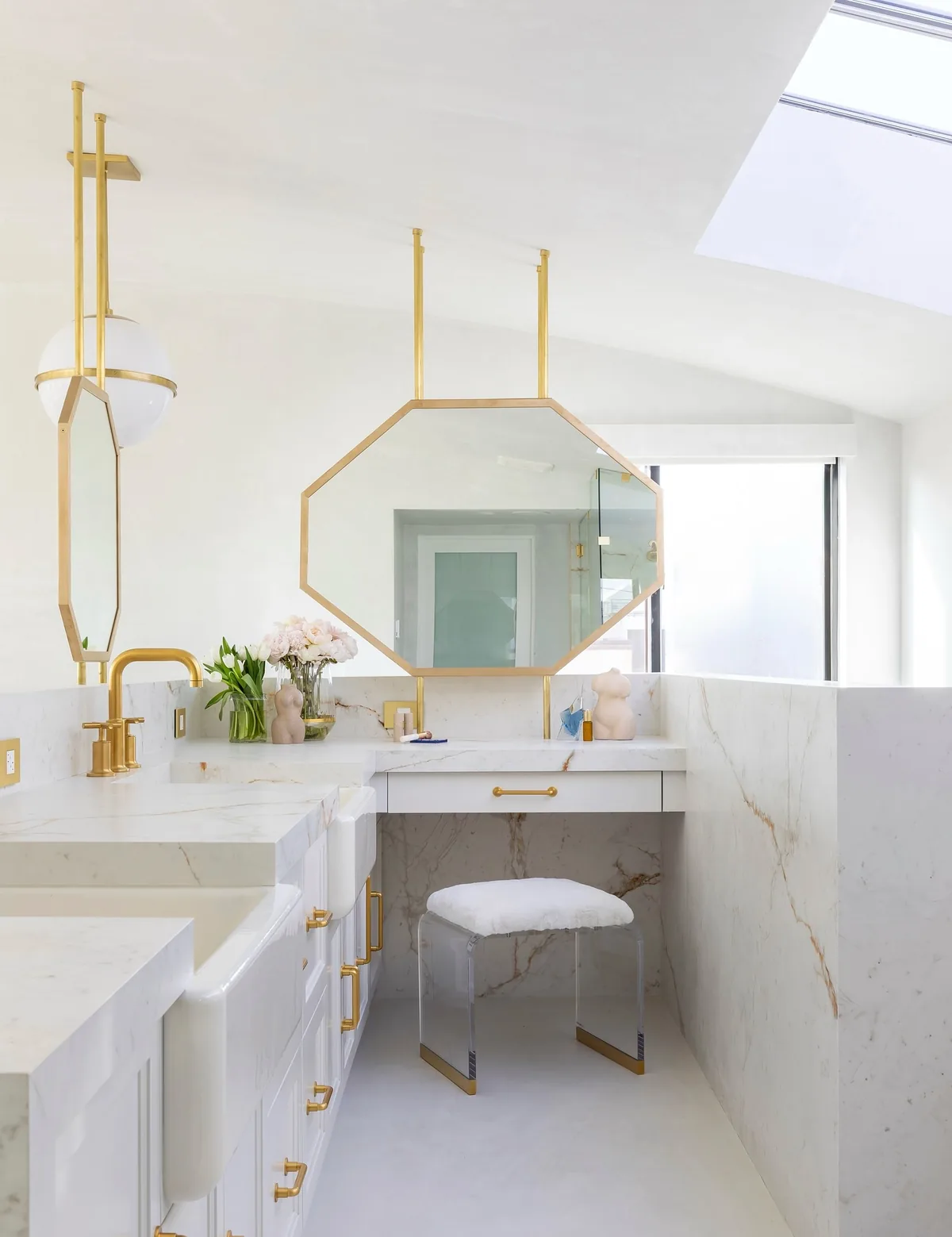
Bathroom mirrors do not have to be rectangles. This eight sided gold mirror hangs from a fine chain above a marble vanity, and the angled edges catch light from several directions, so the whole wall sparkles gently. Geometric shapes like this suit bathrooms because their hard lines agree with tile, stone and chrome.
If you hang a mirror by a chain or cord, the real fixing is the hook in the wall, so use one rated well above the mirror’s weight and check the cord for fraying once a year. Center the mirror over the faucet, not just over the vanity, a small detail that looks wrong in every photo when it is off. Gold and brass finishes warm up white bathrooms that can otherwise feel clinical, as this room proves.
Align the mirror’s center line with the faucet, not the cabinet. Leave 4 to 6 inches between the backsplash and the mirror’s bottom edge.
21. Keep the Bathroom Mirror Simple in a Calm Scheme
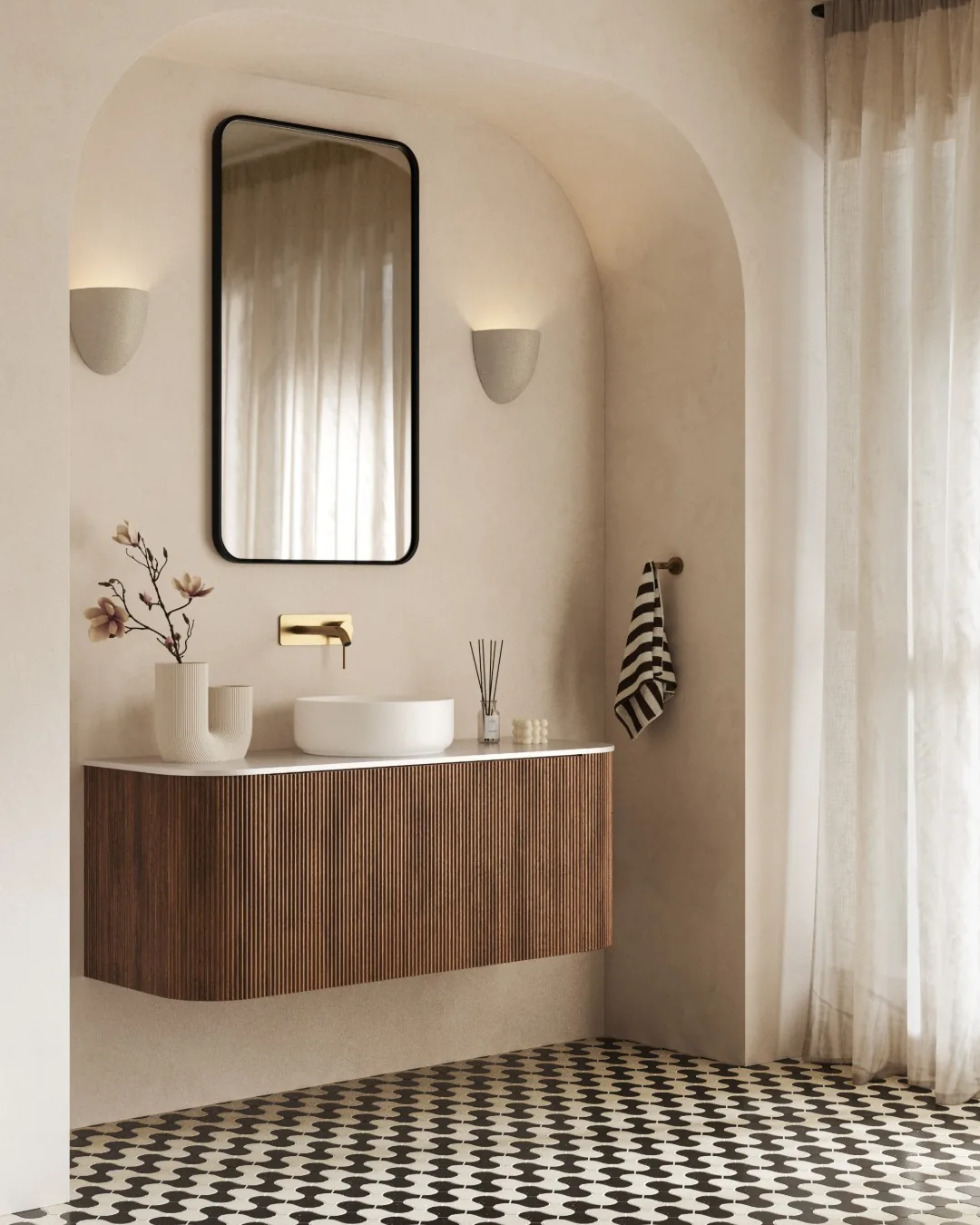
After several grand bathrooms, this quiet one makes the opposite case: a plain rounded rectangle mirror, a wood vanity, two wall lights, nothing else asking for attention. In small bathrooms a simple mirror often beats a decorative one, because the room already holds tile, chrome and bottles, and calm is the luxury.
Rounded corners are practical as well as soft; there are no sharp points at face height in a tight room. Hang the mirror so its center is at the eye level of the household’s main users, roughly 60 inches (152 cm) in a shared bathroom. A black frame on pale walls gives just enough outline, and the same mirror in oak or white would nearly vanish. Choose the frame color by contrast, not by matching, in small white bathrooms.
One plain mirror, rounded corners, frame in the room’s darkest tone. Two lights, one each side. Nothing on the vanity that does not earn its place daily.
22. Match a Bold Bathroom With a Bamboo Gold Mirror
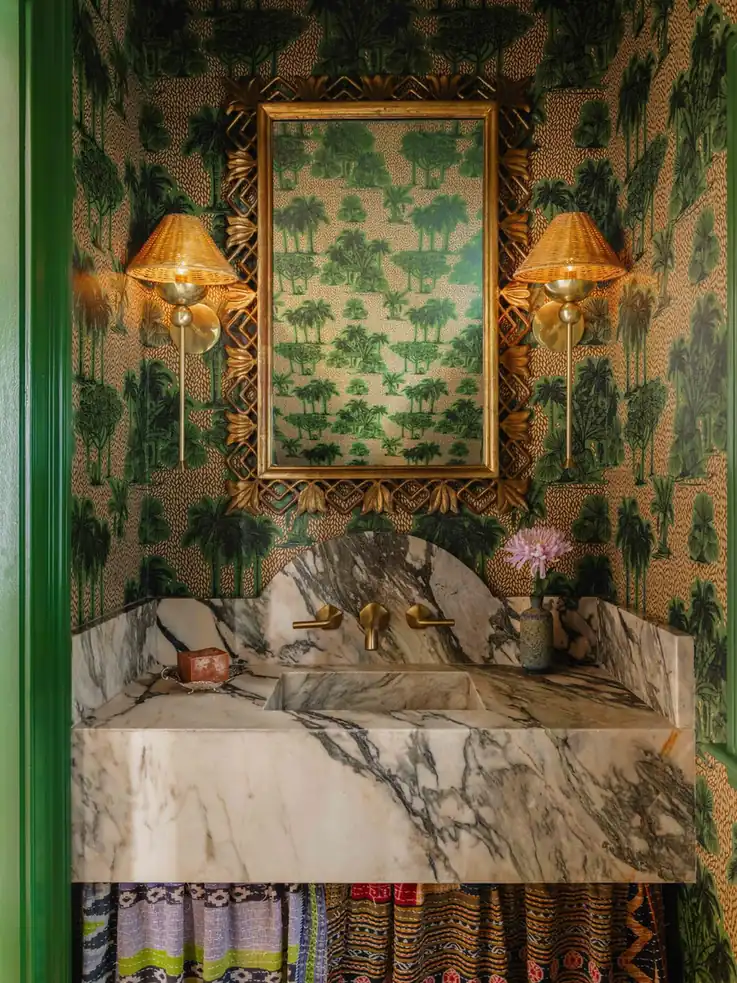
This bathroom is not shy: green jungle wallpaper, a marble sink with heavy veining, lamps with woven shades. A plain mirror would disappear here. The gold bamboo style frame holds its own against the pattern and repeats the warm metal of the taps, so the mirror reads as part of the design instead of an apology.
The lesson travels to calmer rooms. When the walls carry pattern or strong color, the mirror frame needs enough presence to be seen, which means thicker, warmer or darker than you first think. Stand in the shop doorway and squint at the frame; if it vanishes at ten paces, it will vanish over your sink. Keep the glass itself a simple rectangle or arch so the frame does the competing.
Busy wall, bold frame, plain glass shape. Plain wall, any frame. Never busy wall, busy frame and busy shape at once.
23. Use a Backlit Mirror Where the Room Has No Window

Windowless bathrooms are where backlit mirrors earn their price. The light ring around this wide mirror lights faces evenly, with no shadow from an overhead bulb, and the glow makes the whole room feel like a spa at night. Most models plug into the same circuit as the old light or run on a standard outlet, and many include a demister pad that keeps the center clear after showers.
Buy the width to match the vanity, and choose a warm to neutral light color (around 3000 to 4000 K) unless you apply makeup for photos, where neutral daylight is kinder. Renters should check the lease before swapping a wired fitting, but freestanding lit mirrors that rest on the vanity give much of the same effect with no wiring at all. This is the one mirror in the list bought for its light first and its reflection second.
Width matched to the vanity. Light 3000 to 4000 K. Demister pad if the shower shares the room. Renter option: a plug in lit mirror that rests on the counter.
5 Mirror Mistakes That Waste the Glass
1. Facing the mirror at a blank wall or a mess. The mirror doubles whatever it faces. Opposite a bare wall it reflects nothing and adds no light; opposite a clutter pile it shows the pile twice. Walk to the spot, turn around, and look at the view before any hook goes in. If the view is dull, move the mirror, not the furniture.
2. Going too small over big furniture. A 16 inch (40 cm) mirror over a 6 foot (180 cm) sofa looks like a porthole. Small mirrors have their place in clusters and trios, but a lone mirror over furniture should span two thirds of the piece below it. When in doubt between two sizes over a sofa or console, the bigger one is almost always right.
3. Hanging it at ceiling height. Mirrors hung with their center far above eye level reflect the ceiling and the tops of door frames, the two least interesting views in any home. Bring the center down to 57 to 60 inches (145 to 152 cm) and the mirror starts showing people, plants and lamplight instead.
4. Leaning a mirror with no safety plan. A leaned mirror that slides is a sheet of glass falling edge first. Skipping the non-slip pad and the anti-tip strap because it looks fine today ignores children, pets, vacuum cleaners and small earthquakes of daily life. Two minutes of hardware is the whole insurance policy.
5. Expecting one mirror to light a dark room alone. A mirror moves light; it does not make it. In a room with one small window, a mirror placed away from that window stays dull. Put the mirror where it can see the window or a lamp, or choose a backlit or antiqued piece that brings its own glow.
Mirror Questions, Answered
What size mirror makes a small room look biggest?
The largest you can place well. A mirror 36 inches (90 cm) or wider on the main wall, or a floor mirror 60 inches (150 cm) or taller, changes how big the room feels. Several small mirrors add sparkle but not the same sense of space, unless they are grouped tightly like the gallery wall in idea 7.
Where is the best place to hang a mirror in a living room?
Opposite or beside the largest window, so it catches daylight, or above the mantel or sofa where it reflects the seating and lamps. The rule behind every good spot is the same: the mirror should face something you enjoy looking at.
Can you have too many mirrors in one room?
Yes, when they start reflecting each other or every wall has one, the room feels restless. Two mirrors per room is a comfortable limit for most homes, three if one is small or mostly decorative like a sunburst or a panel. Spread them so no mirror reflects another mirror directly.
How do you hang a heavy mirror in a rental without drilling?
Lean it instead, with a non-slip pad and an anti-tip strap into one small anchor hole at most. For wall hanging without holes, only trust adhesive strips for mirrors under about 7 lb (3 kg), and use French cleat style adhesive hangers rated above the weight. Anything heavier deserves a proper hook; one small hole is cheaper to fill than one broken mirror.
Is a round or an arched mirror better for a small space?
Both work. Round mirrors soften rooms full of rectangles and suit spots above furniture. Arched mirrors add height, which small rooms usually need more, and they lean beautifully in corners. Choose the arch when the ceiling feels low, the round when the furniture feels boxy.
Should a bathroom mirror be as wide as the vanity?
Slightly narrower looks best: about 75 to 90 percent of the vanity width, with the mirror centered on the faucet. For double sinks, either one wide mirror or two matching mirrors work; two mirrors feel calmer when the space between the sinks is wide.
Final Thoughts
Mirrors reward the homes that place them with intent. One big piece facing the light will do more than five small ones scattered at random, and the mirror decor ideas above all follow that same order: choose the reflection first, the size second, the frame last. Start with the room that feels darkest or smallest, measure the wall, and buy the biggest honest mirror the budget allows. If money is the limit, the secondhand routes in this list, ornate frames and gallery collections, often beat new glass for half the price. Mirrors also sit happily inside a bigger budget plan, and this roundup of budget home decorating ideas for small homes shows where a mirror purchase fits among the other cheap upgrades. Hang it at eye level, strap it if it leans, and let it show the best view your home already has.

Elora Vania here, founder and Senior Editor of Home Aure. With years of experience in interior styling and home decor, I created this site to bring thoughtful, practical design advice to real homes—helping you create spaces that feel warm, personal, and beautifully lived-in.