

Small rentals come with the same three problems: white walls you cannot paint, a landlord who wants the deposit back, and a living room that already came with a sofa you didn’t pick. You can still build a home that feels warm, layered, and personal. Afrohemian decor ideas for small rentals work especially well here because the style is built from layers you add on top of what you already have, not from gutting a room.
Pinterest’s 2026 trend report names Afrohemian as one of its top home styles for the year, built from African and African diaspora textiles, art, and natural materials layered with bohemian styling. Searches for “afrobohemian home decor” and “adire fabric” both climbed fast in the lead-up to the report.
This guide gives you 21 specific, small-space, renter-safe ways to bring the look into your home, room by room, without painting a wall or losing your deposit.
What Is Afrohemian Decor?
Afrohemian decor blends African and African diaspora design traditions with the relaxed, layered habits of bohemian styling. That can mean a resist-dyed Yoruba adire textile, a carved West African stool, Ethiopian basket weaving, or art by a diaspora artist, mixed with plants, warm wood, and soft natural light.
It is important to say clearly: Africa is not one culture, and African design is not one single look. A Nigerian adire cloth, a Ghanaian Asante stool, and an Ethiopian basket come from different countries, different communities, and different traditions. This guide treats them that way. When this article names a specific textile or craft tradition, it is because a museum, craft history source, or maker has identified it that way. When an item’s exact origin is not confirmed, the guide describes what you can actually see: the pattern, the color, the material.
Before You Decorate Your Small Rental
A few ground rules keep this whole project renter-safe and space-smart:
- Measure your real walking paths first. In a small room, furniture that blocks a door or a walkway will make the space feel smaller, not cozier.
- Check your lease before you drill, paint, or use strong adhesive. Most of the ideas below use furniture, textiles, and clip-on fixtures instead.
- Start with what you already own. A plain sofa, a bare bookcase, and a blank wall are not problems. They are the base layer.
- Favor portable pieces. Rugs, cushions, baskets, and art move with you. Built-in shelves do not.
Related reading: rental decorating ideas without adhesives and 19 ways to make a rental feel like yours when you can’t paint.
1. Build an Earthy Palette Around What You Already Own
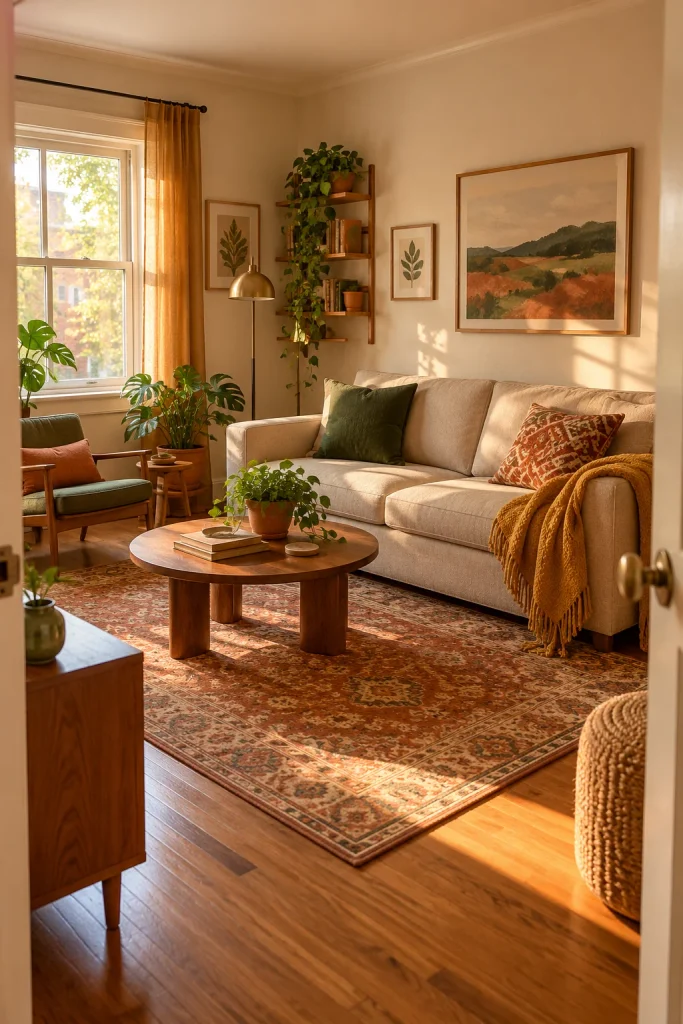
Before you buy anything, look at what is already in the room: your sofa color, your floor, your biggest piece of furniture. Afrohemian rooms lean on warm, earthy colors like terracotta, rust, mustard, deep green, and off-white, with black and wood tones holding it together. You do not need to match this exactly. You need two or three colors that already exist in your rental to repeat on purpose.
- Pick one warm color (terracotta, rust, or mustard) as your main accent.
- Pick one deep, grounding color (deep green or charcoal) to stop the room from feeling too bright.
- Keep your walls and big furniture as the neutral background.
- Buy small items first (cushions, a throw, one rug) in your chosen colors before buying anything large.
This matters in a small space because a scattered color palette makes a room look cluttered even when it is not. A repeated, limited palette makes the same number of objects look intentional.
Quick Tip: Pick Your Palette in 5 Minutes
Stand in your living room and name the three colors you see the most of right now (floor, sofa, biggest wall). Write them down. Those three colors are your starting palette. Every new cushion, throw, or rug should match at least one of them.
2. Let Resist-Dye Style Cushions Give a Plain Sofa Some Character
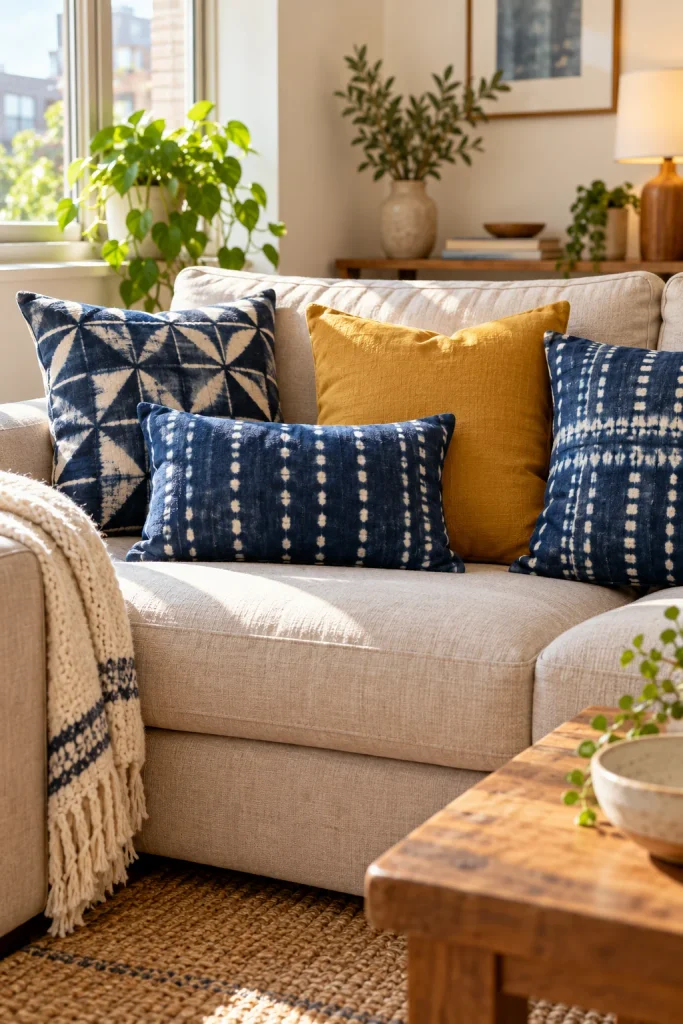
A plain sofa is the easiest canvas in a small rental, and cushions are the cheapest, most reversible way to change its whole mood. One pattern worth knowing is adire, a traditional indigo resist-dye cloth made for generations by Yoruba women in southwestern Nigeria, where fabric is tied, stitched, or painted with cassava paste before dyeing so the pattern appears in white against deep blue.
Start here, one step at a time:
- Pick a plain or low-pattern sofa as your base.
- Add two or three cushions in a bold, high-contrast print.
- Mix in one or two plain cushions in a matching solid color so the eye has somewhere to rest.
- Check the material: a genuine handmade resist-dye textile will feel different from a printed cotton copy, and the listing should say which one you are buying.
Cushions sold as “adire-inspired” or “adire print” are usually machine-printed reproductions of the pattern, not the handmade cloth itself. Both can look good on a sofa. Only call it adire if the seller can actually say it was made using the traditional resist-dye process.
Do
- Ask the seller if the cushion is hand resist-dyed or printed
- Mix one bold print with one or two plain cushions
- Keep prints within your chosen palette
Avoid
- Calling any blue-patterned cushion “adire” without checking
- Covering the whole sofa in the same print
- Buying five different bold patterns at once
3. Use One Patterned Throw as Your Starting Point
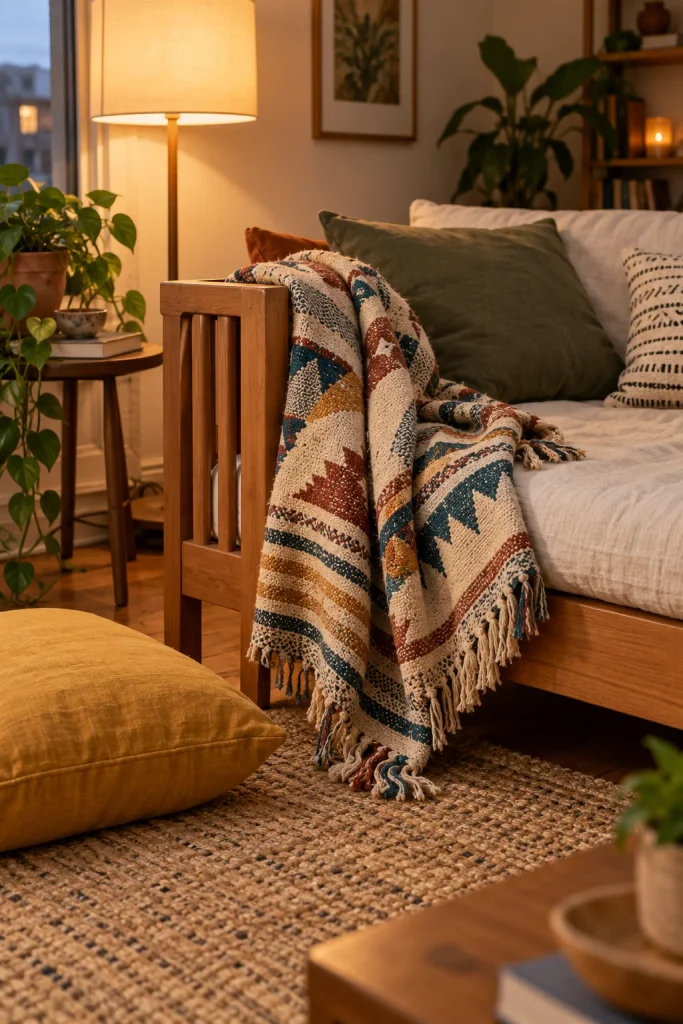
A single patterned throw can anchor an entire room, which is useful when you are decorating slowly. Drape it over the back or arm of a sofa, chair, or daybed, and build your other choices (cushions, a rug, art) around its colors.
One good throw usually beats three competing ones. In a small living room, too many bold patterns fighting for attention makes the room feel busy rather than warm. One throw gives you a clear reference point: when you shop for a rug or cushions later, you hold them up against this throw and ask, “does this share a color with it?”
Key takeaway: Buy your patterned throw before your rug or your cushions. Let its colors decide the rest of your shopping list, not the other way around.
4. Choose a Rug That Fits the Seating Area

A rug that is too small will make a seating area look like it is floating in the middle of the room, and in a small rental, floor space is already limited. A flatweave, kilim-style rug (a flat, pattern-woven rug tradition found across several regions including Turkey, the Caucasus, and parts of North Africa) works well here because it is thin enough not to block doors and light enough to move or roll up when you leave.
Option A: Rug under the front legs only. All seating pieces have their front legs on the rug, back legs off. Works in tighter rooms where a full-size rug would not fit.
Option B: Rug under the whole seating group. Every piece of furniture sits fully on the rug. This feels more grounded but needs more floor space to work.
In a studio or a living room under about 120 square feet, Option A almost always looks better and leaves more usable floor. In a larger living room, Option B pulls the whole seating area together.
5. Make Handwoven Baskets Work as Storage

Basket weaving is a strong, living craft tradition in many African communities, including well-known weaving regions in Rwanda, Ghana, and Botswana. Rather than guessing at a specific basket’s origin, look for a seller or maker who states where and how it was made.
In a small rental, baskets solve a real problem: they hide clutter without a cabinet. Use them for:
- Throw blankets and extra cushions
- Remote controls, mail, and charging cables
- Plant pots, to add height and texture under a plant
- Shoes or bags by the door
A stack of two or three different-sized baskets by a sofa or shelf also reads as decor on its own, so storage and styling happen in the same move.
Before You Buy a Basket
- Does the listing say where and by whom it was made?
- Is it sturdy enough to hold what you plan to store?
- Does the size fit the gap you actually have (measure first)?
- Natural fiber baskets can shed small fibers at first. Fine for blankets, less fine for anything that needs to stay lint-free.
6. Display African and Diaspora Art on a Low Cabinet
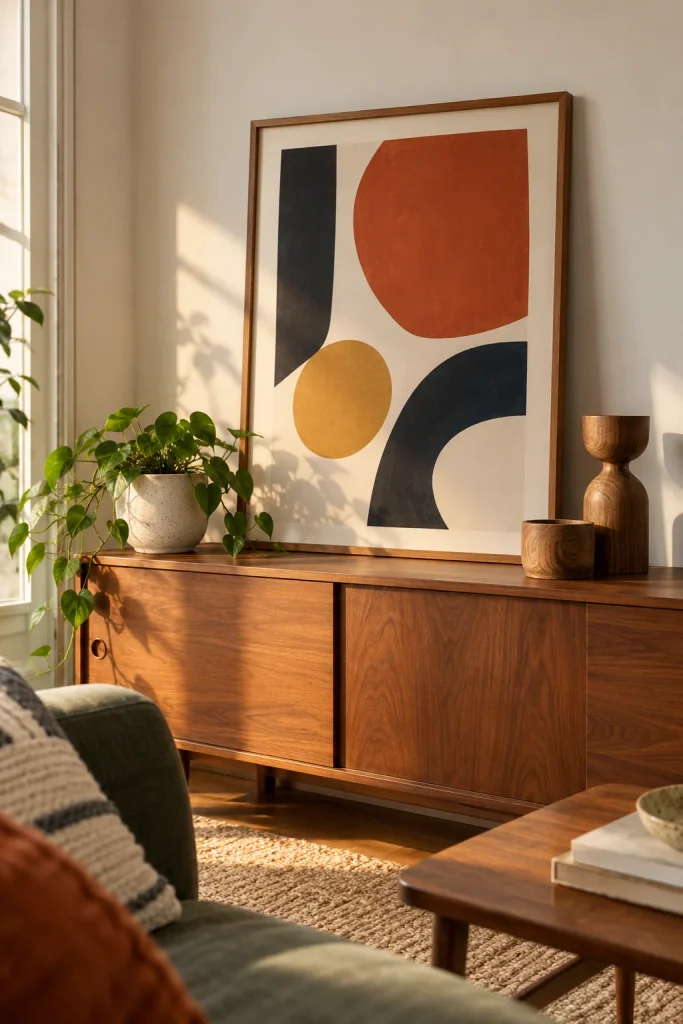
You do not need wall space to show art. A low cabinet, console, or even a stack of books can hold a small piece of art, leaning rather than hung. This is useful in a rental where drilling multiple holes for a gallery wall is not allowed.
Lean one larger piece at the back, then layer a plant, a small carving, or a candle in front at different heights. Keep the piece centered on real African or diaspora artists and makers rather than generic “tribal-style” prints with no credited source. If you buy a print, look for the artist’s name in the listing. If you cannot find one, that is worth noting before you buy.
Three Steps to Style a Leaning Art Display
- Lean your largest art piece flat against the wall at the back of the cabinet.
- Add one tall item (a plant or a tall vase) to one side, not the center.
- Fill the remaining space with two or three low objects of different heights.
7. Give a Meaningful Textile Its Own Display Space
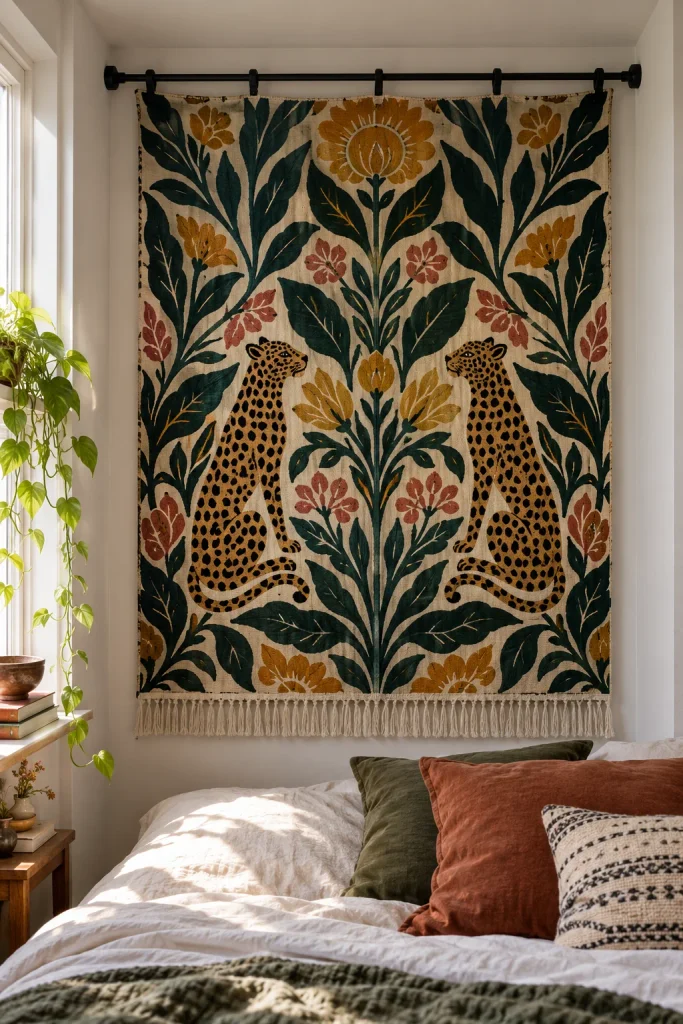
A textile that has a story (a family piece, a market find, a cloth tied to a specific place or technique) deserves to be seen as its own thing, not folded into a drawer. Hanging it is also a no-drill option if you use a clip-on curtain rod or a spring-tension rod set into an alcove or doorway, instead of nails.
If you don’t know the textile’s exact origin, it is fine to describe it honestly: the colors, the pattern, the weave, how it was gifted or found. You do not need to assign it a cultural label to give it a place of honor on your wall.
Key takeaway: A textile hung with a tension rod or clip rod, no nails, can come down and go back up in minutes when you move, which makes it one of the most rental-friendly statement pieces on this list.
8. Fit a Rattan Accent Chair Into an Unused Corner
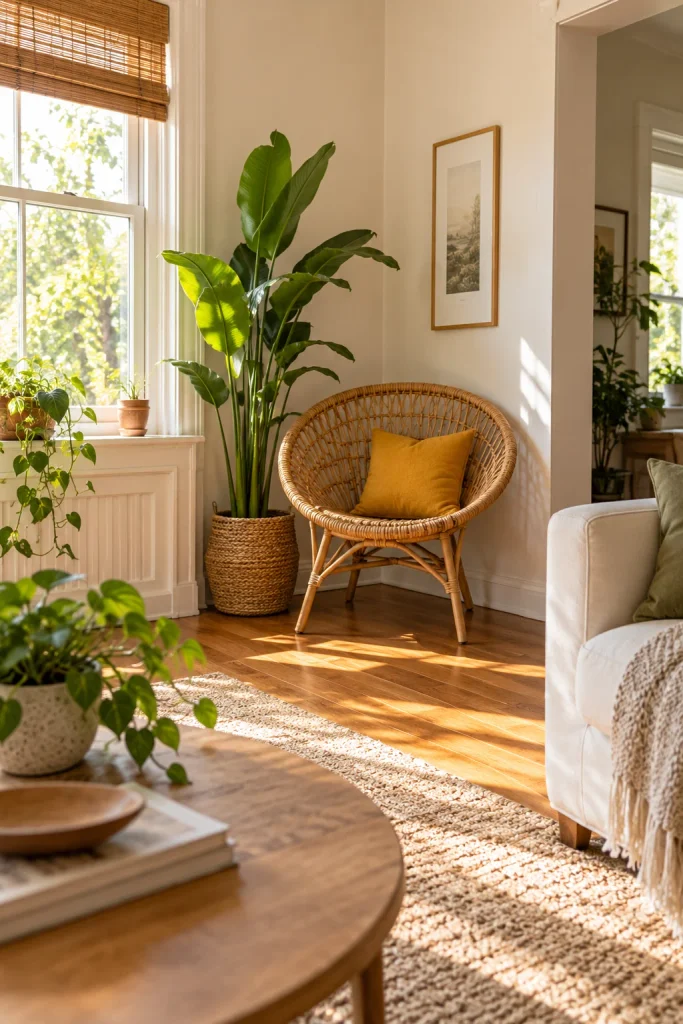
Every small apartment has one awkward corner: too small for a sofa, too big to ignore. A rattan accent chair fills that gap without crowding it. Rattan is a lightweight, woven natural material used in furniture across many design traditions worldwide, and it fits the Afrohemian palette because of its warm, honey-brown tone and open, airy weave.
- Measure the corner before shopping. A chair that is even two inches too wide will block a walking path.
- Pick an open-weave or see-through chair style so the corner still feels light, not heavy.
- Add one small cushion in your palette color, not three.
- Skip a side table here if the corner is tight. One chair, one plant, is enough.
A corner that works
At least 24 to 28 inches of clear floor width, no door swinging into it, natural light nearby.
A corner to skip
Behind a door, in a main walking path, or a corner you already use for coats and bags.
9. Use a Carved Stool-Style Table as a Small Side Table

A small carved wood stool can double as a side table next to a sofa or chair, giving you a flat surface for a cup or a lamp without the bulk of a full end table. Some decorative stools sold today are styled after West African stool traditions, including the carved stools of the Akan and Asante peoples of Ghana, which in their traditional form are sacred objects tied to identity, authority, and in some cases royal lineage, not anonymous furniture.
When you shop, look specifically for stools made and sold as decorative home furniture rather than ceremonial or museum pieces, and avoid treating an actual sacred or ritual object as a side table.
- Measure the gap next to your seating (height should sit near the arm of your sofa or chair).
- Choose a stool made and marketed as home decor furniture, not an antique ceremonial object.
- Use a coaster or small tray on top if you plan to rest drinks on it regularly.
Before You Buy a Carved Stool
- Is it sold as decorative furniture, not a ceremonial or sacred antique?
- Is the seat height comfortable next to your specific chair or sofa arm?
- Is the wood solid enough to hold a lamp or a drink safely?
10. Add a Movable Pouf for Flexible Seating
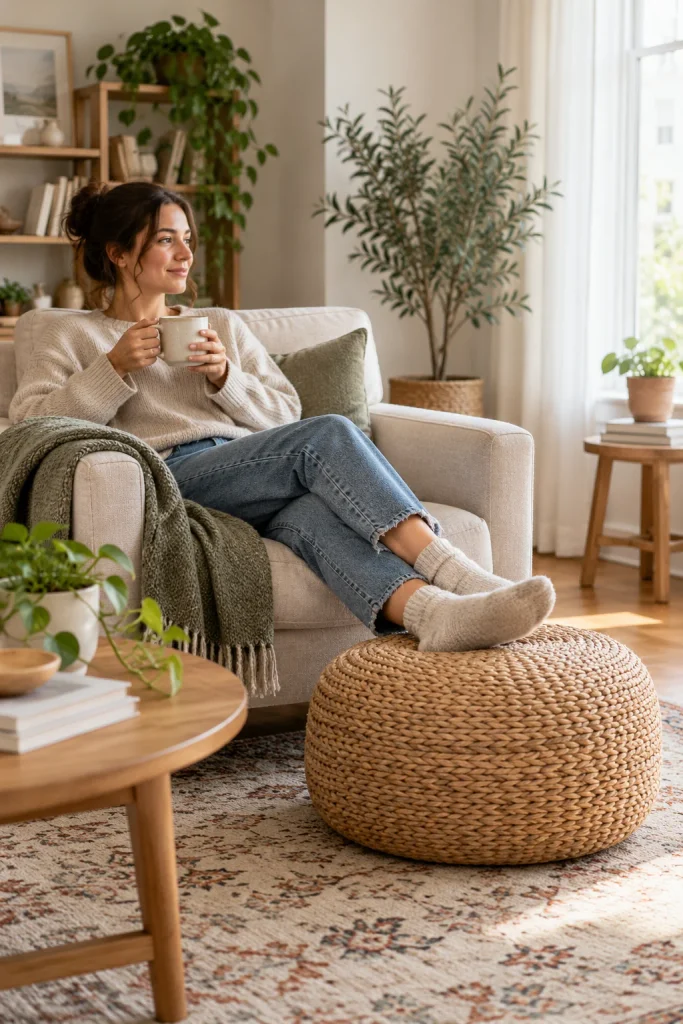
A pouf (a soft, low, often cylinder-shaped footstool, commonly made with leather or woven textile covers in styles popularized through Moroccan design) solves a real small-space problem: you need extra seating sometimes, but not a permanent second chair all the time.
Option A: One pouf as a footrest. Keep it by your main chair most days, pull it over as a seat only when guests come. Option B: Two small poufs instead of one armchair. More flexible for groups, easier to tuck away, but less supportive for long sitting.
If your space is under about 300 square feet, one pouf usually works better than two. It takes up less visual space and still does the job.
11. Bring Warm Light Down to Seating Level

Overhead lighting alone makes a small room feel flat and a little cold. A warm-toned floor lamp or table lamp near your seating area, set at eye level or lower when you are sitting, does more to change the mood of a room than almost anything else on this list.
- Use a warm bulb (look for “warm white” or a lower Kelvin number on the box) instead of a bright white bulb.
- Place the lamp near, not above, where people sit.
- A woven rattan or natural-fiber lampshade adds texture even when the light is off.
- Plug-in lamps need no wiring work, which makes them fully rental-safe.
Key takeaway: One warm plug-in lamp placed at sitting height can change the feel of a room more than a new piece of furniture, and it needs no landlord approval.
12. Create One Plant Corner That Matches Your Light
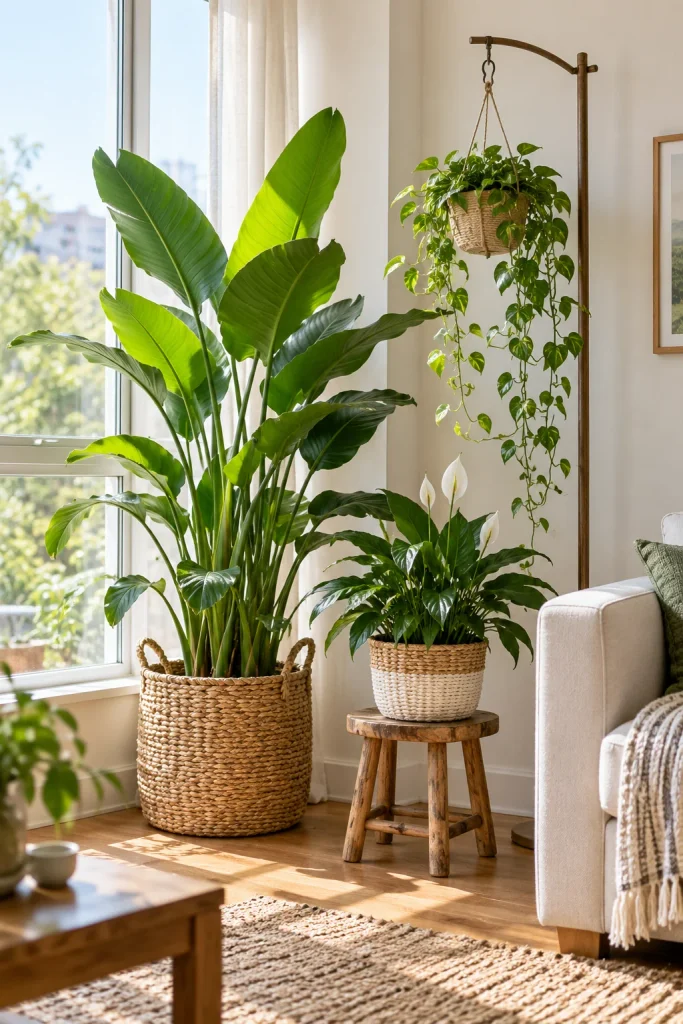
Plants do a lot of work in this style, but only if they survive. Rather than scattering single plants around the whole apartment, group two or three in one corner that actually gets enough light for them.
- Bright, direct light for several hours: a snake plant, pothos, or a small palm will do fine.
- Low or indirect light: a pothos, ZZ plant, or snake plant again are more forgiving choices.
- Group plants at different heights (floor, stool, hanging) rather than lining them up at the same level.
- Check the specific plant’s own care instructions for water and light, since needs vary even within these forgiving varieties.
Quick Checklist: Picking Your Plant Corner
- Stand in the corner at midday and check how much direct sun it gets
- Pick plants matched to that actual light, not the light you wish you had
- Group at least two plants of different heights together
- Use a basket or woven pot to tie the corner into your palette
13. Soften the Windows Using the Existing Curtain Rod
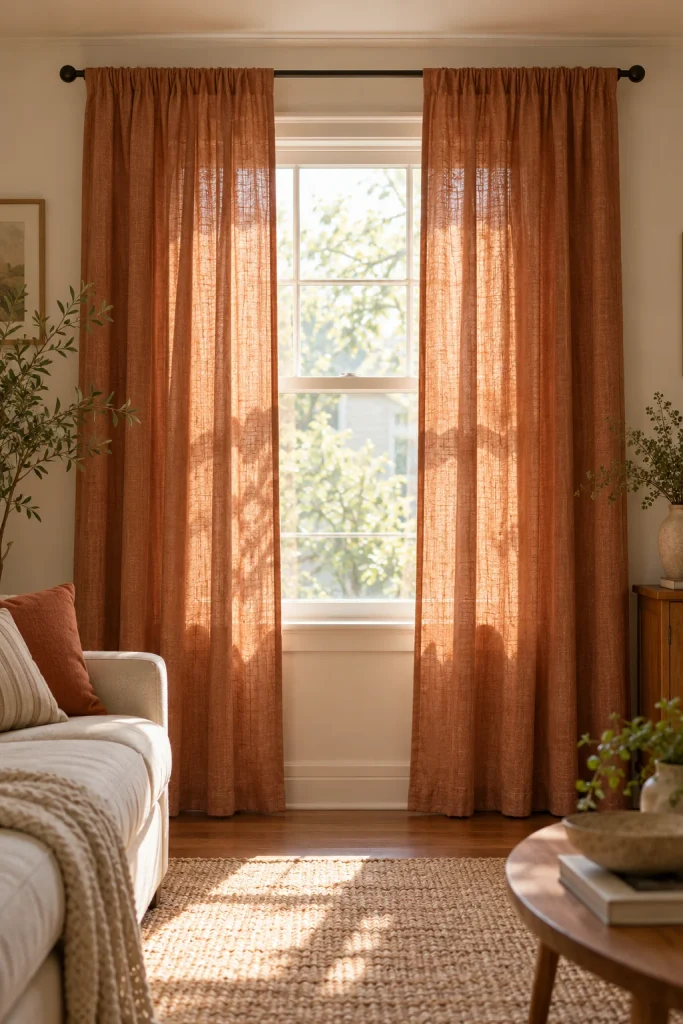
Most rentals already have a curtain rod installed. You rarely need to replace it to change the whole feel of a window. Swap in curtains with texture (raw cotton, linen, or a woven look) in a warm or earthy tone, and the window instantly reads as part of the room’s styling instead of a leftover rental fixture.
If your current rod sits awkwardly close to the glass, look for curtain rings or clips that extend the hanging point slightly, rather than installing a new rod bracket.
Before You Buy New Curtains
- Measure your existing rod length, not just the window width
- Check the rod’s weight limit if you’re adding heavier woven fabric
- Confirm the curtain length clears the floor or radiator
14. Style a Bookcase With Art, Books, and Open Space
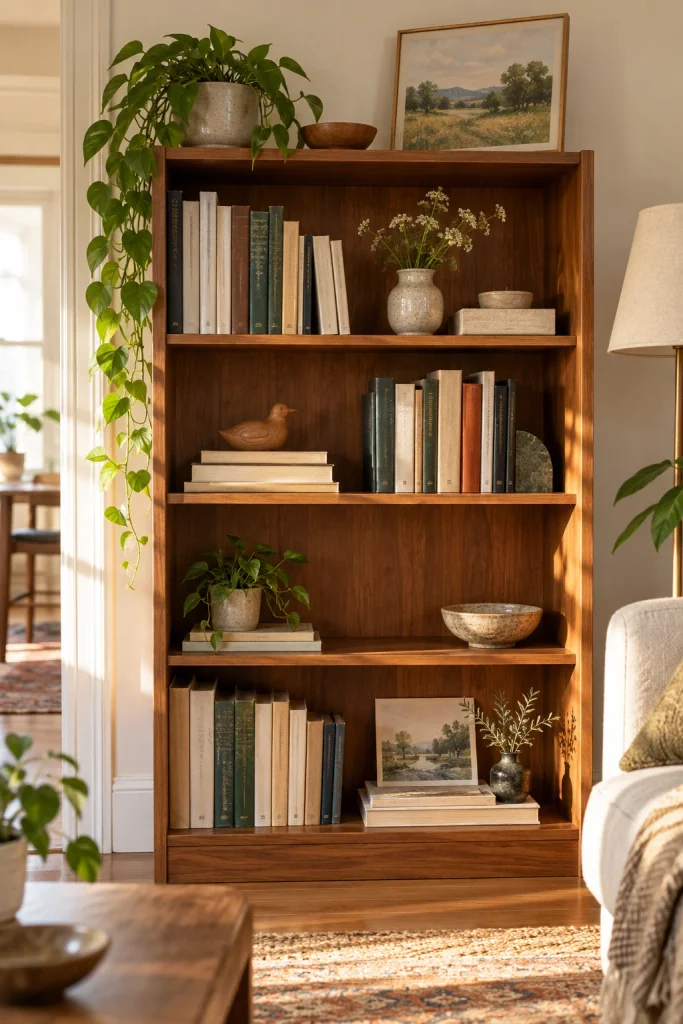
A bookcase packed edge to edge with books looks busy, not warm. Leave real gaps on purpose, and use those gaps for small art pieces, carved objects, or a plant, so the shelf has a visual rhythm instead of a wall of spines.
A simple problem many renters hit: too many books, not enough decor, and a shelf that ends up looking like a library instead of a living room feature.
The fix: Pull about a third of the books off the shelf (store the rest in a basket or box elsewhere). Stack some books flat instead of upright, and set one small object on top of each stack. Leave at least one shelf section with nothing but a single piece of art or one object, so the eye has a place to land.
Checklist: A Bookcase That Doesn’t Feel Crowded
- At least one shelf has visible empty space
- Books are mixed upright and stacked flat
- No more than one small object per book stack
- One art piece is leaning rather than every item standing the same way
15. Give the Bedroom Its Color Through Bedding
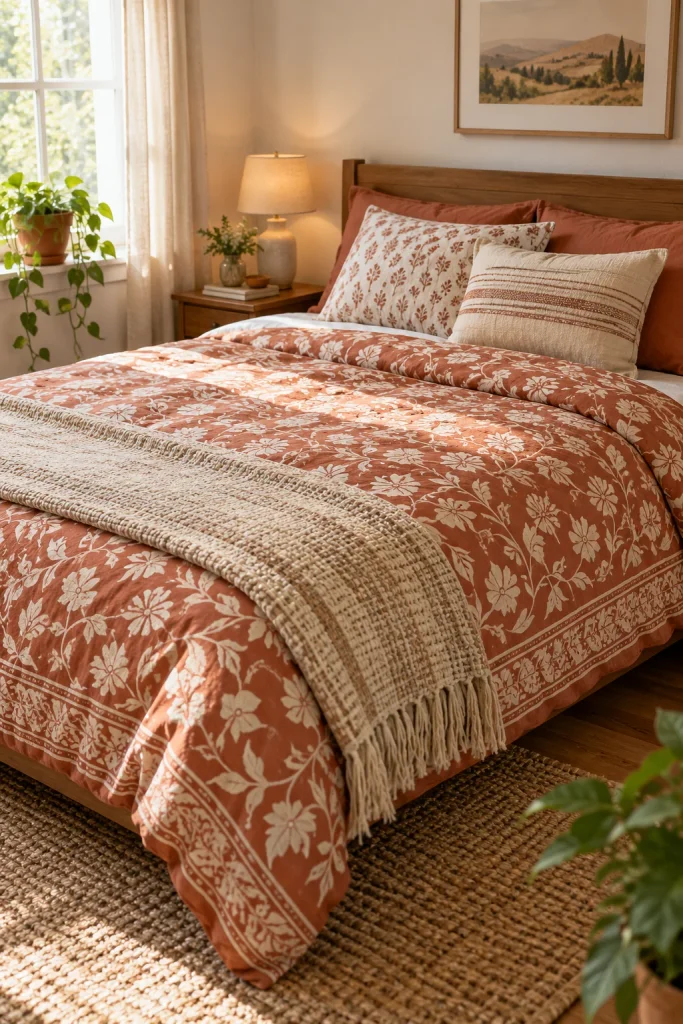
You almost never need a new bed frame to change a bedroom’s whole mood. Bedding (a patterned duvet cover, a textured throw, two or three mismatched-on-purpose pillow covers) does the job for a fraction of the cost and takes five minutes to install.
- Start with a solid or simple duvet cover in one of your palette colors.
- Add one patterned throw folded at the foot of the bed.
- Mix two pillow cover patterns that share a color, not the same print twice.
- Swap out one accent (a lamp or a small rug) rather than everything at once if your budget is tight.
Key takeaway: Bedding is fully portable and needs zero tools, which makes it the lowest-risk, highest-impact change in a bedroom you’re renting.
16. Make a Small Entryway Useful With a Bench and Basket
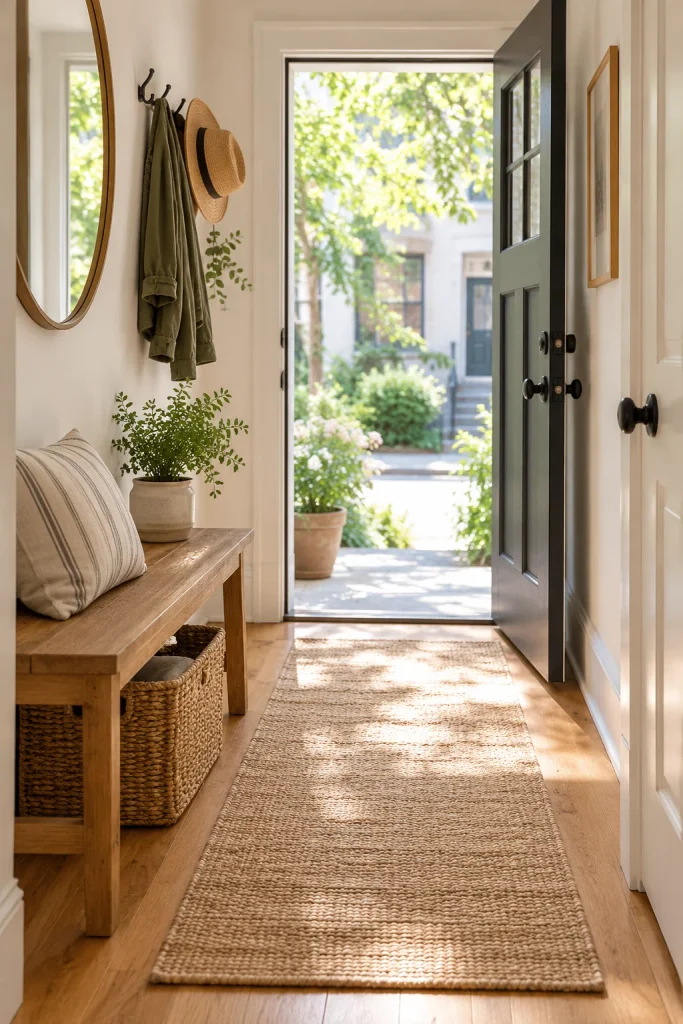
A tiny entryway (or even just a wall by the front door) can hold a narrow bench with a basket underneath. This gives you a place to sit down to put on shoes, and a place to drop keys, mail, or a bag, which keeps clutter from spreading into the rest of a small apartment.
- Measure the width of your entry wall before buying anything.
- Choose a bench narrow enough to leave the door swing clear.
- Add one basket underneath for shoes or bags.
- Hang one hook on the wall above if your lease allows a small nail or a removable hook, for a coat or bag.
Before You Buy an Entryway Bench
- Does the open door still clear the bench fully?
- Is there room for a basket to sit underneath without sticking out?
- Can it be moved easily if you need the space back on move-out day?
17. Bring Textile and Ceramic Details Into the Kitchen
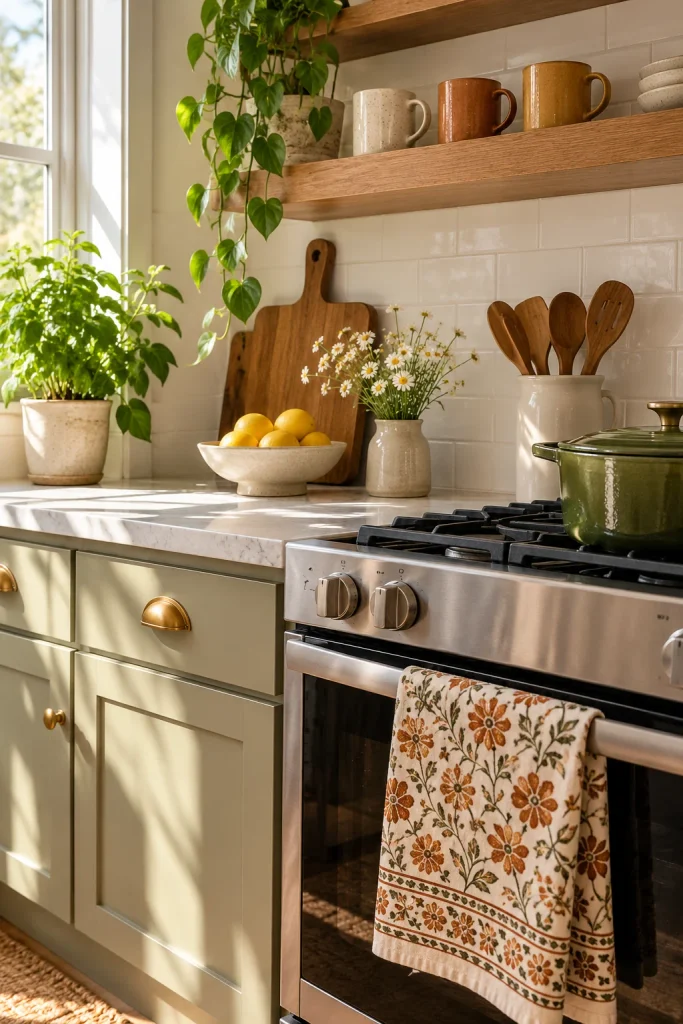
The kitchen often gets left out of a decorating project, but a few swaps carry the same warm look without touching cabinets or counters.
- Hang one patterned kitchen towel on the oven handle instead of a plain one.
- Swap a few mismatched mugs for a small set of warm-toned ceramic mugs or bowls on open display.
- Use a woven placemat or runner on a small table, in a pattern that echoes your living room palette.
- Keep counters mostly clear. One or two styled items read as intentional; ten items read as clutter.
Do
- Pick one or two warm ceramic pieces to leave out
- Repeat your palette colors in a towel or runner
Avoid
- Covering every inch of counter with decor
- Mixing more than two patterns in one small kitchen
18. Warm Up a Rental Bathroom With Towels and Storage

A bathroom usually has the least room to make permanent changes, so towels, a bath mat, and open storage carry almost the entire look.
- Choose towels in one or two palette colors instead of mismatched leftovers.
- Add a small woven basket on the floor or counter for extra toiletries.
- Use a natural-fiber bath mat if your bathroom floor allows it (check for a non-slip backing).
- A small plant that tolerates humidity (like a pothos) can sit on a shelf or the back of the toilet tank if there’s any natural light.
Quick Tip
Buy towels in sets of two matching colors rather than a mixed bundle. It is the single fastest way to make a rental bathroom look pulled together.
19. Separate a Studio With a Freestanding Woven Screen

A studio apartment’s biggest challenge is making one room do the job of two or three. A freestanding woven screen, sometimes made from rattan, bamboo, or raffia panels, can mark off a sleeping area from a living area without any construction or wall.
- Measure the width you need to cover, and pick a screen a few inches wider for overlap.
- Place it so it still allows a clear walking path on at least one side.
- Angle it slightly rather than flat against the wall to make the divided space feel less boxed in.
Because it is freestanding, it folds, moves, or leaves with you entirely, with no wall work involved at all.
Key takeaway: A freestanding screen gives you a room divider that needs zero landlord approval and zero tools, which is rare for anything that actually changes how a studio functions.
20. Carry the Look Onto a Small Balcony
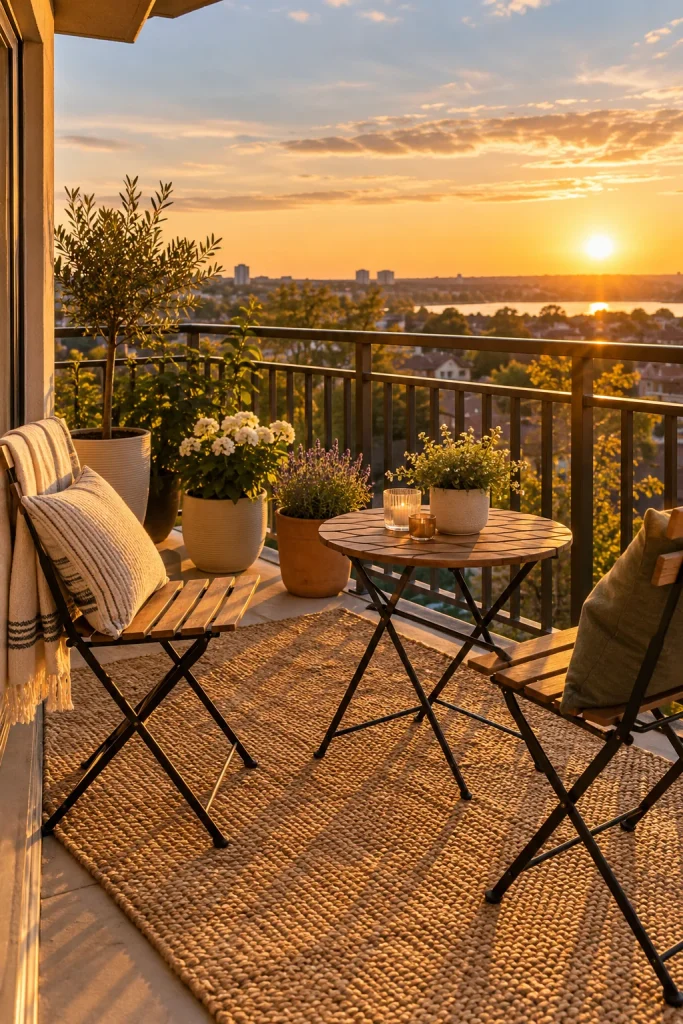
A balcony is often the most overlooked square footage in a rental. Two chairs, one small woven rug rated for outdoor use, and a few potted plants can turn it into an actual extra room instead of a storage spot for bikes and boxes.
- Choose an outdoor-rated rug, since an indoor rug will not hold up to rain or direct sun.
- Pick plants that can handle your balcony’s actual sun exposure, which is often stronger than it looks.
- Use lightweight, stackable or foldable seating if the balcony is narrow.
- Check your lease for any rules about what can be stored or displayed on a balcony before you buy.
21. Give a Thrifted Wood Piece a Useful Role
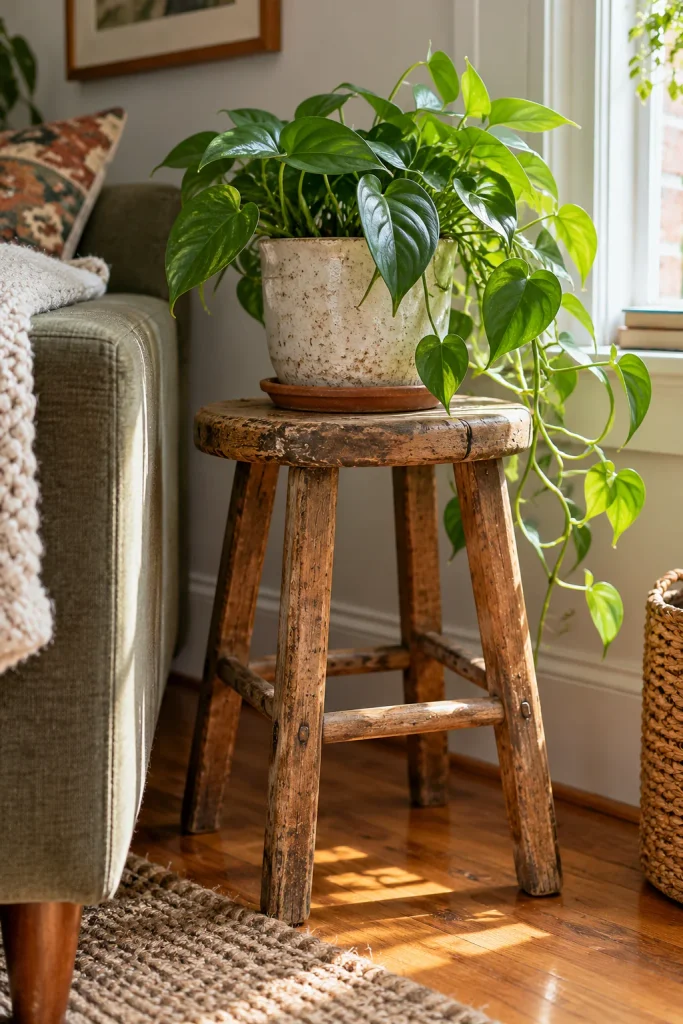
A worn wooden stool, a small side table, or an old crate from a thrift store or secondhand marketplace fits naturally into this style, since Afrohemian decor already favors natural material and visible age over anything brand-new and glossy.
Give it one clear job (a plant stand, a stack of books, a lamp base) rather than leaving it as a vague decorative object with no purpose. A wood piece with a job earns its place in a small room faster than one that is just sitting there.
Quick Checklist for a Thrifted Wood Find
- Check for wobble, cracks, or pest damage before buying
- Give it one specific job in your room
- Wipe down with a damp cloth and let it dry fully before placing textiles or plants on it
How to Mix Afrohemian Patterns Without Making the Room Feel Busy
- Share a color, change the scale. A large-scale rug pattern pairs well with small-scale cushion patterns, as long as they share at least one color.
- Leave plain areas on purpose. A patterned rug, a patterned throw, and a plain wall can sit together. Three patterned surfaces touching each other usually cannot.
- Keep sightlines open. Stand at your doorway and look across the room. If your eye has nowhere to rest, pull one pattern out.
- One pattern per surface type. One pattern on the rug, one on the cushions, one on the throw. Avoid stacking two patterns on the same cushion or the same chair.
What to Buy First on a Small Budget
Buy in the order that solves your actual problem, not in the order a showroom displays things.
- If your room feels cold and bare: start with cushions and one throw. Cheapest entry point, biggest visible change.
- If your floor feels empty or echoey: prioritize the rug next.
- If storage is your real issue: baskets solve two problems (clutter and style) at once.
- If you want one “statement” item: a textile wall hanging or a piece of art gives the most visual impact per item.
There is no fixed total cost here, and a full room makeover is not the goal. Pick the one item that fixes your biggest current frustration, then move to the next.
How to Shop for African Art and Textiles Thoughtfully
- Look for a named maker or region, not just “African print” as a catch-all description. A listing that names a maker, a country, or a specific craft tradition is more trustworthy than one that doesn’t.
- Ask directly if you’re unsure whether a piece is handmade or machine-printed. A reputable seller will tell you plainly.
- Expect natural variation. Handmade textiles and baskets will have small irregularities. That is a sign of handwork, not a flaw.
- Follow the seller’s specific care instructions for washing or cleaning, since natural dyes and fibers can behave differently from synthetic ones.
- Separate decorative items from ceremonial or sacred ones. Some carved stools, masks, and ritual objects carry deep cultural and spiritual meaning and were never meant as generic decor. If a description uses words like ceremonial, ritual, or sacred, treat that piece with more care and research before placing it in a casual decorating role.
Common Afrohemian Decorating Mistakes in Small Rentals
- Calling every patterned textile by a specific cultural name. If you don’t know the origin, describe what you see instead of guessing.
- Buying too many bold patterns at once. This is the fastest way to make a small room feel cluttered instead of warm.
- Choosing a rug that’s too small for the seating area, which makes furniture look like it’s floating.
- Forgetting to measure walking paths before adding a chair, stool, bench, or screen.
- Skipping the lease check before using any adhesive hook, nail, or wall anchor.
Frequently Asked Questions About Afrohemian Decor for Small Rentals
What is Afrohemian decor? Afrohemian decor combines African and African diaspora design traditions, like specific textiles, art, and handcraft, with the layered, relaxed habits of bohemian styling.
How is Afrohemian different from boho? Boho styling on its own draws from many global sources loosely. Afrohemian is more specific: it centers African and diaspora makers, textiles, and craft traditions, styled in a bohemian way.
Is Afrohemian the same as African-inspired decor? Not exactly. “African-inspired” can be a vague, generic label applied to any earthy or patterned decor. Afrohemian, done well, credits specific traditions, materials, and makers rather than treating “African” as one interchangeable style.
Can this style work with minimalism? Yes. A minimalist Afrohemian room might keep just one or two statement pieces (a textile, a carved stool) against a mostly plain, uncluttered background, rather than layering many patterns at once.
Can it mix with modern or Scandinavian furniture? Yes. A plain modern sofa or Scandinavian-style table is actually a good neutral base for Afrohemian textiles, art, and natural materials to stand out against.
How do I use African art and textiles respectfully? Buy from sellers or makers who clearly state origin and technique, avoid assigning a specific cultural name to an item unless it’s confirmed, and treat sacred or ceremonial objects as more than generic decor.
How do I create the look without clutter? Limit yourself to a shared palette, leave plain surfaces between patterned ones, and group similar objects (baskets, plants) rather than scattering single items everywhere.
Can it work in a studio? Yes. A freestanding woven screen, one defined plant corner, and bedding changes do most of the work in a single-room space without needing separate furniture for each “zone.”
What colors suit a small living room? Warm, earthy tones (terracotta, rust, mustard) paired with one deeper grounding color (deep green or charcoal) and a neutral background keep a small room feeling warm without feeling smaller.
Can I use bold patterns in a tiny room? Yes, in limited amounts. One bold pattern on a rug or a throw, balanced by plain walls and plain furniture, reads as intentional. Several bold patterns in a tiny room can feel overwhelming fast.
How do I choose the right rug size? In tight rooms, a rug under just the front legs of your seating works. In larger rooms, a rug under the full seating group looks more grounded. Always measure the actual floor space first.
How do I work with mismatched furniture? Unify mismatched pieces with a shared color palette in cushions, a throw, and a rug, rather than trying to make the furniture itself match.
How do I decorate without painting? Lean on textiles, cushions, rugs, baskets, art, and lighting, all of which change a room’s feel without touching the walls.
How do I display art without drilling? Lean art on a shelf, cabinet, or the floor against a wall, or use a tension rod to hang a textile instead of nails.
Can I avoid adhesives completely? Yes. Freestanding furniture, leaning art, clip-on curtain rods, and tension rods for textiles all avoid adhesive entirely.
Is removable wallpaper suitable for every rental wall? Not always. Wall texture, paint type, and your specific lease terms all affect whether removable wallpaper will apply and remove cleanly. Check your lease and the product’s own application and removal instructions before using it.
How do I use an existing curtain rod? Swap only the curtains, not the rod, and check the rod’s weight limit if you’re switching to a heavier woven fabric.
Which pieces are easy to take when moving? Rugs, baskets, cushions, throws, freestanding furniture, art, and plug-in lamps all move easily. Anything drilled or glued to a wall does not.
What should I buy first? Buy based on your actual frustration with the room right now: cushions and a throw for a bare room, a rug for an empty floor, baskets for clutter.
How can I use what I already own? Identify two or three colors already in your room and repeat them in every new item you add, instead of starting from a blank slate.
Where can I find African artisan-made decor? Look for sellers and marketplaces that clearly name the maker, region, and technique for each piece, and ask directly if that information isn’t listed.
How do I distinguish handmade textiles from printed copies? Handmade resist-dye or hand-woven pieces usually show small natural irregularities and should be described by the seller as handmade. A listing that only says “print” or “inspired by” is likely a machine-made reproduction.
Can thrifted furniture work? Yes. A sturdy secondhand wood piece given one clear job (plant stand, side table, lamp base) fits naturally into this style.
How do I avoid buying unnecessary accessories? Shop for your current frustration, not for a full look all at once. One well-placed item solves more than five scattered ones.
How can I use adire fabric? Genuine adire, a traditional Yoruba indigo resist-dye cloth from southwestern Nigeria, works well as cushion covers, a framed or leaning textile piece, or a hung wall panel. Confirm with the seller whether a piece is handmade adire or a printed reproduction of the pattern.
How do I style verified bogolan textiles? Only use the name “bogolan” (a traditional mud-dyed cloth from Mali) when a seller or source has verified that identity. Treat it as you would adire: as a textile with real craft history, styled as a cushion, throw, or wall hanging rather than cut up for unrelated projects.
Can I mix different textile traditions? Yes, as long as you keep each one’s identity accurate rather than blending their names together, and you let shared colors, not matching patterns, tie them into one room.
Do I need rattan furniture? No. Rattan is a popular material in this style because of its warm tone and light weave, but the style works with any warm natural material, including wood, jute, and cotton.
Is a natural-fiber rug practical for my household? Natural-fiber rugs (jute, sisal, flatweave cotton) handle foot traffic well but can be harder to fully clean after a major spill than a synthetic rug. If you have young kids or pets prone to accidents, a flatweave cotton rug is usually easier to wash than jute or sisal.
How can baskets provide useful storage? Use them for blankets, remotes, mail, shoes, or plant pots. Grouping two or three sizes together works better visually than scattering single baskets around different rooms.
How do I style a bedroom without a new bed? Change the duvet cover, add one patterned throw, and mix two pillow covers that share a color, leaving the bed frame itself untouched.
How do I bring this style into a kitchen? Swap in one patterned towel, a few warm ceramic mugs or bowls, and a woven placemat or runner, keeping counters mostly clear.
What works in a bathroom? Matching towels in one or two colors, a woven storage basket, and a natural-fiber bath mat with a non-slip backing carry the look without any permanent changes.
How do I choose plants for available light? Check how much direct sun a spot actually gets at midday, then pick a plant suited to that light level rather than the light you wish the spot had.
How do I adapt the room for children or pets? Favor flatweave or machine-washable textiles over delicate handmade pieces in high-traffic areas, keep small decorative objects (like carved stools) out of reach, and choose sturdy, low furniture over anything top-heavy or easily tipped.
How do I style a small balcony? Use an outdoor-rated rug, plants matched to real sun exposure, and lightweight or foldable seating, after checking your lease for any balcony restrictions.
Room-by-room afrohemian guides
- Afrohemian living room ideas for renters
- Afrohemian bedroom ideas on a budget
- Afrohemian small apartment decor
Final Thoughts
You don’t need a big apartment or a big budget to make a rental feel like yours. Start with one room, one problem, and one idea from this list; a cushion, a throw, a basket, and build outward only when that first change feels right. Afrohemian decor rewards slow, personal choices more than a rushed, all-at-once shopping trip anyway.
If one of these ideas fits your space, save this guide to Pinterest so you can come back to it room by room.
Note: the three reference photos supplied for this brief were used only as styling and mood inspiration, as instructed, and are not described, credited, or embedded in the article text above. No source or license information for those three images was supplied, so they were not treated as publishable assets