Hosting Thanksgiving in a small apartment starts with one honest fact: the dinner is big and the rooms are not. A full turkey dinner, a table full of people you love, and a kitchen the size of a hallway can feel like a puzzle with too many pieces, and most renters quietly give up and let someone else host. That is a shame, because the small space is not the enemy. Crowding is, and crowding is a layout problem, which means it can be solved with furniture you already own.
These fourteen small apartment hosting ideas solve it in four moves. First you make room at the table by borrowing space from the rest of the flat. Then you serve the food buffet-style, so the table itself stays calm. Then you dress that table so it feels generous instead of squeezed. And last you plan the small things that keep a full room cozy rather than cramped, right down to where dessert happens. Everything here is renter-safe: nothing is fixed to a wall, nothing needs a drill, and every piece of furniture goes home again the next morning.
The four moves
Room: borrow space from the rest of the flat before you add anything
Buffet: food on the counters and shelves, so the table holds people
Dressing: one long centrepiece and one set rhythm at every place
Comfort: rehearse the table, and give dessert its own place
This is the honest part, said before anyone buys a thing: not every guest list fits every flat, and no trick in this article changes that. What these ideas do change is how many people the same rooms can hold in comfort. A buffet line frees the table. A bench seats three where two chairs sat. A separate drinks station stops the queue forming at the kitchen door. Put the moves together and a dinner that felt impossible starts to feel like a plan, with room for elbows, plates and second helpings.
Table of Contents
- Make Room at the Table
- Turn the Living Room Into the Dining Room for One Night
- Extend a Small Table With a Folding Table at the Same Height
- Borrow Chairs From Every Room and Bench One Side
- Host It Porch-Style With One Long Table if Any Outdoor Strip Exists
- Serve It Buffet-Style
- Turn the Kitchen Island or Counter Into the Buffet
- Style a Bookshelf or Console as a Gratitude Buffet Station
- Set a Separate Small Drinks and Dessert Station Away From the Food
- Set a Table That Feels Big
- Lay One Long Centrepiece Runner Instead of Many Small Decorations
- Mix Real Plates With One Dressed Place Setting Per Guest
- Use Checkered Cloth and Warm Colour to Make a Plain Table Feel Like Fall
- Go Cottage-Style With Texture When the Room Is Plain
- Borrow the Traditional Full-Table Look at Half Scale
- Keep It Cozy, Not Crowded
- Plan a Rehearsal Tablescape a Week Early
- Move the Party Outdoors or to the Biggest Room for Dessert
- 5 Mistakes That Shrink a Small-Space Thanksgiving
- FAQs About Small Apartment Hosting Ideas
Make Room at the Table
The first problem is never the food. It is the table, or rather the lack of one: a small kitchen table that seats four on a good day, a coffee table at knee height, and a guest list that has outgrown both. The four ideas in this group treat the whole apartment as the dining room for one night. The living room lends its floor, a folding table lends its length, the other rooms lend their chairs, and even a porch or balcony strip gets a chance to host.
Start a week early with a tape measure and a rough sketch of the room. Mark where the table or tables will stand, where guests will walk, and where you will stand to serve. The walkway matters more than the seating: a dinner where nobody can get up without three people shuffling sideways feels crowded no matter how pretty the table looks. Aim for one clear path from kitchen to table and one clear path to the bathroom, and let every other decision fit around those two lines.
Everything in this group is reversible by breakfast. Furniture slides back, folding tables fold, borrowed chairs go home to their rooms. Nothing is screwed, glued or hung on a nail, and the floor under the extra seating gets a rug or a mat so chair legs and shuffling feet leave no mark for the landlord to find.
One honest warning before the group starts: resist the urge to solve the seating problem by buying furniture. A small flat does not need a bigger table for 364 days of the year, and anything you buy for one dinner has to live somewhere for the other 51 weeks. Borrow, fold and slide first. The only purchase this whole article will suggest, right at the end, is the one piece that folds flat enough to earn its storage space.
Group 1: Space, borrowed
Living room: the sofa slides to the wall and the table takes the floor
Length: a folding table at the same height doubles the seats
Seating: a bench on one side, borrowed chairs on the other
Porch: any outdoor strip becomes a second dining room
Turn the Living Room Into the Dining Room for One Night

Look at how calmly this room holds both lives at once. A long wooden dining table runs across the foreground with black spindle chairs tucked along it, a white runner down the middle and one wide bowl holding a small green plant. Directly behind it, pushed flat against the wall, sits the grey sofa, loaded with cushions and a folded throw, under a big landscape print. The room has not been emptied. It has been rearranged, and the dining table has been given the floor for the evening.
That rearrangement is the whole idea. On Thanksgiving, the sofa gives up its usual spot in the middle of the room and slides against the wall, the coffee table moves to a bedroom or a hallway corner, and the dining table, or two tables pushed together, takes the centre. The sofa then does double duty as extra seating along one side of the table and as the soft landing spot for drinks before dinner and coffee after it.
Work out the slide a few days ahead, not on the morning. Sofas are heavier than memory says, and a rug under the feet helps it glide and protects the floor at the same time. Push it flat to the wall so no dead gap opens behind it, and pile the cushions high like the photo does, because a sofa dressed as a banquette looks deliberate while a bare sofa shoved aside looks like storage.
Leave the walkway honest. Guests need to reach the table, and you need to reach the kitchen with a hot dish in both hands, so test the route with an empty tray before the day. If the route works with elbows out and a tray level, it will work with a turkey. When the evening ends, the room slides back in ten minutes and nobody would know it had hosted a feast.
Slide logic
Furniture that slides beats furniture that lifts. A rug under the sofa feet protects the floor and lets one person do the moving, and a sofa pushed flat to the wall reads as a banquette rather than a sofa in the way.
Extend a Small Table With a Folding Table at the Same Height

This long wooden table seats a crowd without a single wasted inch, and the details are worth reading slowly. White plates sit on dark woven placemats, linen napkins are folded beside them, and the centre is a loose line of tall yellow tapers in silver holders, small vases of roses and one larger pot of autumn leaves. The chairs do not match at all: dark wooden ones, black ladder-backs, a woven seat at the end. Nobody looking at this table thinks about the chairs. They think about dinner.
Now imagine that length built from two tables instead of one, because that is the renter version. Your small dining table seats four. A folding table of the same height, set end to end with it, seats four more, and a long cloth or runner thrown over the join hides the seam so completely that guests read one long table, exactly as this photo reads. Height is the only measurement that truly matters: tabletops within a finger width of each other, so plates sit level and glasses do not wobble at the join.
Level what is almost level. A folded piece of card under one folding-table leg fixes most small differences, and the runner or cloth does the rest. Put the join where the centrepiece runs, not where a guest’s knees go, and give the folding table the far end, since it carries slightly less weight per seat than your solid table.
Dress the two tables as one from the start: one runner, one line of candles, one style of setting repeated down the whole length. The photo’s confidence comes from that single long rhythm, not from matching furniture. At the end of the night the second table folds flat against a wall or under a bed, and your four-person table goes back to its ordinary life.
Height rule: two tables only read as one table when their tops sit level. Match the height first, hide the join with the cloth second, and nobody will ever ask where the seam is.
Borrow Chairs From Every Room and Bench One Side

This little nook is the smartest small dining arrangement there is, and it fits in a corner. An oval wooden table stands in front of a long upholstered bench built along the wall, dressed with two paisley cushions, and two white spindle chairs face it from the other side. The bench seats three people in the space where two chairs and their elbow room would go, because bench sitters share one long seat and need no gaps between them. A big floral print and a lantern light above finish the corner so it feels like a room, not a squeeze.
The renter bench does not need to be built in. A storage bench, a padded ottoman, the foot of a bed moved for the night, even the sofa itself slid up to the table all do the same work. What matters is the shape: one long seat along the wall or along one side of the table, holding the guests who are happiest to stay put, often the kids or the friends who claim the corner as their territory for the whole evening.
Then borrow the rest of the seating without shame. The desk chair from the bedroom, the vanity stool, the hallway chair, a sturdy step stool for the smallest guest: a Thanksgiving table with five kinds of chairs looks collected, not desperate, especially once cushions or a folded throw go on the plainer ones. The photo’s two white chairs against the patterned bench show the trick, contrast reads as a choice.
Plan the bench side for the people who get up least, because bench sitters in the middle climb out over their neighbours. Put the host at a chair end, near the kitchen path, so you can slip away for the gravy without a row of guests standing up to let you pass.
Bench maths
1. A bench seats three in the length where two chairs and their gaps seat two
2. Put bench sitters who get up least in the middle seats
3. The host takes a chair at the end nearest the kitchen
Host It Porch-Style With One Long Table if Any Outdoor Strip Exists

Down the length of this covered porch runs one long table set for a full autumn dinner: black cross-back chairs down both sides, pumpkins and fall foliage gathered along the centre, glasses and layered plates at every place, and big hanging lanterns glowing above it all. The porch is barely wider than the table. It works because a long narrow space matches a long narrow table, and because the outdoors supplies the elbow room that the walls do not.
Many small apartments have some version of this strip: a balcony, a patio slab, a shared porch, a wide stoop. If yours can hold a table and chairs with a walkway on one side, it can hold Thanksgiving, weather permitting. A folding table fits a balcony better than a fixed one, and chairs borrowed from inside complete the set. Measure the strip with the chairs pulled out, not pushed in, because guests need room to sit down, not just room to be seated.
November weather is the honest catch, so plan for the cold rather than hoping it away. Seat guests after the sun is off the space only if blankets and a throw per chair are ready, keep hot drinks flowing from the drinks station inside, and have the indoor backup decided in advance: if the wind picks up, dessert moves inside and nobody apologises. Tell guests in the invitation that part of the evening is outdoors, so coats and warm shoes arrive with them.
The light does half the styling out here. In the photo the lanterns hang in a row and turn a plain porch into a dining room; a string of outdoor lights along the rail or a few lanterns on the table does the same job without a single fixing into the building. Everything hangs from the furniture or stands on it, and everything comes back in before bed.
Porch palette: late sunlight, pumpkin orange, leaf green and black chairs. The outdoors supplies the colour; you supply blankets.
Serve It Buffet-Style

A seated dinner in a small apartment fails at the serving stage, when twelve dishes try to live on a table built for four plates and every pass of the potatoes becomes a negotiation. The buffet solves it by moving the food off the table entirely. The table goes back to its one true job, holding people, and the food takes over surfaces that were doing nothing: the kitchen counter, a bookshelf, a console, the top of a dresser.
Set the buffet as a one-way line, because a line is what stops the crowd. Plates at the start, then the sides, then the turkey near the end where you or a helper can carve or serve, then cutlery and napkins last of all, so nobody juggles a full plate while hunting for a fork. Guests flow in one direction, fill a plate, and land at the table, instead of milling around the food in a knot.
Keep the hot food close to the kitchen so seconds do not mean a parade through the flat, and keep one surface in reserve for the empty dishes to land on. A buffet also has a quiet social gift: people talk in the line. The cousin you have not seen all year is suddenly next to you at the cranberry sauce, which is half the point of the day.
Every station in this group stands on furniture that lifts, folds or rolls away. No shelves get screwed in, no hooks go up. If a surface in your flat can hold a casserole without wobbling, it can hold a place in the line.
Line logic
A buffet is a one-way street: plates first, food in eating order, turkey near the end, cutlery last. A line that flows one way never turns into a crowd standing around the food.
Turn the Kitchen Island or Counter Into the Buffet
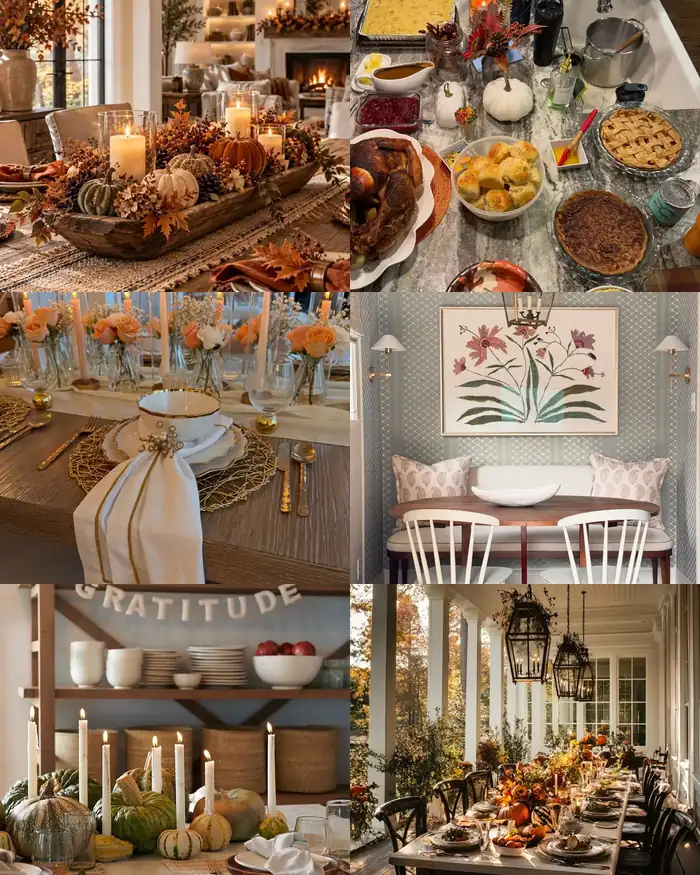
This kitchen island is Thanksgiving headquarters, and it is gloriously unembarrassed about it. A roast turkey sits on a platter at one end, foil trays of sides run in a row behind it, and around them sit the gravy boat, the cranberry sauce, a bowl of rolls, a dish of mashed potatoes and two whole pies, all within reach of the sink. Two small white pumpkins stand in the middle doing the decorating. Nothing here is styled for a magazine, and that is exactly why it is worth studying: this is what a working buffet actually looks like.
Copy the order, not the polish. The island or counter closest to the stove holds the hot food, because hot food travels badly and refills come from the oven. Line the dishes up so guests move one way along the counter, plate in hand, and come off the end near the table. Trays and foil pans earn their keep here: they catch drips, they stack when empty, and they make the landing zone for dirty dishes obvious.
Use the sink end wisely. In the photo the pies sit by the sink, which keeps dessert in the same zone as the washing up it will create. Keep a clear patch of counter beside the sink for stacking used plates as the meal goes on, and the kitchen never reaches the stage where every surface is wearing a dirty dish. A bin bag hung inside a cupboard door, out of sight, handles the scraps as they happen.
If your kitchen has no island, the same line works along a counter run, with the table pushed close so the route from buffet to seat is a few steps. What matters is that the food has its own territory and the table stays out of the serving business. The two white pumpkins are the final lesson: a buffet needs one small nod to the season, not a display.
Island order
1. Plates at the start of the counter, where hands are empty
2. Sides in the middle, in foil trays that catch every drip
3. Turkey at the end, carved or helped by the host
4. A clear patch by the sink kept free for returning plates
Style a Bookshelf or Console as a Gratitude Buffet Station

A wooden open shelf has been turned into a serving station here, and every shelf has a job. The top shelf carries a letter banner that spells out GRATITUDE, strung loosely across the front. Below it sit stacks of white bowls and plates ready for guests, a bowl of red apples, and drinking glasses lined up at the edge. The bottom shelf holds woven baskets, and in front of the unit the table carries big heirloom pumpkins and tall white candles standing in small gourds.
Read it as a storage answer, because that is what it is. In a small flat, the plates for ten people have to wait somewhere, and a bookshelf or console cleared for the day holds the spare plates, the extra glasses, the serving spoons and the dessert bowls where guests can help themselves. The banner matters too: one word strung across the top turns a piece of storage furniture into the named station of the evening, and guests stop asking where things are.
Clearing a shelf for the day is a thirty-minute job with a box. The books go into the box, the box goes in a cupboard or under the bed, and the shelf gets wiped and loaded in order: plates low where the weight sits safely, glasses where hands can reach without leaning over food, baskets below for bread rolls, napkins or the overflow of serving tools.
String your own version of the banner from card and twine, hung over the shelf edge or tied at the corners, nothing pinned into the wall. The pumpkins at the front do the same work as the two white ones on the island: a small seasonal signal that says this station was planned, not improvised. After dessert, the shelf is still loaded, so coffee and second helpings of pie have a home until the washing starts.
Station rule: storage furniture becomes a serving station the moment you name it. One banner, one stack of plates, and guests help themselves instead of asking where things live.
Set a Separate Small Drinks and Dessert Station Away From the Food

This close view is the heart of the dinner itself: a golden roast turkey on a bed of dark kale leaves, stuffing spilling from the centre, a whole pumpkin pie waiting just behind it, another bowl of stuffing at the top of the frame, and red candles standing at the edges. It is worth pausing on how little space the star of the meal actually needs. The turkey and the pie, the two things everyone came for, fit on one corner of one table.
That is the logic of splitting the stations. The turkey carves and serves from the buffet, but dessert and drinks belong somewhere else entirely: a side table, a desk, the top of a low dresser in the living room. Pie, coffee and cold drinks in a second spot pull half the traffic out of the kitchen at the exact moment, after the main course, when the kitchen is busiest with plates coming back and the host is trying to find the cream.
Set the dessert station up before dinner, covered with a cloth, so the changeover takes two minutes: uncover the pies, put the kettle on, and announce it. Guests who want pie drift one way, guests who want seconds drift the other, and the two streams never collide in the doorway. A separate drinks spot works the same trick all evening, because the person topping up a glass is never blocking the person carving the turkey.
Candles belong on this station too, as the photo shows, at the edge where they light the food without sitting in the serving path. Keep flames in glass holders and away from the flow of sleeves and plates. The small apartment version of a grand dessert table is one pie, one pot of coffee and room to stand, and it is enough.
Split the stations
Kitchen: hot food only, close to the oven and the sink
Side table: pie, coffee and cold drinks, away from the queue
Candles: at the edge of the dessert station, in glass, out of the serving path
Set a Table That Feels Big
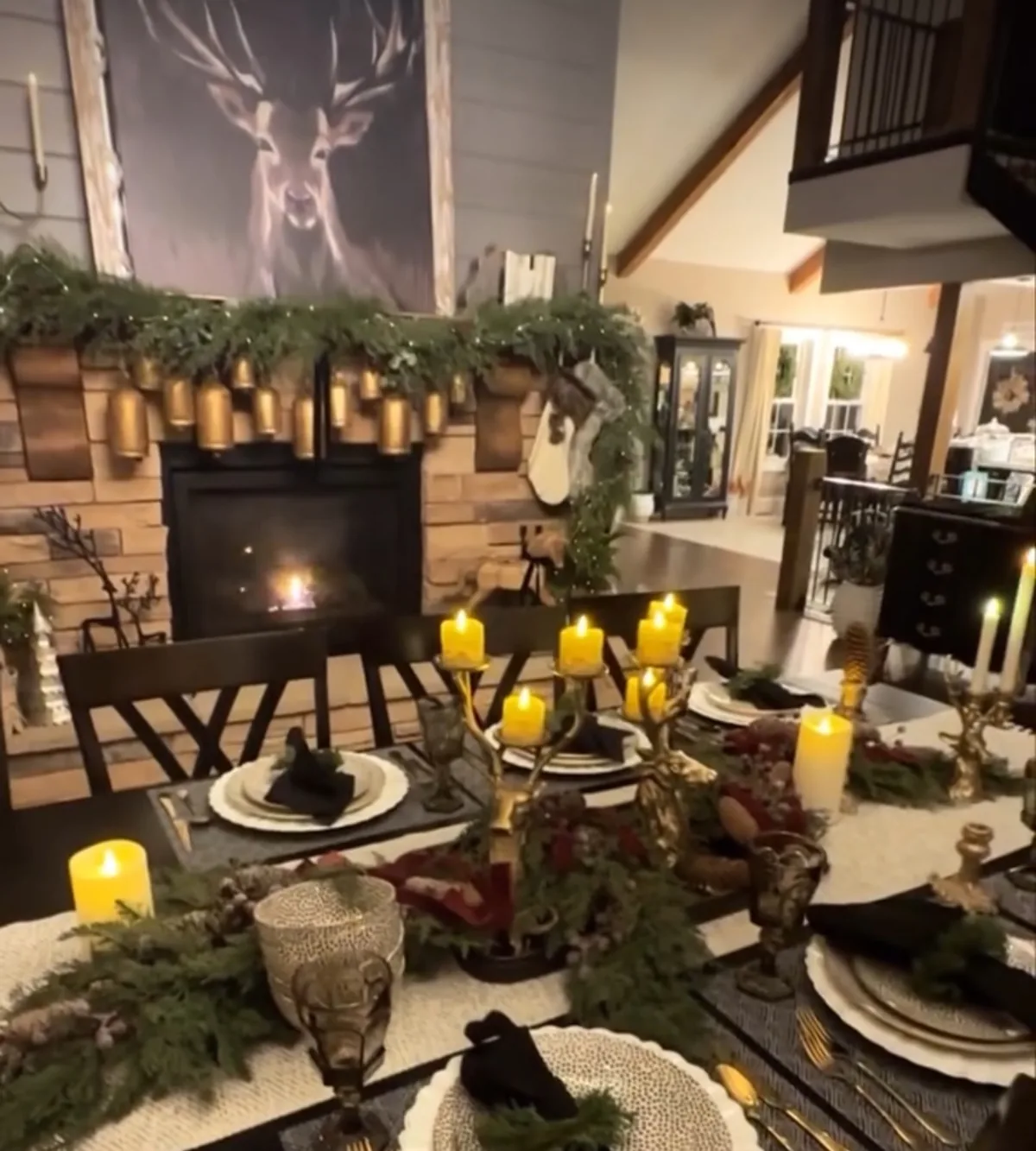
Stand back and look at what makes this table feel grand. Down its middle runs a thick garland of greenery, a living runner that never stops, with gold candlesticks and fat lit pillars rising out of it. Every place has layered plates, a dark napkin folded on top, a smoked glass and gold cutlery. Behind it all, a fireplace wears its own garland with a row of gold bells, so the table and the room are telling the same story. The table is not enormous. The styling is doing the size.
That is the promise of this group for a small apartment. Your table may seat six where you wish it seated ten, but the feeling of a feast comes from what runs down the middle and what repeats at every place, not from the square footage underneath. One long centrepiece line, one dressed setting per guest, one warm colour carried all the way through: these are the moves that make a small table read as a celebration.
Work with a palette of three things at most: a green or leaf element, a warm metal or candle glow, and one cloth colour. In the photo it is greenery, gold and cream with black napkins for contrast. In your flat it might be foliage, copper and rust, or greenery, white and wood. The palette is the discipline that lets borrowed plates and mismatched chairs sit down together without looking borrowed.
And a word for the hosts of very small tables: dress the places, not the room. A guest remembers the setting in front of them, the candle near their plate, the napkin that was folded for them. Spend your effort inside that one square of table each person owns, and the room beyond it can stay plain.
The ideas in this group borrow the styling of big dining rooms and shrink the scale, not the effect. Half the candles, a shorter garland, a runner that ends where the table ends. Nothing here is fixed to anything, and the crochet table ideas linked in the FAQs cover the handmade version of the same linens.
Feast palette: deep greenery, warm gold, cream cloth and one dark contrast. Three or four notes, repeated at every place, are what make a small table feel grand.
Lay One Long Centrepiece Runner Instead of Many Small Decorations
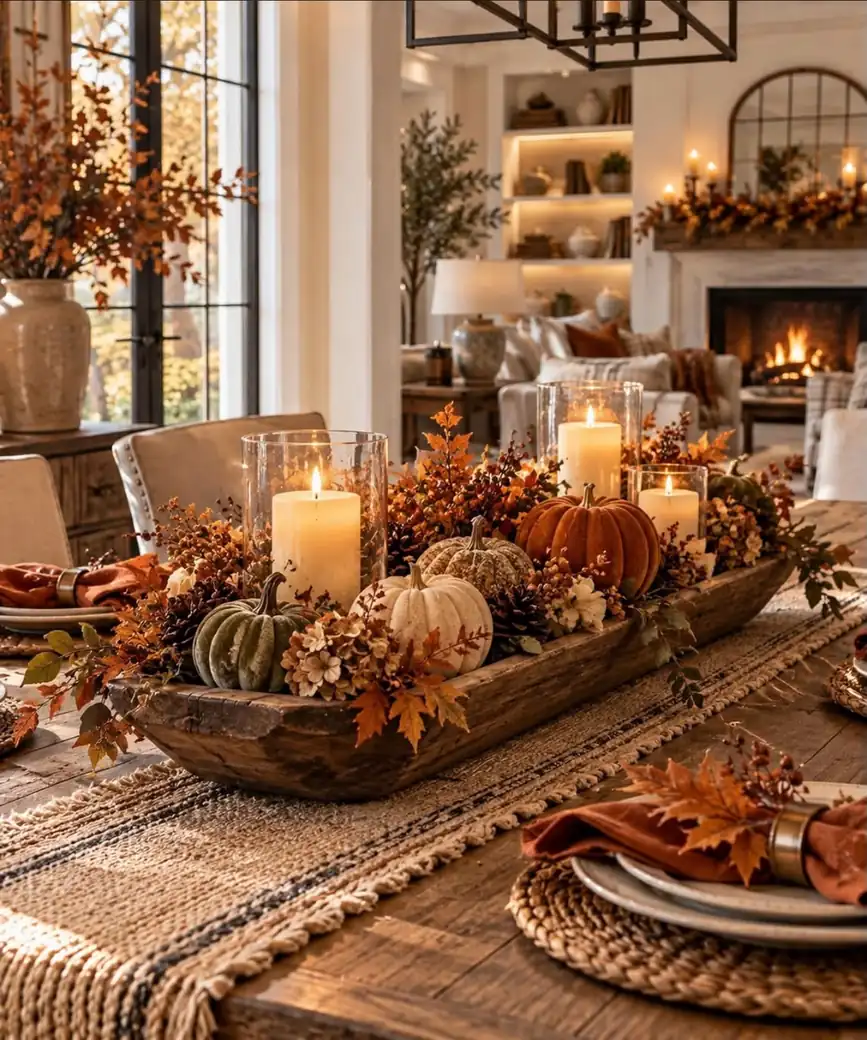
The hero table of this article earns a second look, because its centrepiece is one long decision. A rustic wooden trough runs down the middle of the table, filled with pumpkins in cream, green and burnt orange, dried leaves and berries tucked between them, and tall pillar candles standing in glass hurricanes above it all. Below it a woven runner with a dark stripe stretches the full length of the table, and at every place there are woven placemats and rust-coloured napkins. One line, unbroken, from end to end.
Compare that with the usual small-table habit: a vase here, a candle there, a pumpkin somewhere else, each one pretty and the whole effect busy. Small decorations scattered on a small table make the table look smaller, because the eye keeps stopping. One long centrepiece does the opposite. The eye travels the length of it and the table feels as long as it can possibly be, which on Thanksgiving is the whole game.
Your trough can be anything long and low: a wooden tray, a shallow basket, a row of small pots pushed together, even a folded runner cloth with pumpkins and candles standing straight on it. Keep it narrow, about a hand and a half wide, so plates and elbows still own the edges of the table, and keep it low in the middle so guests can see each other, with the tall candles in glass at the ends where they block nobody’s view.
Build it the day before, minus the lit candles, and live with it through one ordinary meal. You will learn fast whether the bowls pass over it easily and whether the person opposite is hidden behind a pumpkin. Adjust it while there is no turkey resting and no guests arriving, and on the day you only have to light the candles.
Runner logic
The eye reads length before it reads width. One long, low, narrow centrepiece makes a small table feel as long as it can be, while scattered small decorations make it feel smaller.
Mix Real Plates With One Dressed Place Setting Per Guest

One place setting is doing all the talking in this photo. A gold-rimmed bowl sits on stacked white plates over a gold wire charger, the napkin is white with a gold edge and gathered through a pearl ring, and the cutlery is gold on both sides. Behind it the table keeps the theme going with small glass vases of peach roses and tall candles in glass. It is a single seat, dressed to the standard of a wedding, and it makes the whole table feel expensive.
The small-apartment lesson hides in the mixing. Most of us do not own ten matching dinner plates, and we certainly do not own ten gold chargers. What we own is six decent plates, four others that nearly match, and a jumble of cutlery. The dressed setting shows how to make that honest mix read as a plan: give every guest the same layers in the same order, plate on a mat or charger, napkin placed the same way, glass in the same spot, and the eye reads the rhythm instead of the differences.
Use what repeats to carry the match. Paper or woven mats under every plate, napkins all folded one way, glasses all from the same shelf even if the plates differ: two repeated elements are enough for the set to look related. If your plates fall into two families, alternate them down the table in a pattern, plain, patterned, plain, patterned, and the mix becomes a design.
Borrow plates before you buy any. Neighbours and family lend dinner plates happily for the one day a year everyone runs short, and a borrowed set that returns washed the next morning is the oldest hosting system there is. Dress each place as you set it, standing back after two settings to check the rhythm, and by the sixth you will have stopped seeing which plates were yours.
Dressed-place rules
1. Same layers in the same order at every seat, whatever the plates
2. Two repeated elements, mats and napkins, carry the match
3. Alternate two plate families in a pattern instead of grouping them
Use Checkered Cloth and Warm Colour to Make a Plain Table Feel Like Fall
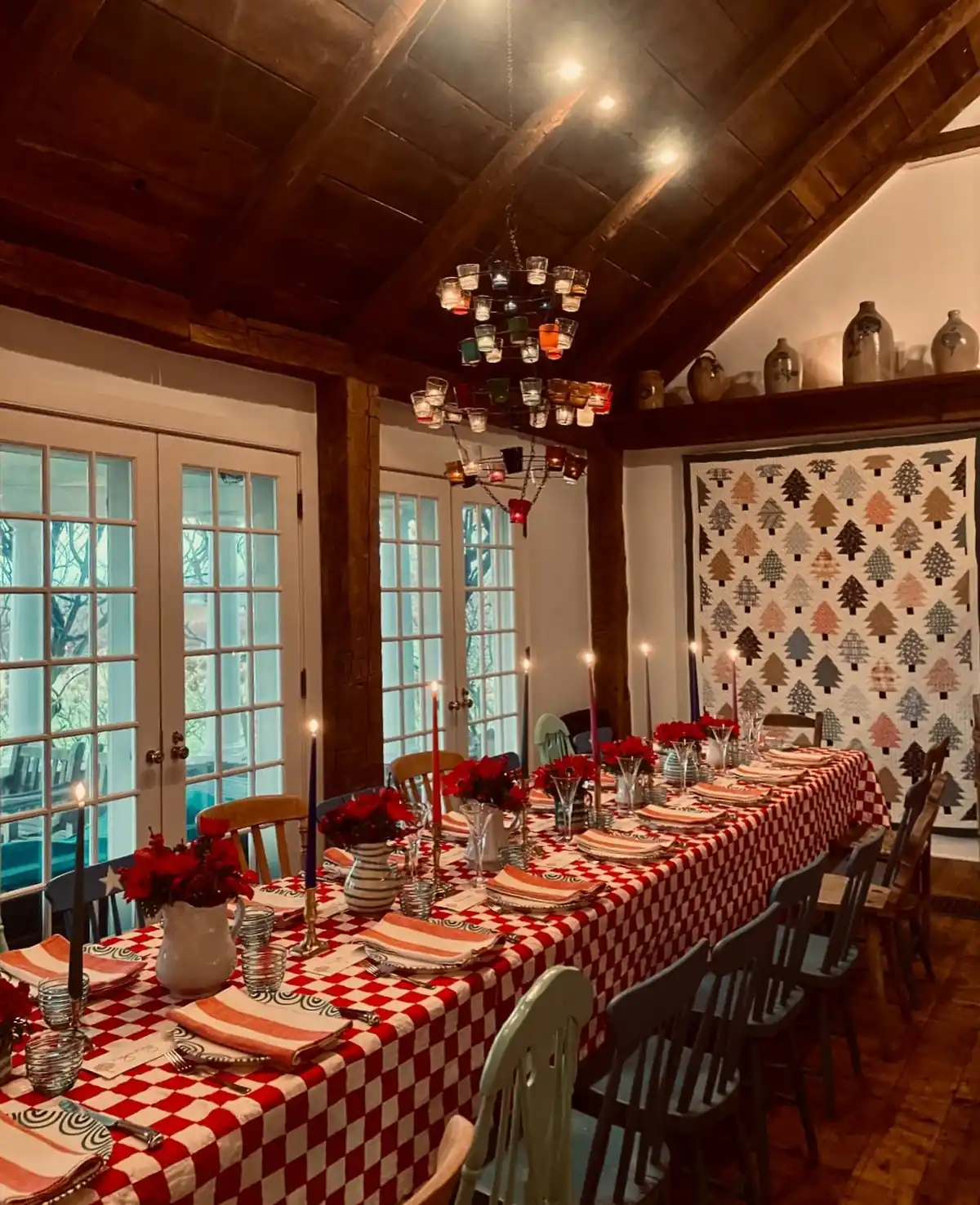
This table runs the whole length of a wood-beamed room, and its secret is a tablecloth. Red and white checks cover every inch of a very long table, and suddenly the plain settings on top of it, striped napkins, simple plates, glass pitchers of red flowers, tall coloured candles, look like a festival. The chairs down both sides do not match. The glasses do not match. The cloth holds the whole thing together and sets the mood before a single dish arrives.
A cloth is the cheapest big change a small table can get, and checks are the hardest-working pattern for a feast, because the pattern hides crumbs, splashes and the odd drip of gravy until the meal is over. In autumn colours, a checked or plaid cloth in rust, cream and brown also does the decorating for you: the table reads as fall from the doorway, before the centrepiece is even on it.
Choose the cloth for the tables you actually have. If you are joining two tables from the first group, one long cloth across both is what sells the single-table illusion, so measure the combined length and let the cloth hang a hand’s width over each end. A cloth that ends mid-table draws the eye to the join; a cloth that covers everything erases it.
Iron or steam the cloth the day before, because checks show creases honestly, and fold it over the back of a door rather than in a drawer overnight. On the day, cloth first, centrepiece second, settings third, in that order, and the plainest rental table in the building will come up looking like the photo: long, warm and ready.
Cloth rule: one cloth across every table you join is what sells the single-table illusion. Checks do double duty: they set the fall mood and hide every crumb until the meal is over.
Go Cottage-Style With Texture When the Room Is Plain

Everything on this round table has a texture you can almost feel. The cloth is printed with big golden leaves, the plates carry a turkey design and sit on woven chargers, the napkins are mustard and green with fringed edges, the goblets are green glass, and in the middle a full bouquet of cream roses and dark red blooms stands next to a small pumpkin and a bowl of walnuts. Even the chairs are bamboo style with checked cushions. It is cottage layering: nothing plain, nothing shiny, everything touchable.
Rental rooms are usually the opposite of this table: white walls, plain floor, a table with no character to speak of. That plainness is exactly why texture works so hard. When the room gives you nothing, the table can carry it all, layer by layer: a cloth with a print, chargers or mats with a weave, cloth napkins instead of paper, coloured glass instead of clear. Each layer is soft goods, all of it washes, folds and stores in one drawer for the rest of the year.
The order of layering matters more than the shopping. Cloth first, then the chargers that set the places, then plates, then napkins placed on the plates so their colour shows, then glasses, and the bouquet or centrepiece last, at the centre, with room to pass dishes around it. On a small round table, keep the centrepiece to one generous piece like this bouquet rather than a ring of small things, because a round table has no spare edge.
Borrow texture shamelessly. A grandmother’s printed cloth, a friend’s spare napkins in a second colour, a woven runner from the living room shelf: cottage style was built on handed-down pieces, and a table of borrowed layers looks more like the photo than a table of new matching sets. Nothing on it is fixed, fragile or precious, which suits a crowded happy room.
Texture layers
Cloth: a print with a leaf or a check, doing the decorating early
Weave: chargers or mats under every plate
Soft: cloth napkins and coloured glass instead of paper and clear
Borrow the Traditional Full-Table Look at Half Scale
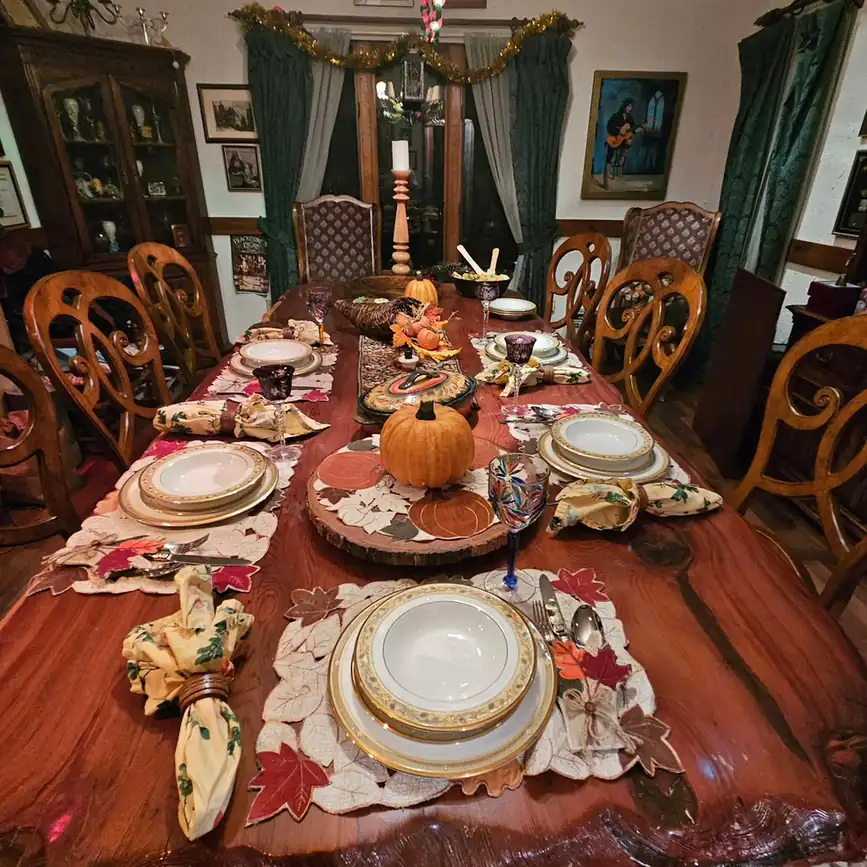
This is the full traditional production: a long polished wood table loaded with places, leaf-shaped placemats in fall colours, gold-rimmed plates stacked in layers, floral napkins gathered in wooden rings, painted goblets, and down the middle a wood slice runner carrying pumpkins, fall leaves and candles. There is a china cabinet against the wall and carved chairs all round. It is somebody’s family dining room at full strength, and nobody in a small apartment should try to copy it whole.
Copy it at half scale instead, because its real lesson is repetition. The placemats repeat, the napkin rings repeat, the layered plates repeat, and it is the repeating that makes it feel abundant. On your smaller table, pick just two of its ideas and repeat them at every place: the leaf-shaped mats in fall colours, say, and the pumpkins down the middle on any long board or tray you own. Two repeated ideas read as tradition. Six ideas on a small table read as clutter.
Scale the centrepiece by the table, not by the photo. This one runs the full length of a long table and can afford its height; on a table seating six, the same wood slice idea shrinks to one short board, two small pumpkins and a pair of candles, leaving real room for the serving bowls when the food lands. Remember that your buffet group has already freed this table from most serving duty, so the centrepiece can afford to be a touch fuller than a table that also holds the turkey.
Keep the gold note small and warm: rimmed plates if you have them, or plain plates with one gold or copper element per place, a napkin ring, a charger, a candle holder. Half scale is not a lesser version of this table. It is the same grammar spoken in a smaller room, and guests feel the grammar, not the dimensions.
Half-scale logic
Tradition is repetition, not size. Two ideas from the grand table, repeated at every place on your small one, read as abundance; six ideas read as clutter.
Keep It Cozy, Not Crowded

By the time the table is set and the buffet is loaded, a small apartment holds more people, heat and steam than it does on any other day of the year. The difference between cozy and crowded is not space at that point. It is planning: the small decisions made days earlier that stop the day feeling like a squeeze. This last group holds those decisions.
The first is rehearsal. A table that has been set once, sat at once and adjusted once behaves on the day like it has hosted before, because it has. The second is escape: every good small-space dinner gives the party somewhere else to be for part of the time, a balcony, a porch, the biggest room for dessert, so the same square feet get a rest and the guests get air.
Keep the host’s own comfort in the plan, too. A host who has a seat, a seat near the kitchen path, and a dessert plan that takes two minutes is a host who stays cheerful, and the mood of the room follows the host more than it follows the seating chart.
None of this group costs money or touches the building. It is the free layer of hosting, and it is the layer guests remember when they describe the evening as relaxed rather than impressive.
Comfort plan
1. Rehearse the full table a week early and fix what fails
2. Give the party a second place to be for dessert
3. Keep one path to the kitchen and one to the bathroom clear all day
Plan a Rehearsal Tablescape a Week Early
This table has the relaxed look of one that was set without hurry: a pale blue cloth, of all colours, with rolled orange napkins at every place, a beaded bird standing in the middle of the table like it owns the day, and loose vases of red berries, pink roses and eucalyptus running down the centre. It sits in a bright glass room, but the table itself is simple. Its confidence is the point. Somebody set this, looked at it, and changed their mind about nothing.
That confidence is what a rehearsal buys you, a full week before the dinner. Set your table completely, cloth, centrepiece, settings, glasses, the works, on a quiet evening. Sit in every seat. Check that the person opposite is visible over the centrepiece, that elbows have room, that a water jug can land somewhere, that the guest at the far end can get out without a chair scraping the wall. Write down what fails, fix it the next day, and put everything away.
Then take one photo of the finished table before you clear it. On Thanksgiving morning, that photo is your instruction sheet: the table sets itself in fifteen minutes while the turkey rests, and no decisions get made under time pressure. The photo also catches the small shortages early, the missing two glasses, the napkins that need washing, the candles with no holders, while there is still a week to borrow or wash.
Hosts of small spaces need this more than anyone, because there is no spare room where mistakes can hide. The blue cloth in the photo breaks the autumn colour rules and gets away with it, which is the other lesson of rehearsal day: it is the time to try the odd idea, the cloth you were given, the bird you inherited, and see it on the table before it counts.
Rehearsal rule: set the table once with nobody coming, sit in every seat, photograph the result, and Thanksgiving morning becomes fifteen quiet minutes instead of a morning of decisions.
Move the Party Outdoors or to the Biggest Room for Dessert

Dessert outdoors looks like this: a grey cloth on a garden table, heirloom pumpkins in pale green and orange running down the middle, plates painted with turkeys resting on gold chargers, deep blue glasses, gold cutlery, and white napkins tied into bows with grey velvet ribbon. The table sits under a tree with the garden behind it. Nothing about it is grand, and all of it feels like an event, because a change of place makes an ordinary course feel like a second party.
That change of place is a pressure valve for a small flat. After the main course, the dining space is hot, the table is covered, and everyone has been sitting for an hour. Announce dessert somewhere else: the balcony or porch if the evening allows, the living room with the coffee table cleared if it does not. The move takes five minutes with guests carrying their own glasses, and the flat breathes again. The cook gets the kitchen back for the first round of washing while it is still easy.
Set the second scene simply, because the pumpkins and plates from the table can travel. A cloth on the coffee table or the garden table, the pies and coffee in the middle, cushions on the floor or chairs carried out, and the same centrepiece pumpkins doing a second shift. Nobody expects a full second tablescape; the charm is in the informality after the formality of the main table.
End the evening out there if you can. Cool air, coffee, and the slower conversation of the day all belong to that second setting, and the guests who linger longest will remember it as the best seat of the night. Then the washing, the folding table and the borrowed chairs wait until morning, which is a kindness the host is allowed to accept.
Second-scene kit
Carry out: the pumpkins and plates travel from the main table
Set down: one cloth, the pies, the coffee pot, cushions or chairs
Stay: cool air and slow talk do the rest of the hosting
5 Mistakes That Shrink a Small-Space Thanksgiving
1. Setting the table for the guest list you wish you had. A table dressed for twelve in a room that seats eight makes everyone feel the squeeze before the food arrives. Count your real chairs, set that many places beautifully, and let the overflow plan, the bench, the second sitting or the porch, be a decision instead of an accident.
2. Serving everything from the table. Twelve dishes on a small table leave no room for plates, glasses or elbows, and every serving spoon becomes a negotiation. The buffet move costs nothing and gives the table back to the people. Food on a counter, drinks somewhere else, and the table holds only what a person is eating.
3. Forgetting the floor. Extra chairs, a folding table and a day of shuffling feet are hard on a rental floor, and scratches and scuffs are the kind of damage a landlord photographs. A rug or flat mat under the dining area protects the surface all day; our guide to covering ugly rental floors covers the same protection in full.
4. Buying furniture for one day. A bigger table, extra chairs and a sideboard bought for Thanksgiving have to live in the flat for the rest of the year, in the very space the dinner needed. Borrow chairs, fold the one table that earns its storage, and let the shops keep the rest.
5. Rehearsing nothing. The host who sets the table for the first time on the morning discovers the missing glasses, the too-tall centrepiece and the chair that blocks the kitchen door at the worst possible hour. One practice run a week early turns all three into small, calm fixes.
FAQs About Small Apartment Hosting Ideas
How many people can a small apartment honestly host for Thanksgiving?
Count seats, not hopes. Start with the chairs you own, add the bench or sofa side, add two for a folding table at the same height, and that total is your honest number. For many one-bedroom flats that lands between six and ten people sitting down together, and more can be hosted happily if some guests eat at the counter or the evening runs as a buffet with mixed seating. A dinner where everyone has a seat, a plate and room to stand up beats a bigger dinner where nobody does.
What if I have no dining table at all?
Then the folding table becomes the dining table for the day, and the coffee table, cleared and dressed with a cloth, works for a small group who are happy on cushions around it. Desks and kitchen counters have hosted many fine Thanksgivings. What a table needs is a level surface, room for knees or cushions, and a cloth to make it feel intended. Dress whichever surface you have the way the third group dresses a table, and nobody will spend the meal thinking about furniture.
How do I keep the kitchen from becoming a traffic jam?
Give every job its own place and keep the paths between them clear. Cooking stays in the kitchen, the buffet runs along one counter or one station, drinks and dessert live in another room, and used plates land in one agreed spot near the sink. Most jams happen because drinks, food and washing all share one doorway. Split the stations, and the same doorway serves one stream at a time.
Can I do the fall table styling on a tiny budget?
Yes, because the styling that reads as fall is mostly colour and repetition, not shopping. A checked cloth, pumpkins from the grocery shop, candles you already own and napkins in one autumn colour will carry the whole table. Our budget decorating ideas order small buys by impact when money needs pacing, and the handmade touches in our crochet table decoration ideas add texture for the cost of yarn and an evening.
What should I do the week before, and what can wait?
The week before is for decisions: the rehearsal tablescape, the seating plan, the borrowed chairs collected, the stations chosen. The day before is for the centrepiece, the cloth and the buffet surfaces cleared. The day itself should hold only cooking, setting the table from your photo, and lighting candles. Once this dinner is done, the same room can turn to the next holiday; our guide to decorating your apartment for the holidays picks up where Thanksgiving leaves off.
Will any of this risk my deposit?
No, provided you keep the renter rules that run through every idea here. Furniture slides or lifts, nothing is screwed, pinned or glued to walls, candles sit in glass away from cloth, and a rug or mat guards the floor under the extra seating. Photograph the rooms before you rearrange them and again when everything is back, and the flat you hand back is the flat you were given. For the bigger seasonal picture, our Christmas living room ideas show the same no-damage approach carried into December.
One Last Thing
A small apartment does not host a smaller Thanksgiving. It hosts a closer one, where the cook is never more than a few steps from the table and every guest is inside the conversation. Borrow the room, serve from the counters, dress the table like you mean it, and rehearse once so the day can be calm. If you buy one thing from this whole article, make it a plain folding table: it doubles your seating for one night, hosts birthdays and board games for years, and folds flat against a wall when it is not earning its keep. Everything here slides back, folds away or washes clean, so the home you hand back is the home you were given, and the feast you remember happened entirely in yours.

Elora Vania here, founder and Senior Editor of Home Aure. With years of experience in interior styling and home decor, I created this site to bring thoughtful, practical design advice to real homes—helping you create spaces that feel warm, personal, and beautifully lived-in.