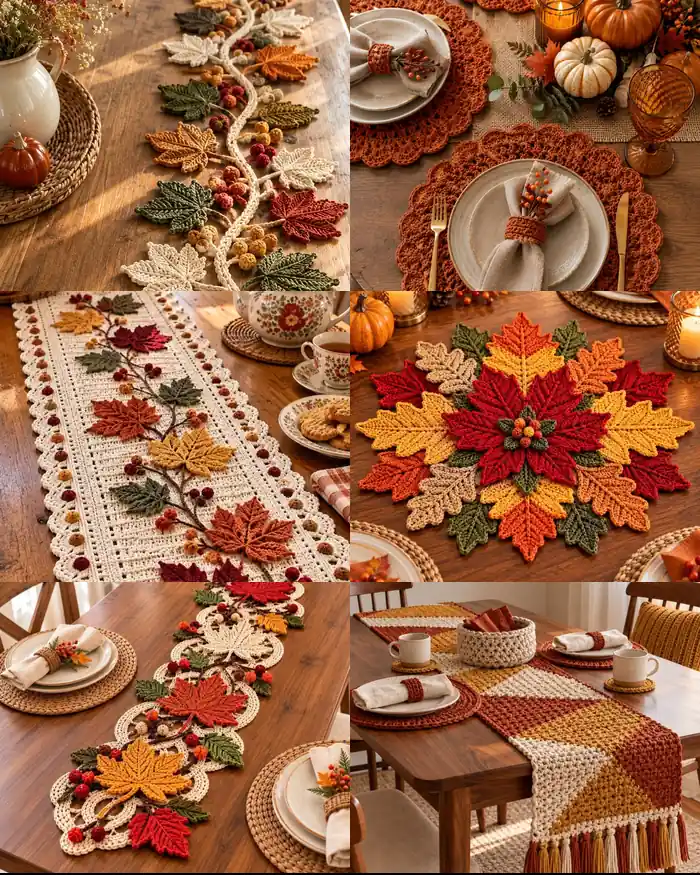
Thanksgiving in a small home usually happens at the same table that holds laptops, laundry baskets and last Tuesday’s mail, and the fastest search for home decor ideas ends with staging photos of dining rooms nobody rents. A crochet layer works differently. One runner, a few placemats and a doily under the candles add color, texture and a handmade warmth that a bare or mismatched table cannot fake, and every piece folds into a drawer when the guests go home. The twelve crochet table decoration ideas below run from the big anchor pieces to the small finishing layers, each one photographed on a real table and sized for the four person tables most apartments actually have.
Table of Contents
- Before You Start: The Table Rules
- 1. Run a Leaf Vine Down the Center Line
- 2. Let the Runner Seat the Guests
- 3. Put a Rust Placemat at Every Seat
- 4. Give One White Doily the Whole Table
- 5. Add a Turkey to the Cutlery
- 6. Edge Each Placemat With a Leaf
- 7. Build the Centrepiece as a Leaf Wreath
- 8. Stand Hot Dishes on a Diamond Trivet
- 9. Dress a Table for Two With Tassels
- 10. Overlay a Full Cloth on the Center Only
- 11. Switch the Coasters When the Holiday Switches
- 12. Fold the Whole Table Away Flat
- Set It in One Afternoon: The Order of Work
- 5 Crochet Table Mistakes That Undo the Warmth
- Crochet Table Questions, Answered
- What a Handmade Table Costs, Honestly
- Final Thoughts
Before You Start: The Table Rules
Rule 1: Protect the walkway around the table. Thanksgiving tables collect extra chairs, a folding stool and at least one person squeezing past with a hot dish. Keep the chair pull out zone clear, about 24 inches behind each chair, and let every crochet piece live on the tabletop itself, never draped over edges where sleeves and serving bowls catch.
Rule 2: One textile language per table. Pick one family and stick to it: all leaves, all lace or all color block. The photos below look calm because each table repeats one idea at every seat rather than mixing five crafts at once. If you own odd pieces, group them by color and use the runner as the anchor that ties the set together.
Rule 3: Heat and wax plan comes before beauty. Hot dishes melt synthetic yarn and candle wax sets into lace for good. Cotton yarn handles warm plates; a trivet still goes under anything straight from the oven, and candles sit on a tray or a doily you can wash, never straight on a runner you love.
Rule 4: Size to the real table. A runner should hang 6 to 10 inches over each end or stop well short of the edge; the awkward in between length reads as a mistake. Placemats need about 15 inches of width per guest so plates, cutlery and a glass all land on or beside the mat without crowding the neighbour.
Rule 5: Renters, keep it liftable. Everything in this list weighs ounces, needs no fixing to the table and leaves no mark on a rented surface. The table underneath can be the landlord’s, the folding one from the closet or a door on trestles; the crochet layer is what guests remember. When the lease ends, the whole dressed table packs into one shopping bag, and the deposit never meets the decor.
One anchor down the middle, one layer at each seat, one glow in the center. If a piece does none of those three jobs, it stays in the drawer.
1. Run a Leaf Vine Down the Center Line
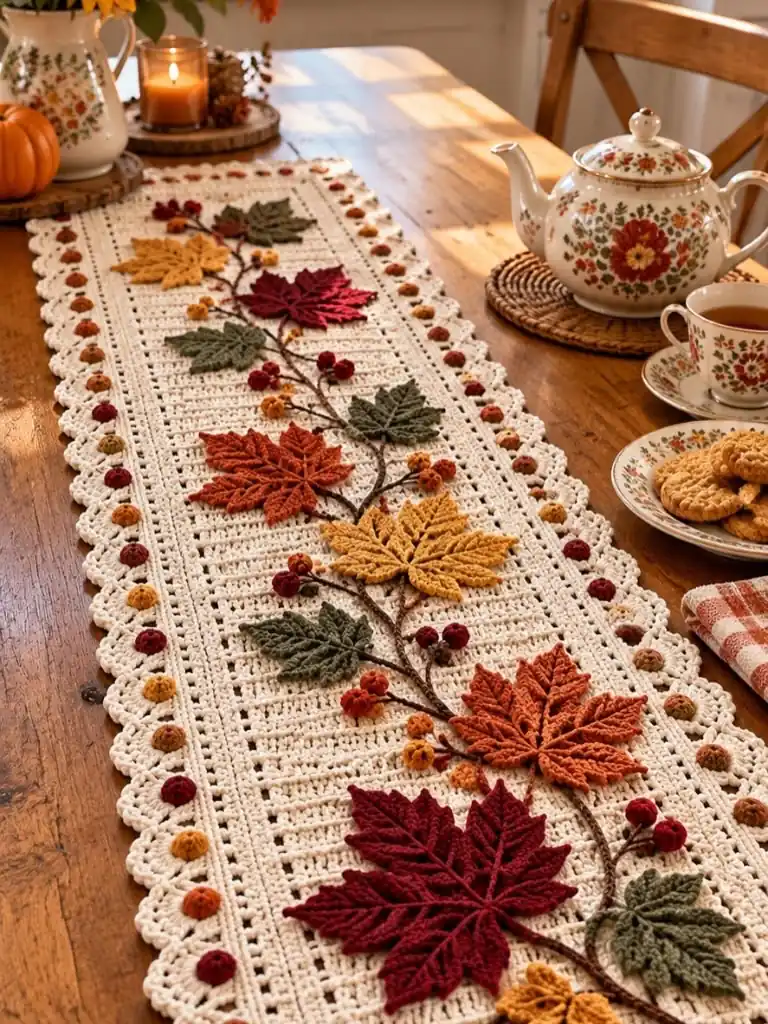
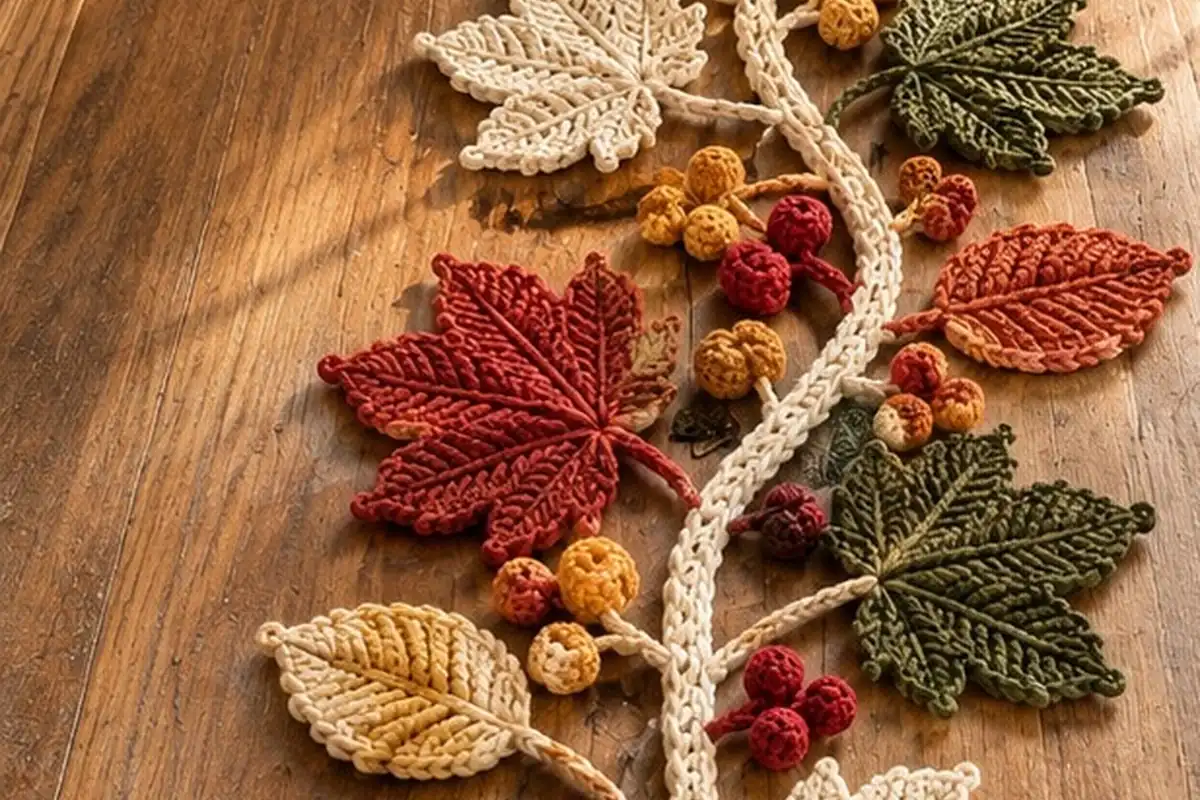
Start where every guest’s eye lands first: the center line. This cream runner carries a vine of crocheted maple leaves in rust, red, gold and green down a lacy base, and on the table it sits beside a teapot and candles without fighting either of them. A leaf vine is the easiest Thanksgiving signal there is, because the table reads as fall before a single pumpkin arrives.
Lay a runner like this on the bare wood rather than over a cloth. The open lace lets the tabletop show through, which breaks up the yarn and keeps a small table from looking dressed in a blanket. Push it slightly off center if a serving board will live in the middle later; the vine forgives asymmetry because it is an organic shape to begin with.
Length is the detail to get right. On a four person table the runner should either pool a few inches over both ends or stop a hand’s width short. This one stops short, which suits a table that also hosts a laptop by day: nothing hangs where knees and chair arms catch. If your only runner is long, fold the ends under and let the folded edge frame the place settings instead.
The colors deserve a slow look. Rust, mustard and deep green on cream is the whole Thanksgiving palette in one piece, so the rest of the table can stay plain: white plates, clear glasses, one candle. When the textile carries this much color, plain dishes are not a compromise, they are the styling.
One more placement note for tables against a wall, which is most apartment tables. Push the runner toward the wall side and leave the room side for plates and arms. A centered runner under a wall side table wastes half its pattern where nobody sits, while a shifted runner shows its full vine to the room and still anchors every setting.
Table length minus 12 to 20 inches, or table length plus 12 to 20 inches. Anything in between hangs at the awkward length. Measure before you fall for a runner.
2. Let the Runner Seat the Guests

Some runners decorate the middle of the table and stop there. This one earns its keep twice: the cream medallion runner carries big crocheted maple leaves in red, orange and gold, and the two place settings at its edges borrow their whole color scheme from it. Woven round placemats under the plates echo the runner’s handmade feel without being crochet at all, which is a useful trick when you own exactly one good crochet piece.
Seat guests from the runner outward. Choose the plate first, then the mat, then the napkin detail, and pull each color from a leaf that is already on the table. Here the napkins carry tiny fall sprigs that repeat the runner’s berries. Nothing matches exactly, and that is the point: a handmade table should look gathered, not purchased as a set.
This layout also solves the small table squeeze. With the runner as the only centerpiece, serving dishes can land on it in a row when the food comes out, and come off it just as fast. Between courses the table goes back to looking dressed instead of cleared.
If your table seats six on a good day and four on a sane one, run the leaf runner for the four real settings and keep the two emergency chairs plain. A half dressed table looks intentional; a crowded one just looks stressed, and guests can tell the difference before they sit down.
The same runner changes jobs after dessert. Lift the serving boards off, leave the runner, and set the coffee cups and the pie on it. Because the leaves run the full length, the table resets itself for the second act without a single new piece, which is more than any cloth with a fixed center design can claim.
Set the real seats fully and keep the overflow seats plain. The runner does the decorating; the extra chairs are just furniture.
3. Put a Rust Placemat at Every Seat

If the runner is the table’s sentence, placemats are the words at every seat. These rust orange crochet mats do heavy work in this photo: they warm up plain cream plates, they tie the pumpkins and amber glass into one scheme, and they give each guest a defined patch of table in a setting that has no tablecloth at all.
Crochet placemats suit Thanksgiving better than stiff woven ones for one practical reason: they are soft. Plates sit flat and quiet on them, cutlery does not skitter, and a glass set down mid story lands without a clink. On a small table where elbows are close, that softness reads as calm.
Match the mat count to the guest count honestly. Four matching mats with two plain spares looks fine. Six mats in three different styles looks like a craft fair. If your set is short, put the matching mats at the seats guests see first when they walk in, and the odd ones at the host’s end where the serving traffic hides them.
The napkin rings here carry the same fall sprig as the runner setting in idea 2, and the lesson transfers: pick one small repeat detail, a sprig, a berry cluster, a wooden bead, and let it appear at every seat. Repetition at the seats is what makes a table feel planned rather than decorated at random.
Rust is also the forgiving host’s color. Gravy, cranberry and red wine all land inside its family, so the mat hides the meal’s evidence better than cream ever will. Put the darkest mats at the seats where the serving dishes pass, which is usually the two middle chairs, and keep the lighter pieces for the ends.
Matching mats at the seats guests see first. Odd mats at the host end, hidden by serving traffic. One repeat detail at every seat ties it together.
4. Give One White Doily the Whole Table

This is the most loved crochet table photo in the whole set, and it shows almost nothing: one white lace doily, alone on a warm wooden table. The pattern does everything, rings of shells and openwork that hold the eye the way a printed cloth would, while the wood glows through the holes. On a dark or mid tone table, white lace is not old fashioned; it is the highest contrast move available.
Use a single large doily as the entire centerpiece base. Set a candle, a small vase or the bread basket on it and the middle of the table is finished. The doily frames whatever sits on it, so even a plain glass jar of supermarket flowers reads as arranged.
There is a rental friendly secret hiding in this photo: a doily covers the table’s worst patch. Rental tables come with ring marks, scratches and one mystery stain. A doily placed with intent parks the prettiest textile in the house exactly over the damage, and nobody has ever asked what is under a centerpiece.
Keep white lace white by washing it the slow way, cool water, a gentle soak, dried flat on a towel. It is a once a season job, because a doily under a candle tray collects almost no food. The pieces at the seats do the dirty work; the center stays clean.
Scale the doily to the table with one rule of thumb: its edge should clear the place settings by a few inches on every side. A doily that creeps under the plates gets pulled, stained and wrinkled all meal long. On a small round table one large doily can be the entire textile plan, worn alone with two candles, and the table still reads as dressed.
Center it under the one thing you want noticed. A doily is a frame, not a cloth: whatever sits on it becomes the centerpiece.
5. Add a Turkey to the Cutlery

Every Thanksgiving table needs one moment that makes people smile before the food arrives, and this is it: a crochet turkey holding the fork and spoon on the dinner plate, ringed by more crochet coasters in fall stripes. It is playful without being childish, and it gives each guest a small handmade object that is theirs for the meal.
Cutlery holders solve a quiet layout problem too. On a small table, a holder lets you set the plate stack before guests arrive without loose cutlery sliding around, and it keeps the table’s edge free for serving dishes. If turkeys are a step too far, the same idea works with a simple pocket in fall colors, which guests read as polish rather than novelty.
Be honest about the count. One turkey per seat is a weekend of crocheting if you make them yourself, and a modest basket total if you buy handmade. That cost buys the piece guests photograph, take home in their memory and ask about next year. If the budget only stretches to two, put them at the kids’ end or the grandparents’ seats, whoever will enjoy them most visibly.
After the meal the holders earn their drawers’ rent: they hold chopsticks, paint brushes, crochet hooks and pens for the rest of the year. Seasonal pieces that work in January get kept; the rest get donated, so choose shapes you would use in another costume.
One practical note before you set them out: a holder stands best with the cutlery already in it. Fill the pockets at the kitchen counter, carry the plates out loaded, and the setting lands finished in one trip per guest. On a small table, where the host is also the server, that saved trip matters more than it sounds.
Every dressed table needs exactly one playful piece. Two is a theme party. The turkey is this table’s one.
6. Edge Each Placemat With a Leaf
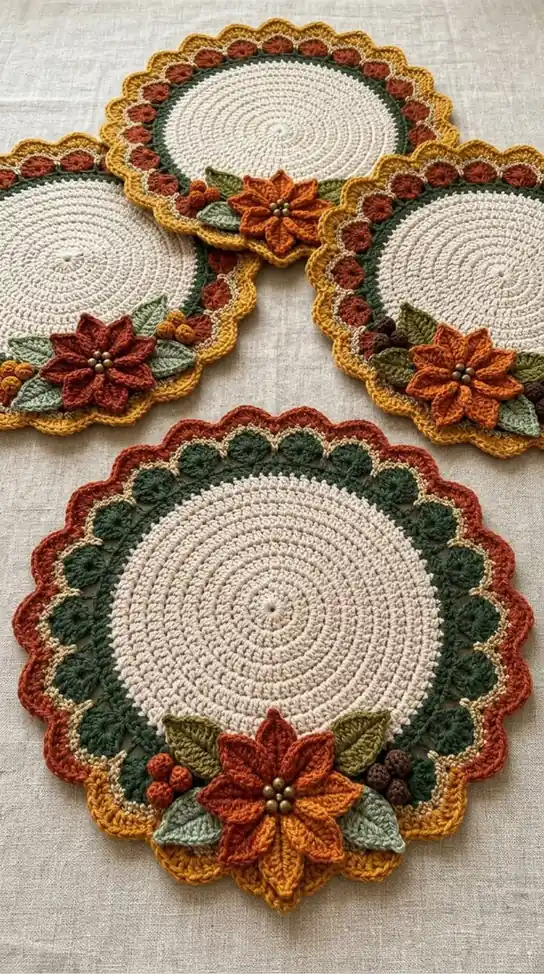
Round placemats are the workhorse of crochet table decor, and this set shows why the edge matters. Each mat is a calm cream center with a border of green and rust, finished with a crocheted autumn flower. The plate lands on the plain middle; the decoration lives at the rim, where it peeks out around the plate like a frame.
That plain center is doing practical work. A heavily textured mat under a plate makes the plate rock, and a lacy open one lets crumbs through to the table. Look for mats with a tight, flat center and the fancy work pushed to the border, exactly as these do, and test one under your heaviest plate before committing to a set.
Four mats on linen, as photographed, also proves a styling point for renters: you do not need a tablecloth and mats. Mats on bare wood or on a plain linen cloth both work, and the mats are the faster wash when gravy happens. Thanksgiving gravy always happens.
Color discipline is the last lesson here. Cream, green, rust and gold repeat across all four mats, so the set reads as one family even though the flowers differ. When buying handmade pieces one at a time, buy to a written palette like this and the collection will always match itself.
Tight flat middle, decoration at the rim. Test your heaviest plate on one mat before you buy or make the set.
7. Build the Centrepiece as a Leaf Wreath

A centerpiece you can fold into a drawer sounds wrong until you see this one: a round wreath of layered crochet maple and oak leaves in red, gold, cream and green, ringed with candles and small pumpkins. The leaves carry the whole fall garden in yarn, they never wilt, and next year they come out of storage looking exactly like this.
Build the middle of the table in rings. The wreath sits flat on the table, a candle or a small pumpkin cluster goes in its center hole, and taller candles stand outside the ring where sleeves can reach the serving dishes safely. Flat is the key word: a low centerpiece lets guests see each other, which matters more to a good meal than any arrangement.
This is also the most forgiving centerpiece for a small table. On a four person table the wreath alone, with one candle, is the whole show. If the table grows with a folding extension, add the pumpkins around it. The piece scales by what you ring it with, not by being replaced.
Makers can treat the wreath as a scrap yarn project, since every leaf is small and the colors are supposed to vary. Buyers should look for leaves stitched to a base ring rather than glued; stitched leaves survive washing, and this piece will collect its share of cranberry sauce by year two.
The wreath moonlights after Thanksgiving, too. Hung on a door or laid around a plant pot, it keeps working through winter, and a ring of leaves in these colors flatters a Christmas table as happily as a November one. Pieces that serve two holidays earn their storage space twice over, which is the real test for seasonal decor in a small home.
If guests cannot see each other over it, it is not a centerpiece, it is an obstacle. Build in rings and keep the middle low.
8. Stand Hot Dishes on a Diamond Trivet
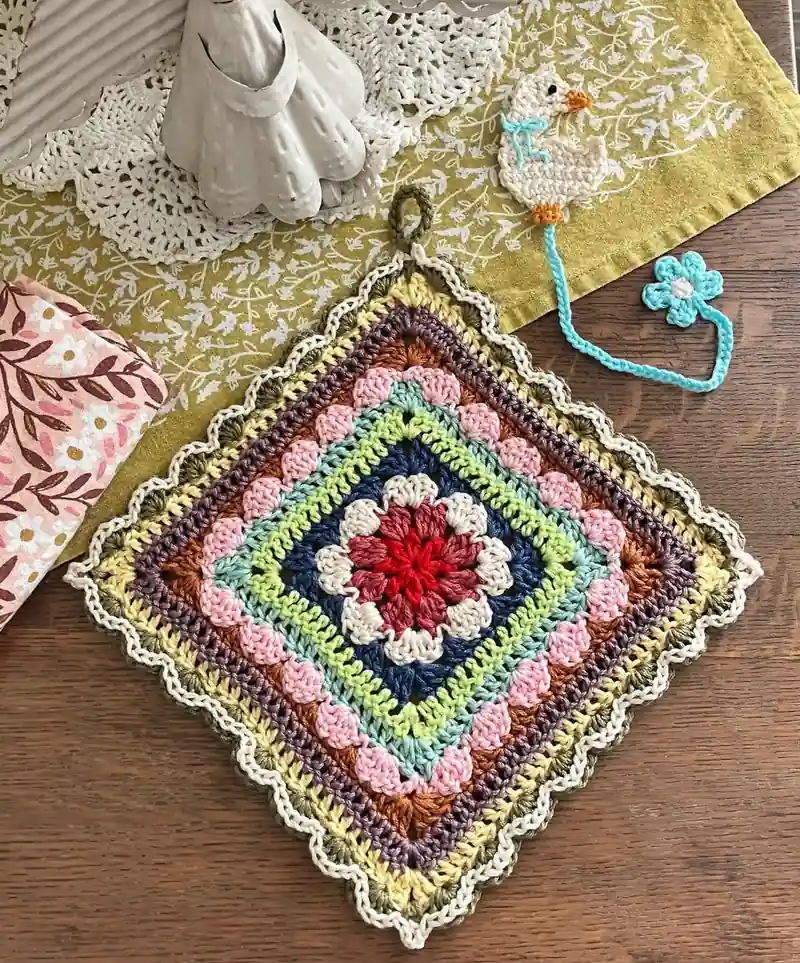
The trivet is the one table piece that works while it decorates. This diamond shaped crochet trivet, worked like a mandala in ring after ring of color, sits on the sideboard or the table’s end all through the meal, and every hot dish that lands in the house lands on it. Between servings it reads as a small rug for the table, pure pattern.
Crochet trivets protect rented tabletops better than thin fabric pads because the stitches trap air, and air is the insulation. Cotton yarn is the non negotiable part: acrylic softens and can melt under a casserole dish, while cotton takes the heat and goes in the wash after. If you are buying, ask what the piece is made of before you ask the price.
Size the trivet to your biggest dish, not your prettiest one. A trivet that fits the roasting pan fits everything else socially. The diamond shape here suits rectangular dishes and slides into the corner of a small sideboard where round mats waste space.
Thanksgiving is the trivet’s busiest day and its best advertisement. Guests notice the dish that arrives steaming on something beautiful, and the table underneath, which may be the landlord’s, stays unmarked. Decor that prevents damage is the renter’s favorite kind, and this is the hardest working idea in the list.
Own two if the meal is big: one lives under the main dish on the table, the other waits by the stove for the pan that always comes out five minutes later. A single trivet spends the whole meal being carried between rooms, hot dish in the other hand, which is exactly the juggling act the piece was bought to prevent.
Trivets and hot pads must be cotton. Acrylic melts under a hot dish. Check the fiber before the color, every time.
9. Dress a Table for Two With Tassels
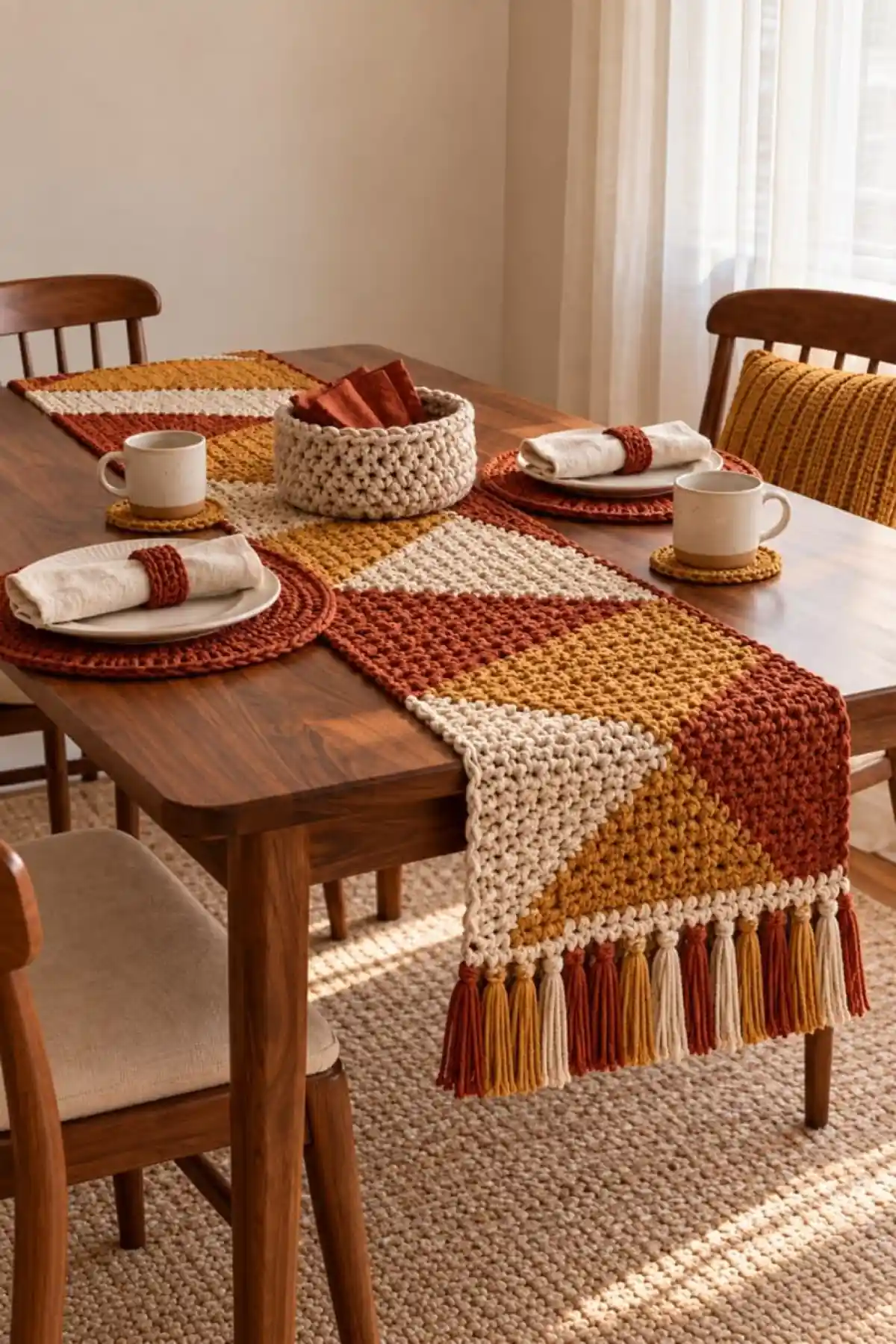
Small Thanksgivings deserve the same ceremony as big ones. This table for two runs a cream, mustard and rust triangle runner with long tassels, adds a crochet basket holding the bread rolls, and sets two full places with napkins and coasters. Nothing about it apologizes for the guest count. If anything, the small table wears the crochet better, because the runner covers more of its world.
The crochet basket is the idea to steal. Bread, rolls or the cutlery for the table can live in it, and a soft basket squishes into whatever gap a small table offers, unlike a tray with fixed corners. After the meal it holds fruit on the counter. One basket, three jobs, no storage problem.
Tassels are the detail guests touch. They hang at the runner’s ends and move when the table is bumped, which gives a still table a little life. Keep tassel length clear of laps and chair arms; a runner that ends at the table edge keeps its tassels in the safe zone and still shows them off.
A two person Thanksgiving also frees the rest of the runner’s budget. One good runner and two good placemats cost less than dressing six seats, and the pieces can be the best handmade work you own. Small tables are where heirloom quality pays off fastest, because every guest touches most of the table.
Set the two places across from each other rather than side by side, even if you usually sit together. A dressed table wants the symmetry, the runner reads better with a setting at each end of its pattern, and the meal feels like an occasion instead of a Tuesday with better food.
Same ceremony, fewer seats. Spend the savings on the best runner you can find; at a small table, every piece gets noticed.
10. Overlay a Full Cloth on the Center Only

A full crochet tablecloth is a serious object, and this one, white with pink lotus flowers and a fringe of hanging buds, shows the scale of the craft honestly. For a Thanksgiving table in a rental, the trick is not to cover the whole table with it. Fold or drape the cloth across the center as an overlay, let the wood show at the edges, and the giant piece becomes a generous runner with a past life.
This overlay approach solves the two problems of full cloths. It hides the mismatch when the cloth and the table are different shapes, since a round cloth centered on a rectangular table reads as a deliberate layer. And it keeps the cloth’s edges, where food lands, out of the gravy line; the center of a table stays cleaner than its rim.
The lotus pink is springlike, and that is fine. A white ground cloth is a neutral stage: lay a rust runner across it, scatter the leaf wreath from idea 7 on top, and the table turns autumnal while the heirloom cloth does the lace work. Layers let one beloved piece serve every season.
If a full cloth comes to you from family, this is also the respectful way to use it. Pieces like this were made to be seen, not stored in a bag. An overlay at Thanksgiving, washed gently and dried flat after, keeps the cloth in the family’s life instead of its cupboard.
A big cloth centered as a layer beats a full cover on any rental table: shape mismatches vanish and the edges stay out of the gravy line.
11. Switch the Coasters When the Holiday Switches
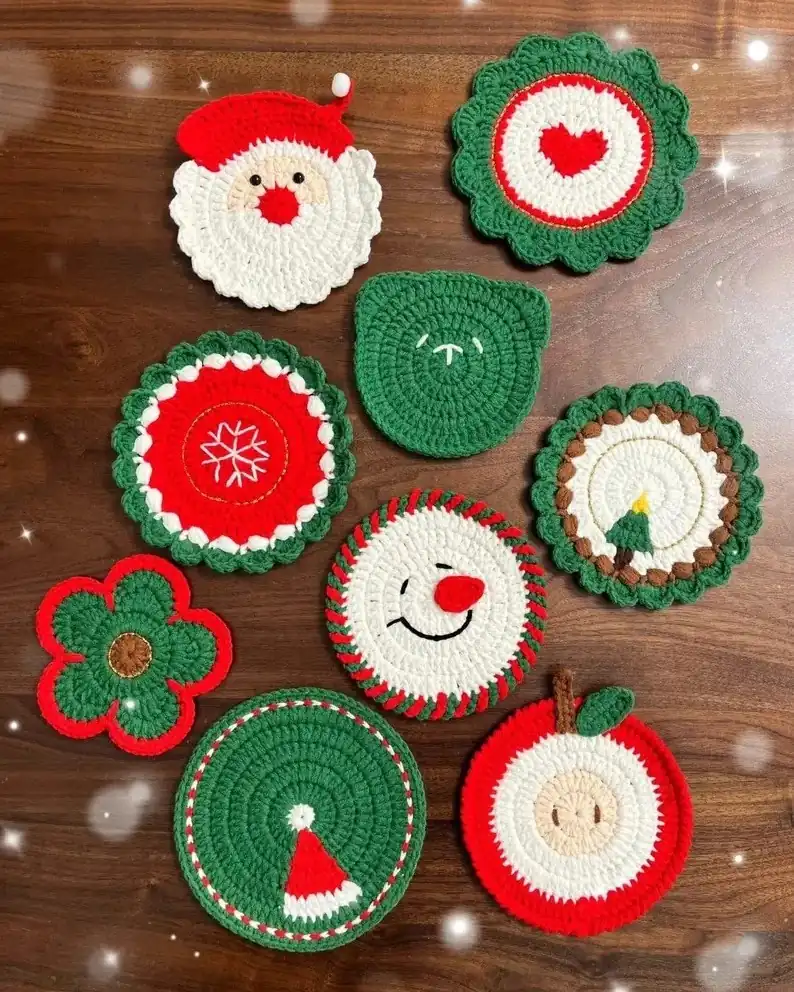
Thanksgiving dinner ends, and the same table starts its December shift. Coasters are the fastest seasonal change a table owns: this flat lay of nine crochet Christmas coasters, Santas, a snowman, trees and an apple in red, green and cream, turns any surface festive in the time it takes to set out drinks.
The lesson inside the novelty is storage logic. Coasters, placemats and cutlery pockets are the small change of table decor: cheap to own in two seasons, flat to store, and visible in every guest’s hand. If you build your handmade collection anywhere, build it here first, because these pieces get used at every gathering rather than admired from a chair.
A coaster at every drink also protects the table through the party season, which in a rental is deposit protection disguised as charm. Set them out early in December, before the first party, not after the first ring mark.
Notice that the color family barely moves: the reds and greens of these coasters sit happily beside the rust and gold of the Thanksgiving pieces above. A handmade collection built on one warm palette can swing from November to December by swapping only the small pieces, which is exactly how a small home should handle two holidays in five weeks.
Swap the coasters and pockets, keep the runners and mats. One warm palette carries the table from Thanksgiving to Christmas.
12. Fold the Whole Table Away Flat

The last idea is the one that makes the other eleven possible in a small home: everything folds flat. This autumn table, with its orange, brown and cream runner and small crochet pumpkins, can be washed, folded and filed into a single drawer or storage box in about ten minutes after the meal. No fragile arrangements, no seasonal bins eating the closet.
Run the pack away in the order that protects the pieces. Shake crumbs outside first, because folded crumbs become permanent guests. Wash what caught food, dry everything flat so the shapes set correctly, then fold lace pieces in tissue or a clean pillowcase to keep the openwork from snagging on zips and buttons in a drawer.
Store the set as a set. Runner, mats, coasters and the wreath in one box or drawer, with the candles’ tray on top, means next year’s table takes an afternoon instead of a shopping trip. Label the box by the meal, not the craft: Thanksgiving Table. Future you, standing in front of open storage in November, will be grateful for plain words.
And the pumpkins in this photo are the closing argument for crochet at Thanksgiving. Yarn pumpkins never rot on the table, never smell by week two, and the small ones double as place markers with a name card tucked against the stem. The table that folds away is not a lesser table. In a small home, it is the only kind that can happen every year.
Shake, wash, dry flat, fold in tissue, store the set together. Ten minutes now buys a ready table next year.
Set It in One Afternoon: The Order of Work
Work the table in the same order the eye reads it. The day before: wash and press the pieces you plan to use, because crochet that dries overnight on a towel lies flatter than anything ironed in a panic. Morning of: clear the table completely, wipe it, and run the runner or overlay down the center while the surface is empty. The center ring goes next, wreath, doily and candle tray, before a single plate appears.
Then set the seats: placemats, plates, cutlery holders, napkins, glasses. Setting seats before serving dishes exist on the table keeps the geometry honest, and the geometry is the first thing guests feel. Serving bowls come last and land on trivets in the gaps the settings leave. If a dish has no gap, it goes on the sideboard without argument, not squeezed against someone’s water glass.
Light the candles ten minutes before guests sit, not when they arrive. Wax that has pooled and settled looks better, wicks behave, and you learn about any draft that bends a flame toward the runner while there is still time to move the arrangement rather than during the toast.
5 Crochet Table Mistakes That Undo the Warmth
1. Mixing every craft you own. Crochet, macrame, woven seagrass and beaded runners on one table reads as a market stall. Choose crochet as the table’s textile and let other materials appear only as wood, glass and ceramic.
2. A runner at the awkward length. Ends that stop two inches past the table edge catch on every lap and chair. Measure with the rules in idea 1 and fold or pool the ends on purpose.
3. Acrylic under hot dishes. Synthetic yarn and a casserole dish are a melted mess and a ruined trivet. Cotton for anything that touches heat, no exceptions, and check thrifted pieces of unknown fiber before trusting them.
4. A centerpiece nobody can see over. Tall arrangements force guests to talk around a vase. Keep the middle low and flat, and let height live at the table’s ends where it blocks nobody.
5. Twelve pieces, twelve colors. A handmade table stays calm when the palette is written down first: cream, rust, gold and green will carry the whole season. Buy to the palette and every future piece matches the family.
Crochet Table Questions, Answered
How do I tell if a crochet runner is real handmade work?
Look at the back. Handmade crochet has tiny irregularities, joins where new yarn started and edges that vary by a stitch or two. A perfectly uniform piece with a printed look is usually machine made or printed fabric pretending. Real handmade work also feels like yarn with body, not like stiffened mesh. The same tests that work for mudcloth and woven textiles apply here: honest handmade pieces vary slightly and age softly.
What yarn is safest for table pieces?
Cotton for anything near heat or food: trivets, placemats under hot plates and coasters under mugs. Acrylic and blends are fine for runners, wreaths and purely decorative layers that stay away from dishes. When the label is missing, treat the piece as decorative until you know better.
How do I wash crochet table linen?
Cool water, a gentle soak with mild soap, no wringing. Roll the piece in a towel to press the water out, then dry it flat, shaping the edges with your fingers. Most table crochet needs this once a season rather than after every meal; spot clean crumbs and spills as they happen.
How many pieces does a small table actually need?
Five: one runner or overlay, one centerpiece base, and mats or coasters at the seats, counted as one family. The five piece set in this article covers a four person table completely. Everything beyond five is a collection, which is a fine hobby and a different budget.
My table is glass. Does crochet still work?
Better than most textiles, because the openwork shows against the glass and the soft yarn stops plates and glasses from ringing on the hard surface. Choose pieces with a tight weave for glass tops so cutlery cannot dip into the holes, and put felt dots under any candle holder that stands directly on the glass.
Where do I find handmade crochet table pieces?
Local craft markets, estate sales and online handmade shops are the reliable sources, in that order for price. Markets let you feel the fiber and check the backs in person. Estate sales release whole matched sets for the price of one new piece. Online, buy from makers who show the back of the work and name the fiber in the listing.
Can crochet work on a modern table?
Yes, if the colors behave. Cream and white lace on a dark simple table reads as texture, not nostalgia, and a single doily under a modern candle is a graphic shape. Keep the rest of the table plain and let the stitch pattern be the only ornament.
What a Handmade Table Costs, Honestly
Prices swing by maker and market, so treat these as planning ranges rather than quotes. A handmade runner is the anchor buy at roughly 25 to 80 dollars depending on length and detail. Placemats run 8 to 20 dollars each bought singly, less per piece in a set of four. A doily centrepiece base is often the bargain of the family at 10 to 30, because makers price them as smalls. Trivets sit around 8 to 15, coasters 3 to 8 each, and novelty cutlery holders are priced like gifts, 5 to 12 each.
Sequenced sensibly, the table in this article builds in two passes. Pass one, the runner and a set of mats, covers the structure for about 60 to 150. Pass two, the wreath, trivets and the playful pieces, arrives when the budget recovers. If one piece gets the money, make it the handmade-style crochet table runner: it is the highest impact buy on the table, the piece in nearly every photo above, and the layer guests remember. Secondhand and market stalls are kind to crochet, since table linen is exactly what estates and grandmothers’ drawers release; buy to your written palette and the finds will match each other.
Final Thoughts
A cozy Thanksgiving table in a small home is not a smaller version of a dining room production. It is a different, warmer thing: one good runner down the middle, soft mats at the seats, a low ring of leaves and candlelight, and one small turkey that makes the table smile. Every piece washes, folds and waits in a drawer for next year, which is why this style suits renters and small homes so well. The handmade-texture thinking continues in these Afrohemian decor ideas for small rentals, the buying tests echo the guide to telling if mudcloth is real, and the two pass budget plan follows the same logic as these budget home decorating ideas for small homes. Add the no paint warmth of making a rental feel like yours and the small space discipline of making a small room look bigger, and the table is ready. Start with the runner this week, while the planning window is open, and let the rest arrive one honest piece at a time.

Elora Vania here, founder and Senior Editor of Home Aure. With years of experience in interior styling and home decor, I created this site to bring thoughtful, practical design advice to real homes—helping you create spaces that feel warm, personal, and beautifully lived-in.