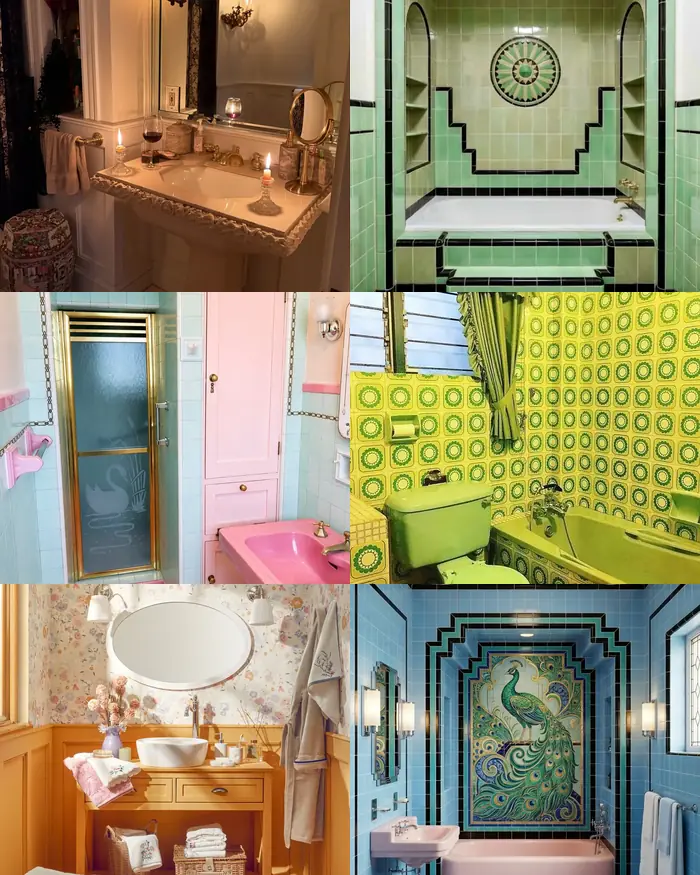
These vintage bathroom ideas start in the one room a plain rental seems to forbid, because the standard rental bathroom is a white box: white tile, chrome taps, a mirror with no frame and not one thing in it older than the lease. Retiling is out, replumbing is out, and paint is usually out too. Yet the rooms people save and share, the Deco mint bathrooms, the pink 1950s originals, the moody clawfoot corners, get almost all of their character from things that hang, lean, fold and lift: colour in fabric, pattern underfoot, brass on the small fittings, porcelain with a story.
These fifteen vintage bathroom ideas borrow five eras in turn, 1920s art deco, 1950s retro, 70s and mid-century warmth, then the moody and grandmillennial looks, and every one is translated into the renter version: peel-and-stick tile instead of retiling, swap-in accessories instead of new fixtures, textiles and freestanding pieces instead of building work. Pick the era that suits your bathroom bones, steal its three easiest moves, and the white box stops being the whole story.
Table of Contents
- 1920s & Art Deco Vintage Bathroom Ideas
- Borrow the Checkerboard Floor, Peel-and-Stick Style
- Style a Pedestal Sink Like a Hotel Vanity
- Add Brass and Black Geometry
- 1950s Retro Bathroom Ideas: Pink, Mint and Chrome
- Let One Retro Colour Run the Room
- Pair Pink With Mint Instead of Fighting It
- Make the Shower Curtain the Colour Statement
- 70s & Mid-Century Vintage Bathroom Ideas
- Bring Warm Wood and a Wooden Stool In
- Run One Bold Patterned Tile Moment
- Choose the Curved Double Vanity Look
- Moody and Grandmillennial Vintage Bathroom Ideas
- Build a Moody Corner With Dark Towels and Candlelight
- Layer Grandmillennial Pattern: Floral, Blue and White
- Give Walls Period Texture With Beadboard-Look Panels
- Renter-Safe Vintage Bathroom Swaps (No Renovation Needed)
- Swap the Shower Curtain, Rings and Bath Mat in One Afternoon
- Swap Knobs and Hooks to Aged Brass, Keep the Originals Bagged
- Layer Vintage Textiles: Turkish Towels and a Small Rug
- 5 Mistakes That Ruin a Vintage Bathroom Look
- FAQs About Vintage Bathroom Ideas
1920s & Art Deco Vintage Bathroom Ideas
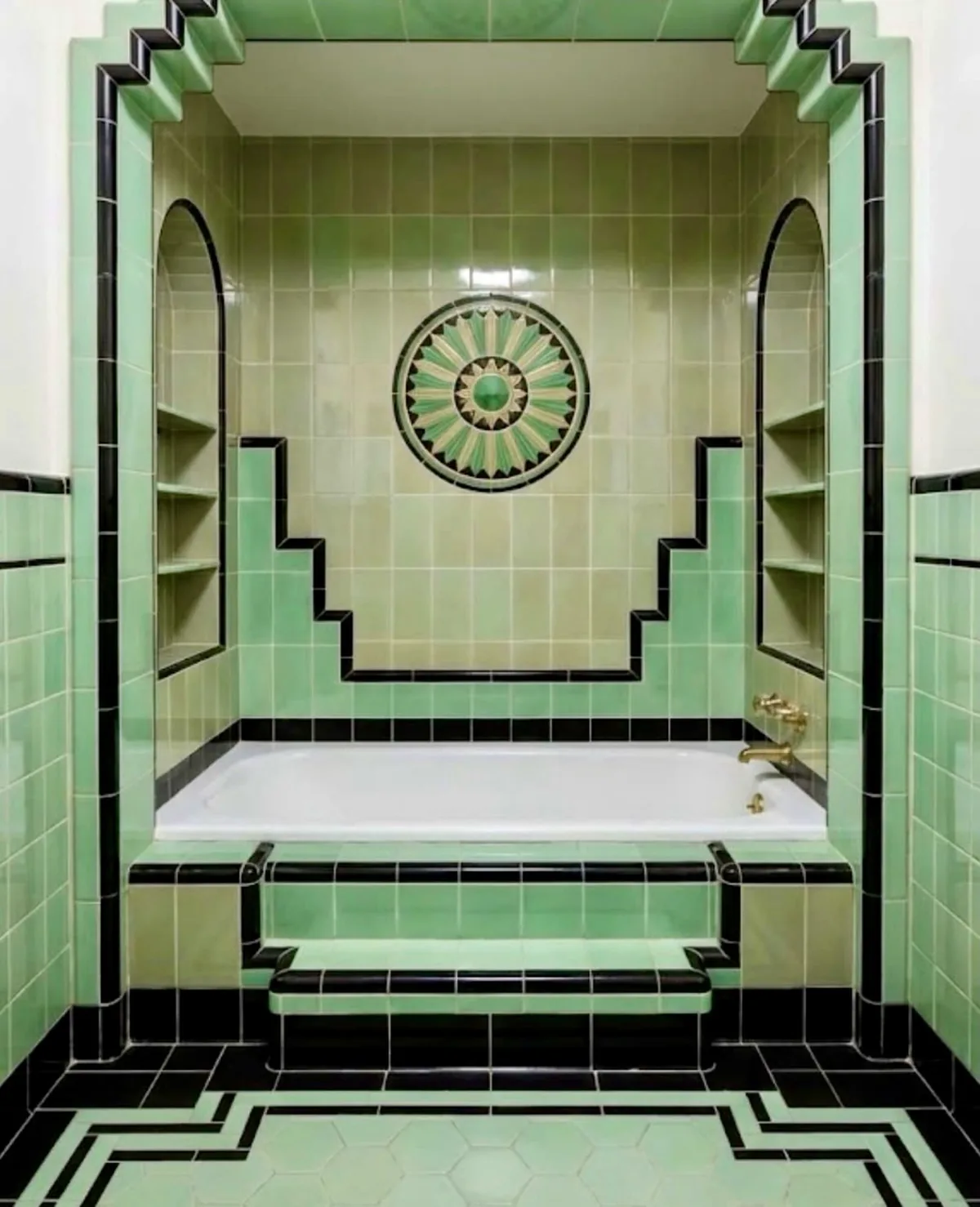
This mint green bathroom is the full 1920s dream, and it is worth saying plainly that it is an owner renovation: mint tile with black trim, stepped arch niches, a round sunburst medallion over the tub, and brass taps. Nobody is asking you to retile a rental. Read it the way this whole first group works: as a set of shapes and colours that peel-and-stick tile, swap-in metal and one good floor pattern can copy in a weekend. Deco was always a style of bold lines and repeated shapes, and lines and shapes are exactly the parts a renter can borrow.
The three ideas in this group steal the era in order of impact. The floor comes first, because a black-and-white checkerboard under your feet changes the room before you notice anything else. The sink comes second, styled the way grand hotels styled theirs, with a tray and a mirror doing the work. The metal comes third: brass tones and black geometric lines on the small things you can unscrew, lean or hang, never on the plumbing itself.
Keep the palette tight while you borrow. Deco rooms run on two or three colours at most, black, white and one jewel or pastel tone, and the discipline is what makes them read expensive. A rental bathroom that picks mint, or blush, or plain black and white, and then repeats it in the curtain, the towels and one tile moment, will read more 1920s than a room with ten vintage objects fighting each other.
Group 1: Borrow the Deco shapes
Floor: a black-and-white checkerboard, laid in peel-and-stick
Sink: a clear rim, a tray, a mirror, one soft light
Metal: brass and black lines, repeated three times each
1. Borrow the Checkerboard Floor, Peel-and-Stick Style
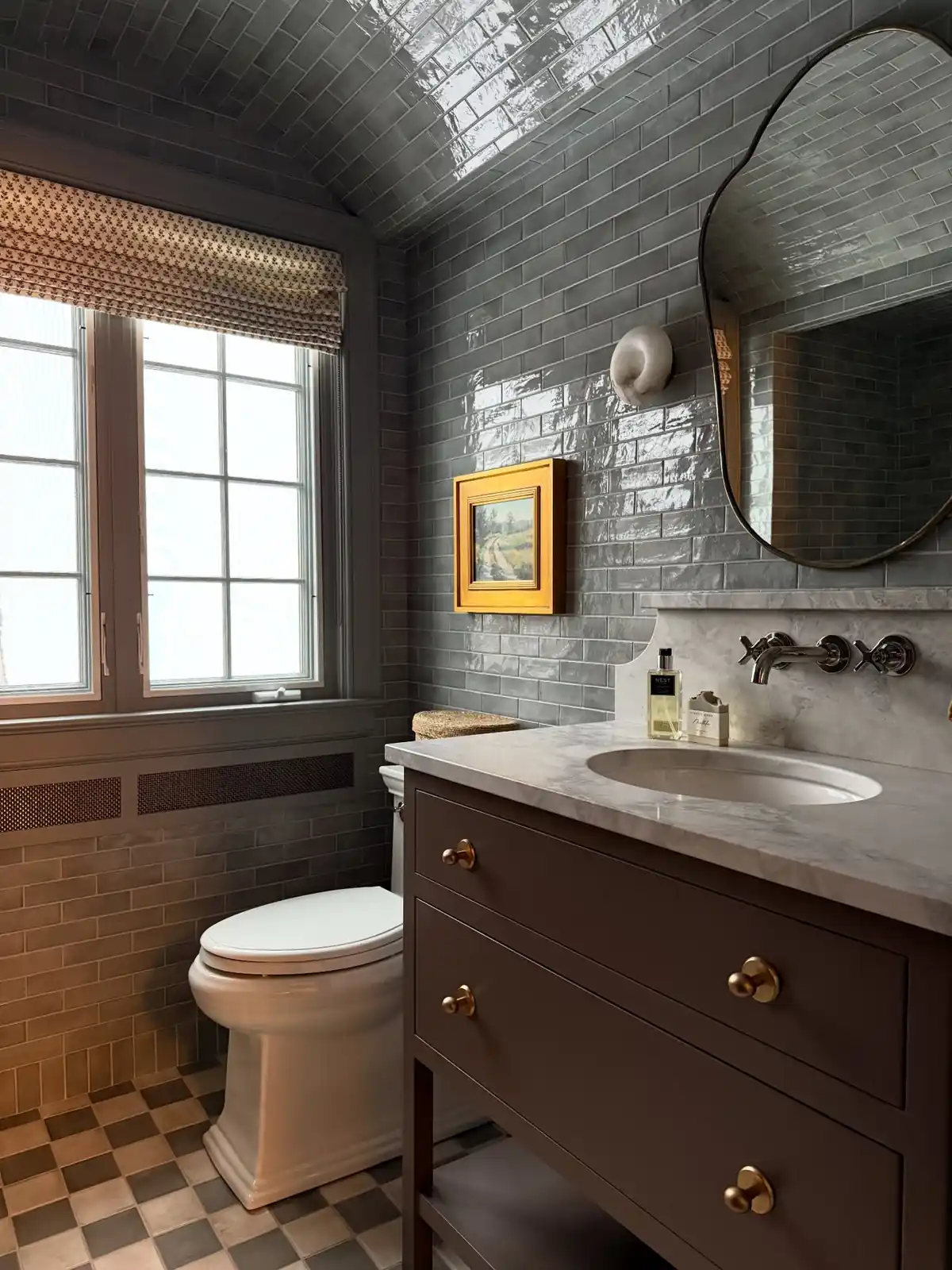
Look at the floor before anything else. This grey subway tile bathroom runs a checkerboard under the vanity and the toilet, grey and cream squares instead of the classic black and white, and it is the floor that gives the whole room its period feel, even though the walls are modern subway tile. The vanity helps, dark wood with round brass knobs and a stone top, but the lesson stands: in a small bathroom, the floor is the biggest pattern you own, and checkerboard is the oldest vintage pattern there is.
The renter version is peel-and-stick floor tile, laid straight over the landlord tiles or the tired lino underneath. Choose classic black and white for the full Deco note, or copy this photo and soften it to charcoal and cream if your room gets little light. Small rooms want smaller squares, so the pattern repeats enough times to read as a pattern and not as four big tiles arguing. Our peel and stick tile guide covers the laying method in full; the short version is clean floor, dry floor, start from the centre line, and keep a few spare tiles for the cuts around the toilet base.
Finish the floor the way the era would: a small rug or bath mat in a solid colour laid over part of it, so the checks frame the room instead of shouting across all of it. The pattern also hides rental life well. Checkerboard forgives dust, hair and water spots far better than a plain pale floor, which makes it the rare vintage choice that is also the lazy choice, and those are the choices that survive real life.
Checkerboard logic
The floor is the biggest pattern in a small bathroom, and checkerboard is the oldest vintage pattern there is. Small squares in a small room, so the pattern repeats enough times to read as a pattern.
2. Style a Pedestal Sink Like a Hotel Vanity
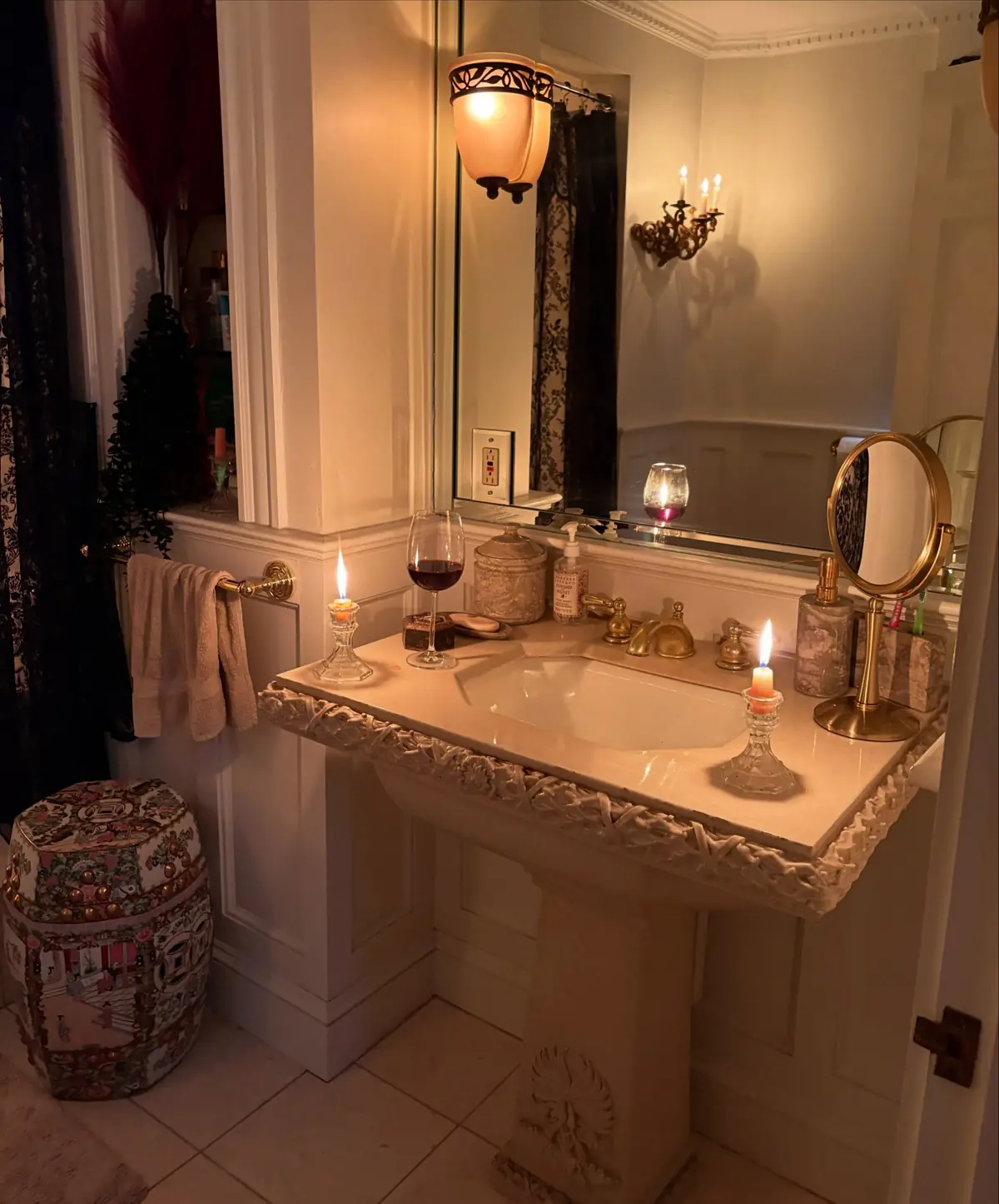
This is the sink from the intro, closer in: a carved pedestal sink with a pair of brass taps, and on its wide rim a whole small ceremony. Two lit candles in glass holders, a round brass table mirror, a stone soap dish, a lidded pot, and beside the sink a patterned garden stool doing the job of a side table. The room is lit like an evening in an old hotel, and almost nothing in the scene is fixed to anything. It is styling, not building work, which is why it belongs in a renter article.
Most rental bathrooms already have the main actor: a plain white pedestal sink or a simple basin with a wide rim. What it lacks is the ceremony. Clear the rim completely, then put back only three things: a tray or soap dish, one mirror with a metal frame, and one soft light source, a candle in a glass holder or a small flameless candle where real flames worry you. The rule is a clear rim with a few chosen objects, not a crowd of bottles standing in a puddle.
The stool beside the sink is the detail worth copying hardest. Every bathroom needs a landing spot for a phone, a book or a folded towel that is not the floor and not the toilet lid. A small stool, a garden stool or even a sturdy wooden box gives the sink its side table, and in a vintage room it doubles as the place a spare towel stack lives. On move-out day, the tray lifts, the mirror packs, the stool walks out, and the landlord sink is exactly as plain as the day you found it.
Sink rule: clear the rim, then put back three things only. A tray, a mirror with a metal frame, and one soft light. A chosen few read as a hotel vanity; a crowd reads as storage.
3. Add Brass and Black Geometry
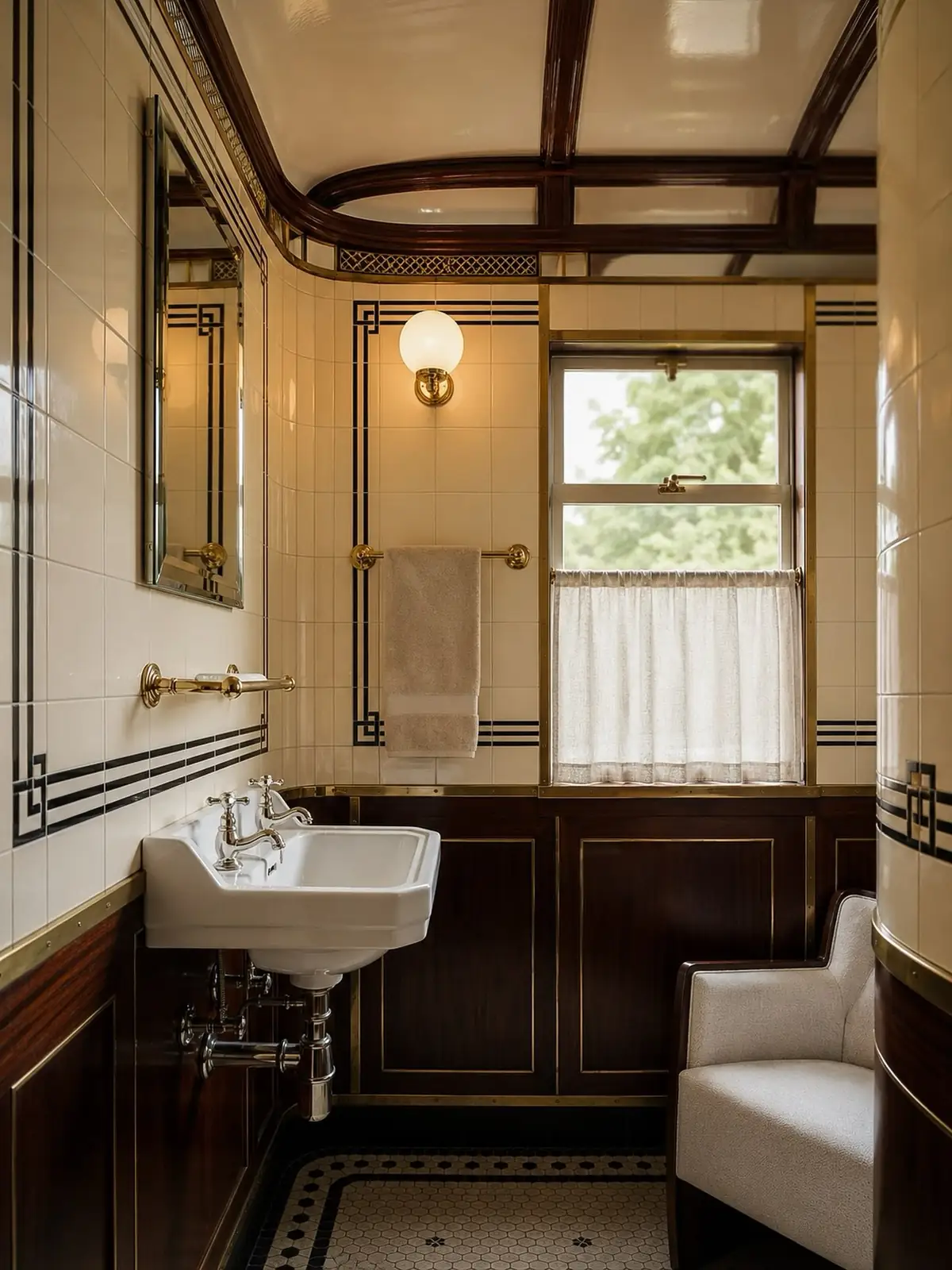
Cream tile, black lines and brass everywhere: this early 1900s bathroom draws its whole design with geometry. Black border stripes run around the cream tiles in stepped corner patterns, brass trim edges the dark wood panels below, a brass towel bar and a round globe light carry the metal up the wall, and the floor is tiny white hex tiles dotted with black. Nothing in the room is ornate. The pattern is made of straight lines and one warm metal, repeated until it feels rich.
That is excellent news for renters, because lines and metal are the two cheapest things to add. The lines can come from peel-and-stick tile trim, from a black-framed mirror and print frames, or from the border of a shower curtain chosen for its geometric edge. The brass can come from everything touchable: a brass towel ring on a removable hook, a brass soap dish, a small brass tray on the sink, even the curtain rings from the swap group later in this article. None of it touches a pipe.
Repeat the pair at least three times each and the room starts to agree with itself. Black in the mirror frame, the curtain border and one frame on the wall. Brass in the dish, the ring and the tray. Two notes, played in threes, is the whole Deco chord. If your bathroom fittings are chrome and cannot change, do not fight them: chrome was period-correct too, so pick chrome as your metal and keep the black geometry as the second note instead.
The Deco chord
1. Black lines in the mirror frame, the curtain border and one wall frame
2. Brass in the soap dish, the towel ring and the tray
3. Two notes, played in threes, and the room agrees with itself
1950s Retro Bathroom Ideas: Pink, Mint and Chrome
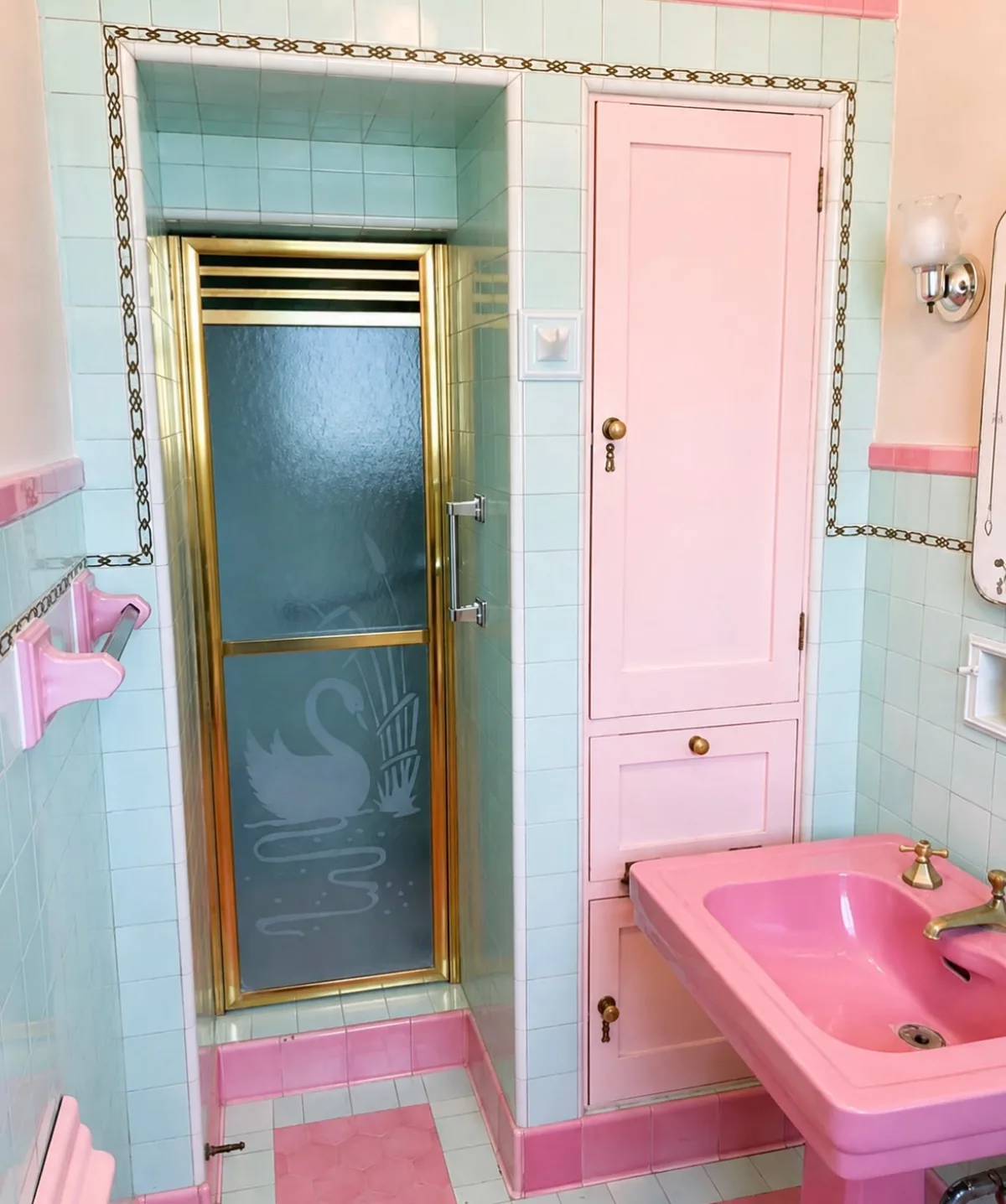
Few rooms survive from the 1950s as cheerfully as this one: a pink pedestal sink with brass taps, a tall pink cabinet beside it, mint green tile on the walls and the shower, and a brass framed shower door tying the metal through the room. It is an original bathroom, kept rather than renovated, and it teaches the 50s rule in one look: the colour was not an accent. The colour was the room, pink and mint together, on the big surfaces, without apology.
Renters cannot inherit a pink sink, and should not try to fake one with paint. The copyable lesson is commitment at the level of everything removable. One retro colour, carried by the shower curtain, the towels, the bath mat and the small accessories, all in the same family, all at once. Half-measures read as accidents; a full set reads as a scheme. The 50s also loved a pair, pink with mint, pink with black, mint with white, so this group works in duets.
The second lesson is that these rooms were small and proud of it. Every object in the photo earns its place, the cabinet is tall and thin, the sink is wall-hung, and there is no clutter on any surface. A 50s scheme in a rental works best with the same discipline: colour everywhere, stuff almost nowhere. Choose your colour, clear the surfaces, and let the duet sing.
Group 2: The 50s duet
One colour: carried by curtain, towels, mat and accessories at once
One partner: pink with mint, pink with black, mint with white
Surfaces: kept clear, because colour everywhere needs stuff almost nowhere
4. Let One Retro Colour Run the Room
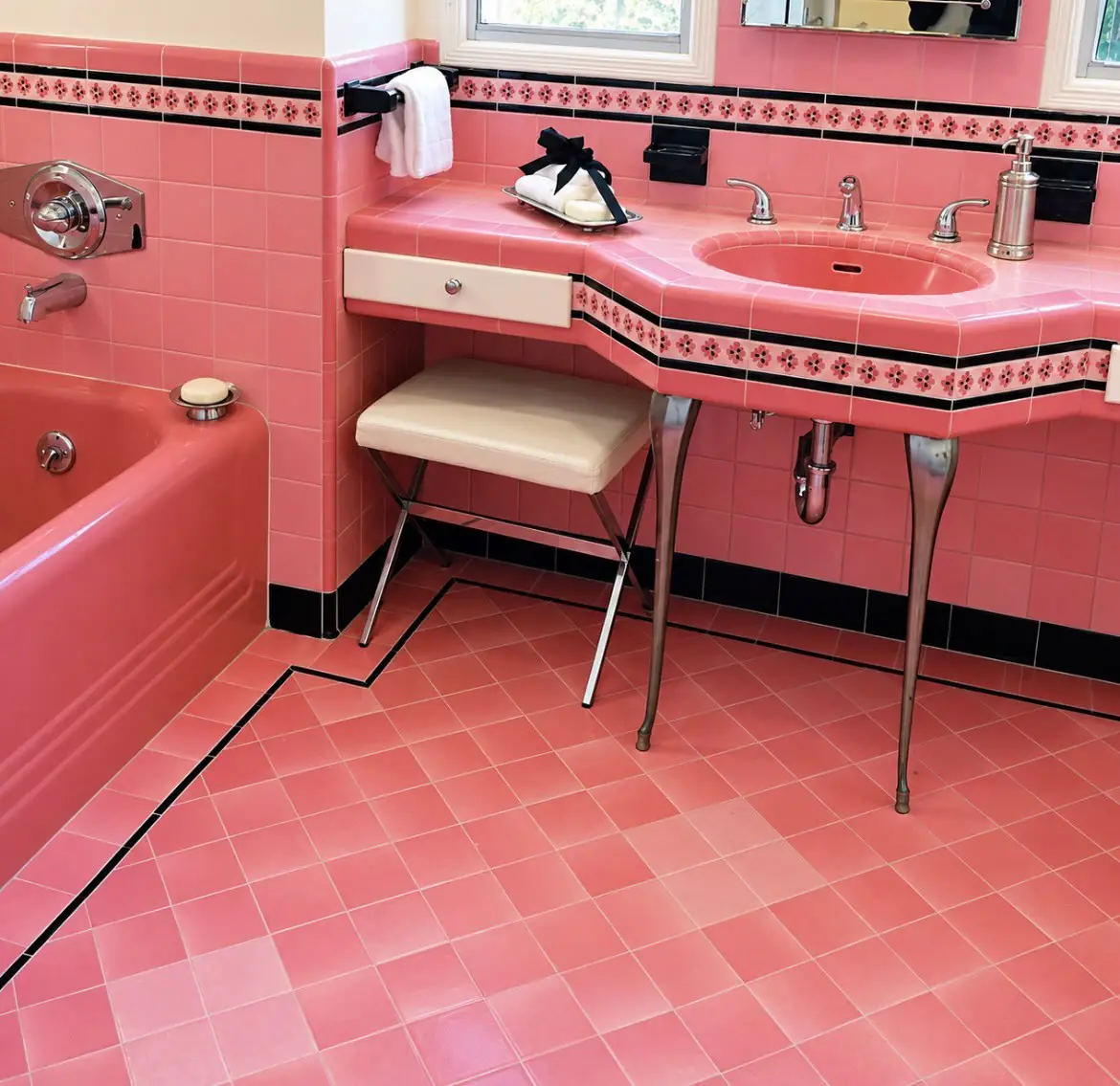
Pink on the walls, pink on the floor, pink in the tub: this bathroom did not decorate with pink, it committed to it. The tiles run wall to wall, the vanity counter is one long pink tiled sweep with the basin set into it, a chrome stool tucks underneath, and a neat tray on the counter holds white towels tied with a black ribbon, the single contrast in the room. Black border tiles and that one black ribbon keep all the pink from turning sweet. It reads bold, tidy and completely sure of itself.
Your rental version runs the same play with textiles and accessories instead of tile. Pick the colour first, a true retro pink, a mint, a butter yellow, and then buy nothing for the bathroom outside it for a while. Shower curtain in the colour, towels in the colour, bath mat in the colour, soap dish and tumbler in the colour. The room will not match the photo surface for surface, but it will match its feeling, because the feeling was never about tile. It was about one colour, repeated until it becomes the design.
Keep one contrast on purpose, the way this room keeps its black borders. A black or chrome tray, a white towel set, one metal soap pump: a single note of something else stops a one-colour room from going flat. And if pink is not your colour, the rule still works in mint, in powder blue or in the avocado family from the 70s group. The era gave us permission to let a bathroom colour be loud. A renter just has to say it with things that hang, fold and lift away.
One colour palette: the retro pink in three depths, one pale neutral, and a single dark contrast. The contrast is what keeps the colour bold instead of sweet.
5. Pair Pink With Mint Instead of Fighting It
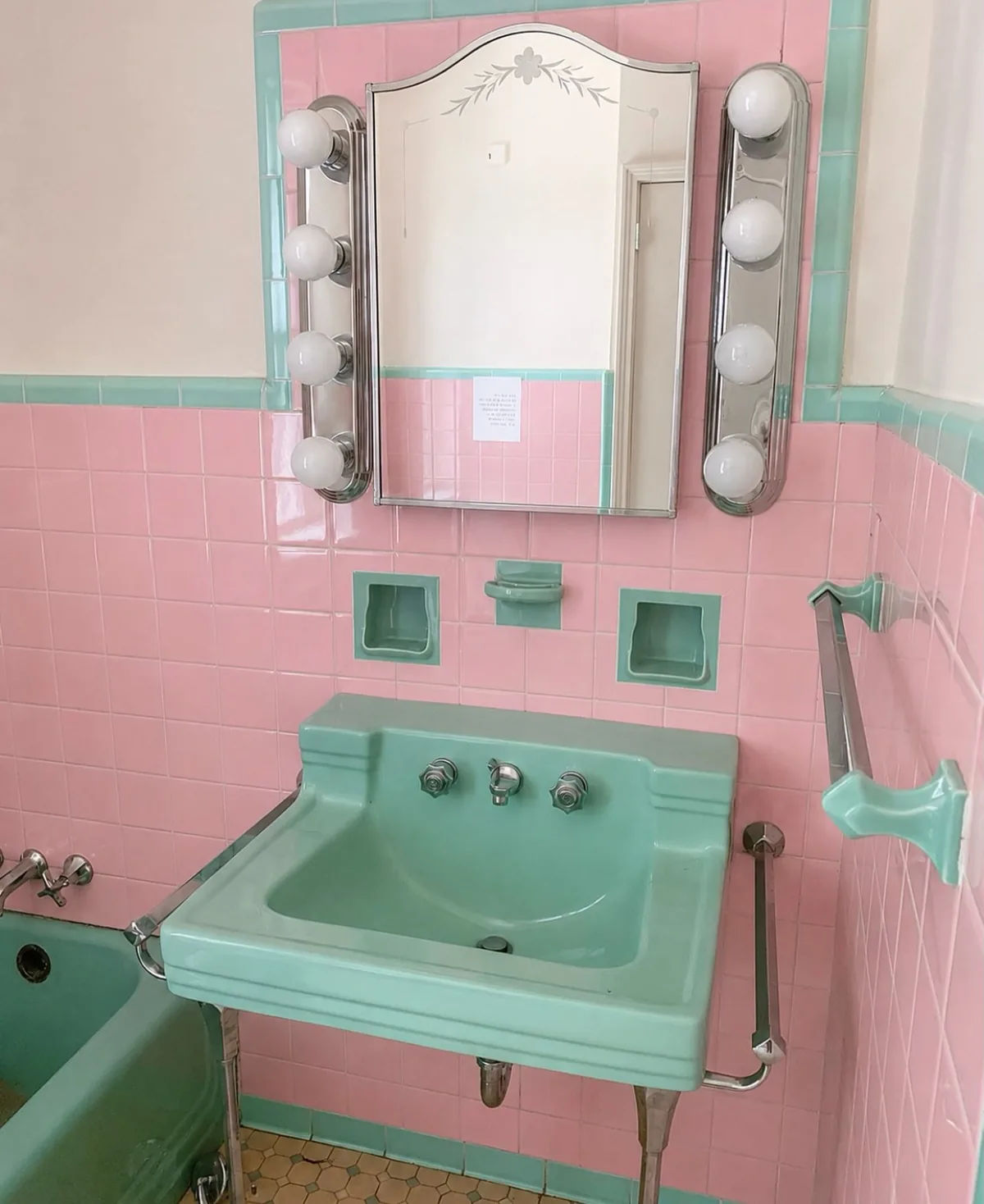
Pink tile walls, a mint green sink, a mint tub in the corner, and an arched mirror lit by two bars of round chrome bulbs: this room is the classic 50s duet, played at full volume. Notice how the pairing is organised. The pink does the walls, the mint does the fixtures, and the chrome does the shine, each colour with its own job, so the two pastels never fight. The mint soap dishes set into the tile and the mint towel rail finish the argument: this was designed, not decorated by accident.
Many renters already live with one half of a duet. An older rental may have a mint or pink tint in its tiles, its tub or its floor, and the instinct is to hide it under grey and white. The 50s answer is the opposite: find the colour its partner. If the room leans mint, bring pink in through the curtain, towels and mat. If it leans pink, mint accessories do the same work. The existing colour stops looking like a flaw the moment it has company.
The bulb bars deserve a renter note of their own. You cannot rewire a rental light, but you can choose the bulbs and the mirror. Round globe bulbs in any existing fitting give that dressing-room glow, and an arched or rounded mirror, hung on removable strips or leaned where the layout allows, echoes the curve of the sink in this photo. Warm white globes, one arch, and the duet is playing in your bathroom too.
Duet logic
Give each colour its own job: one does the walls and big textiles, the other does the fixtures and small pieces. Two pastels with set jobs never fight; two pastels mixed at random always do.
6. Make the Shower Curtain the Colour Statement
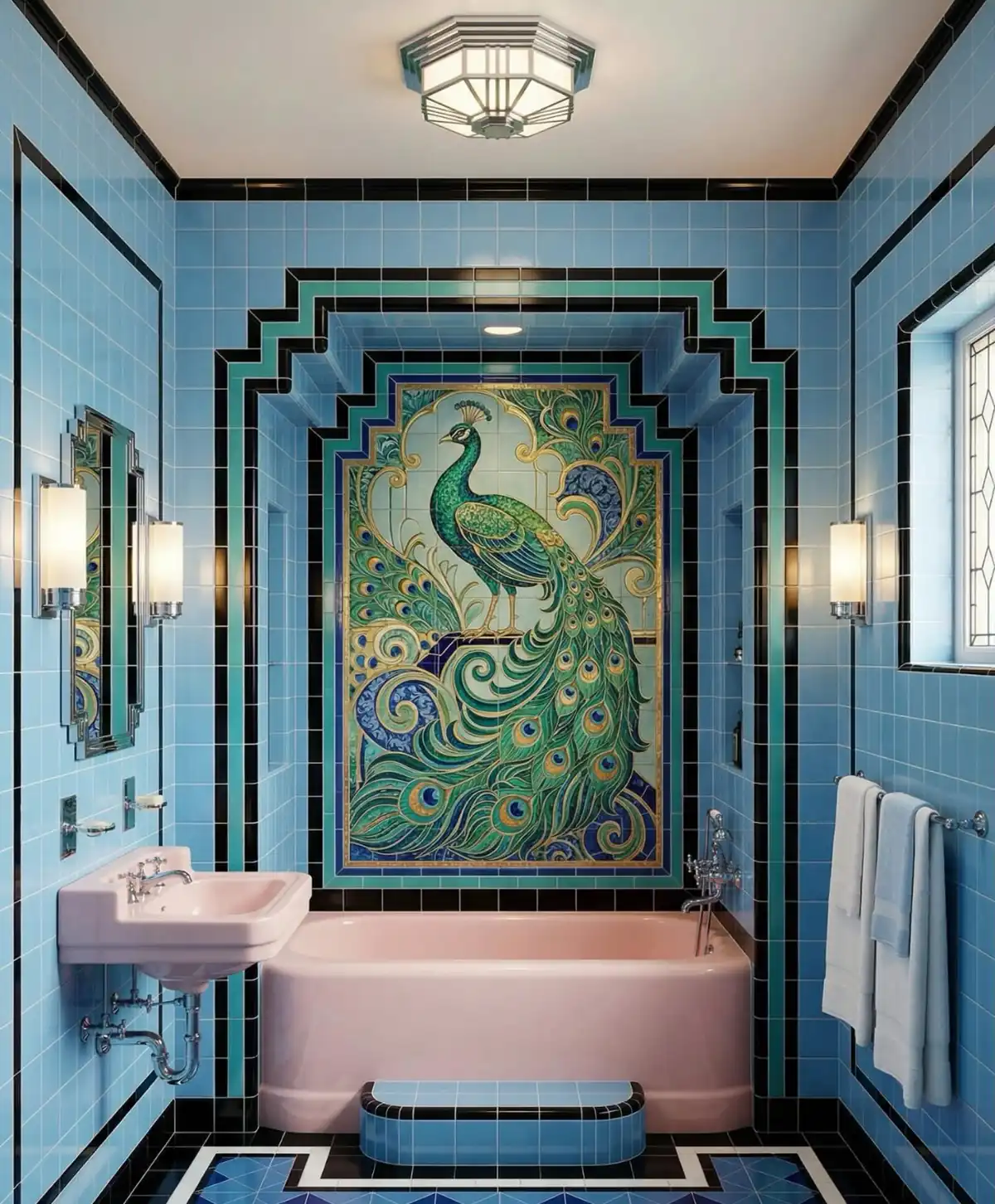
This blue Deco bathroom sits right on the border between the 20s group and this one, and it earns its place here for one reason: the colour statement hangs over the tub. A peacock in green, gold and deep blue spreads across the tile panel above a pale pink bath, blue tiles climb the walls with black and teal stepped borders, and even the sink is pink. In an owner bathroom the statement is tile. In a rental, that exact spot, the big flat rectangle over and around the bath, is where the shower curtain hangs. The curtain is the renter version of the peacock panel.
Hang the boldest thing you own there. A curtain is the largest single piece of fabric in most bathrooms, it sits at eye level, and it is the first thing seen from the door, so it should carry the era colour or pattern for the whole room: a Deco fan pattern, a 50s atomic print, a bold retro floral. Everything else can stay quiet, white towels, plain mat, clear bottles, because the curtain is doing the talking. This is also the brief hero buy of the article for a reason: a vintage-style shower curtain set with brass rings changes the biggest surface in the room for the price of a takeaway dinner for two.
Fit matters more than print. Hang the rod as high and as wide as the fittings allow so the curtain falls in a long flat sheet like the panel in the photo, and choose a fabric curtain with a plain liner behind it rather than a thin plastic sheet, because fabric hangs in folds that read as decor while plastic reads as packaging. When the season or your taste changes, the statement swaps in ten minutes and the old curtain folds into a drawer.
Curtain rule: the shower curtain is the largest flat surface in a rental bathroom, at eye level, seen first from the door. It carries the era. Everything else can stay quiet.
70s & Mid-Century Vintage Bathroom Ideas
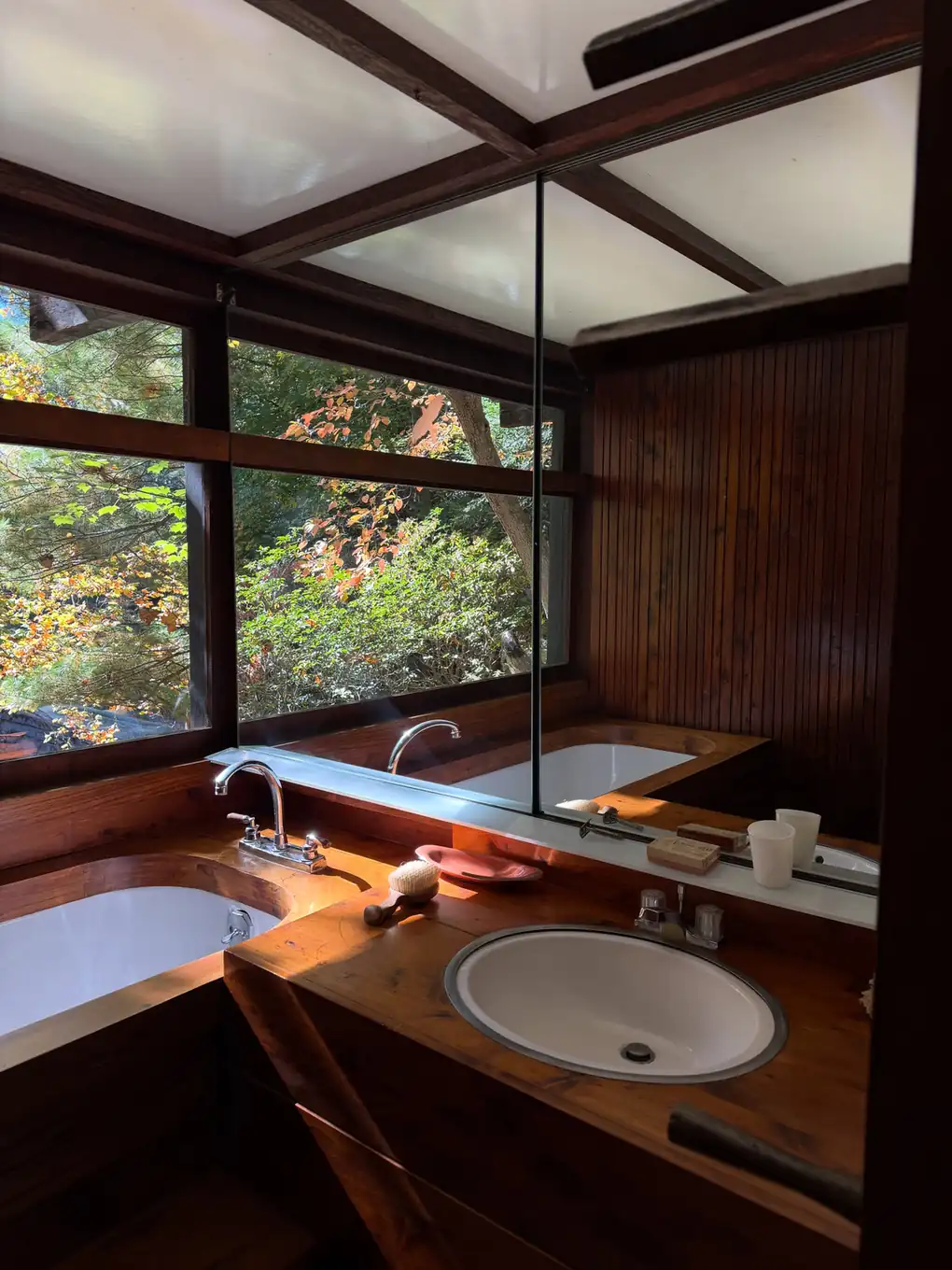
After the hard shine of the Deco and 50s rooms, the 70s and mid-century bathrooms went warm. This one is wrapped in dark wood: a wooden vanity counter with an oval sink set into it, a wall of mirrors, slatted wood panels, and windows that look straight onto trees. It is a built room, not a styled one, so read it for its materials list rather than its layout: wood, warm light, simple shapes, nothing chrome-plated that could be wood instead.
The rental translation is a materials swap, not a renovation. Wood enters a rental bathroom on a stool, a tray, a bath caddy, a woven basket and a bath mat with a warm pattern, all freestanding, all cheap secondhand. The 70s also brought the boldest tile patterns of any era in this article, and one strip of patterned peel-and-stick can borrow that too. The mid-century half of the group adds the curves: rounded mirrors, an oval shape repeated, and the long low line of a double vanity.
Warmth is the test for every object in this group. If a piece would look at home in the wood room in the photo, by colour or by material, it belongs. If it is white plastic, it is probably the thing making your bathroom feel modern in the wrong way. Swap the plastic first; it is the cheapest era change in the whole article.
Group 3: Warmth and curves
Wood: stool, caddy, basket and tray, all freestanding
Pattern: one bold tile moment, never four walls of it
Curves: a round mirror, an oval shape, pairs in balance
7. Bring Warm Wood and a Wooden Stool In
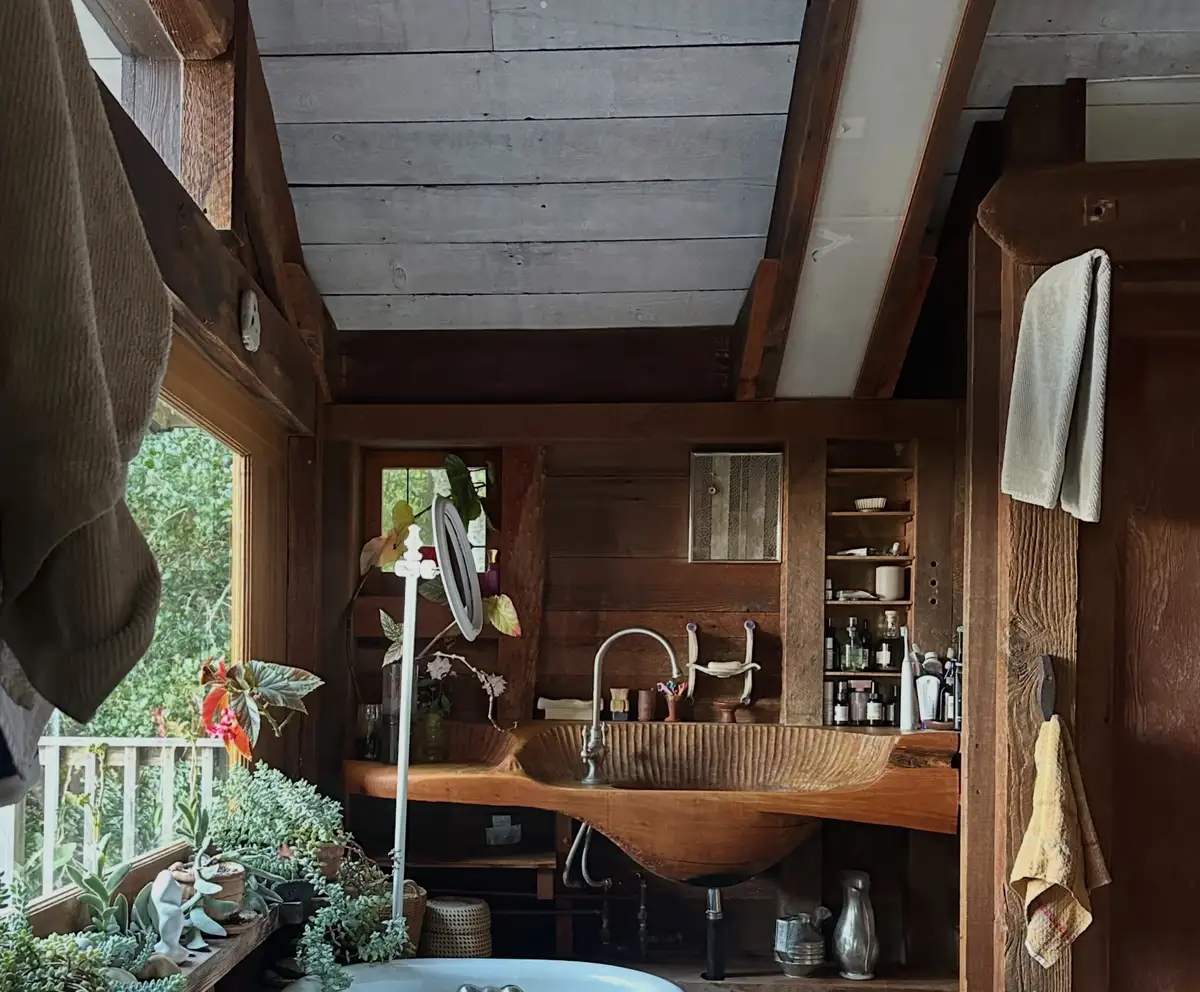
Wood climbs every wall of this rustic bathroom: a carved wooden sink bowl set into a thick wooden counter, open shelves holding bottles and jars, a freestanding oval mirror on a stand, plants crowding the windowsill, and towels hanging from simple hooks on a wooden post. It is a hand-built room and no renter will copy it whole, but it shows what wood does to the smallest, coldest room in a home. It makes it feel like a cabin instead of a clinic, and that feeling is available in much smaller doses.
Start with the stool. A small wooden stool beside the tub or the sink is the hardest-working object in this group: a landing spot for a towel and a book during a bath, a stand for a plant the rest of the week, a step for the high shelf on Sundays. Beside it, a wooden bath caddy across the tub and a woven basket for spare towels or loo rolls repeat the material until it reads as the scheme. Three wooden things, none of them fixed, and the room has its 70s warmth.
Secondhand is the honest source here. Wooden stools, trays and baskets are exactly the things charity shops and market stalls are full of, usually for less than one new plastic organiser. Check a stool for wobble and a basket for a sound base, give both a wipe and a dry day in the sun, and they are ready. Keep wood out of standing water, on a mat or the stool rather than the wet floor, and it will outlast the tenancy and come with you to the next bathroom.
Wood, in threes
1. A wooden stool beside the tub or sink, the landing spot
2. A bath caddy across the tub, holding the book and the candle
3. A woven basket for spare towels or loo rolls
8. Run One Bold Patterned Tile Moment
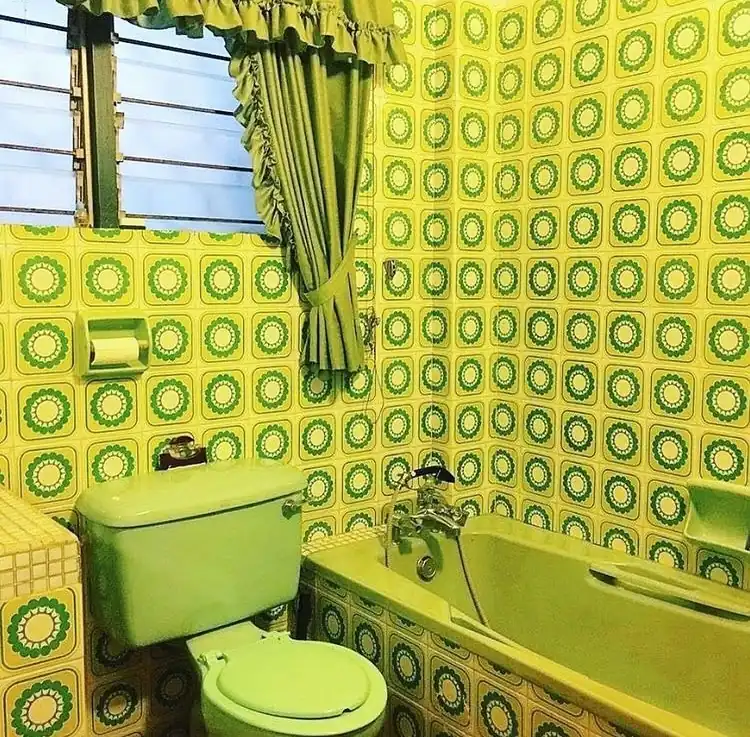
Green on green on green: this 1970s bathroom matches lime green fixtures, a green toilet and a green bath, to walls of yellow-green tiles printed with bold floral circles, finished with a ruffled green curtain. It is the loudest room in the article and it knows it. The pattern covers every wall, which is exactly what a renter should not copy. What is worth copying is the courage: one strong repeat pattern, chosen on purpose, in a room that was not afraid of it.
The rental dose is one moment, not four walls. A strip of bold patterned peel-and-stick tiles behind the sink, a patterned floor run from the tile guide method, or one wall of a small loo done in a removable patterned panel: pick the surface your eye hits from the door and give it the pattern, then stop. Cement-look geometrics, floral circles and starbursts all read 70s; keep the rest of the room plain so the moment stays a moment.
Colour discipline is what keeps bold from becoming busy. This photo works because every green is a cousin of every other green. Choose your pattern first, then pull your towels, mat and curtain from colours inside it, never from colours that merely go with it. If the pattern has three greens and a yellow, your textiles live in those four shades only. One patterned surface, a strict palette, and a small rental bathroom gets the 70s energy without the 70s overwhelm.
70s palette: lime, leaf and butter yellow with one deep green. Pull every towel and mat colour from inside the pattern, never from colours that merely go with it.
9. Choose the Curved Double Vanity Look
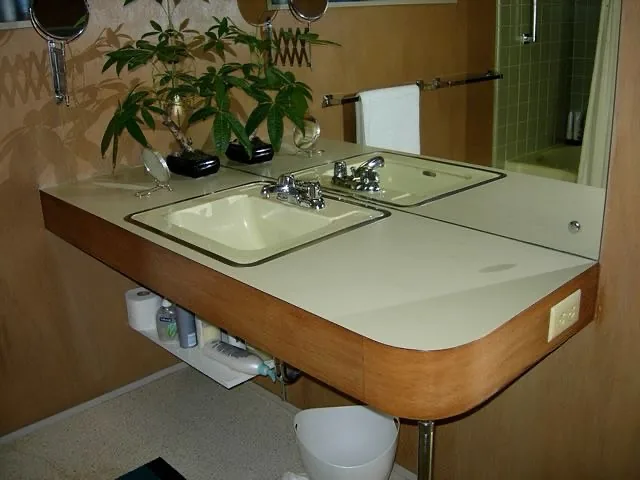
This mid-century double vanity is all one long curve: a cream counter sweeping out in a rounded front, two sinks set into it, chrome taps, wood-grain side panels, and a wide mirror running the length of it. Underneath sits a simple white bin, and a plant softens the corner. Rentals rarely offer two sinks, so the copyable part is not the plumbing. It is the shape language: long, low and curved, with the mirror doing the widening and the wood grain warming the white.
Borrow the curve in the pieces you control. A rounded or oval mirror is the biggest one: it breaks the straight lines of a tiled rental bathroom the way the counter curve does here, and a mirror with a thin wood or brass frame borrows the warm edge too. Below it, line the counter objects along a gentle arc rather than a straight row, a tray at one end, the soap dish at the other, and keep the middle clear so the counter reads as one long surface.
The double idea still helps a single-sink renter. Two matching sets, two towels folded the same way, two tumblers, a plant at the far end like the one in the photo, gives a plain vanity the balanced look of a designed pair. Symmetry is free, it needs no permission, and it is the quiet trick behind most mid-century bathrooms: nothing fancy, everything in its pair, the whole room calm. If your counter has room, a small stool tucked under it, like the bin corner here kept simple, finishes the long low line.
Curve logic
Rental bathrooms are all straight lines and right angles. One big curve, a round or oval mirror, changes the room the way the curved vanity front changed the originals: quietly, and everywhere you look.
Moody and Grandmillennial Vintage Bathroom Ideas
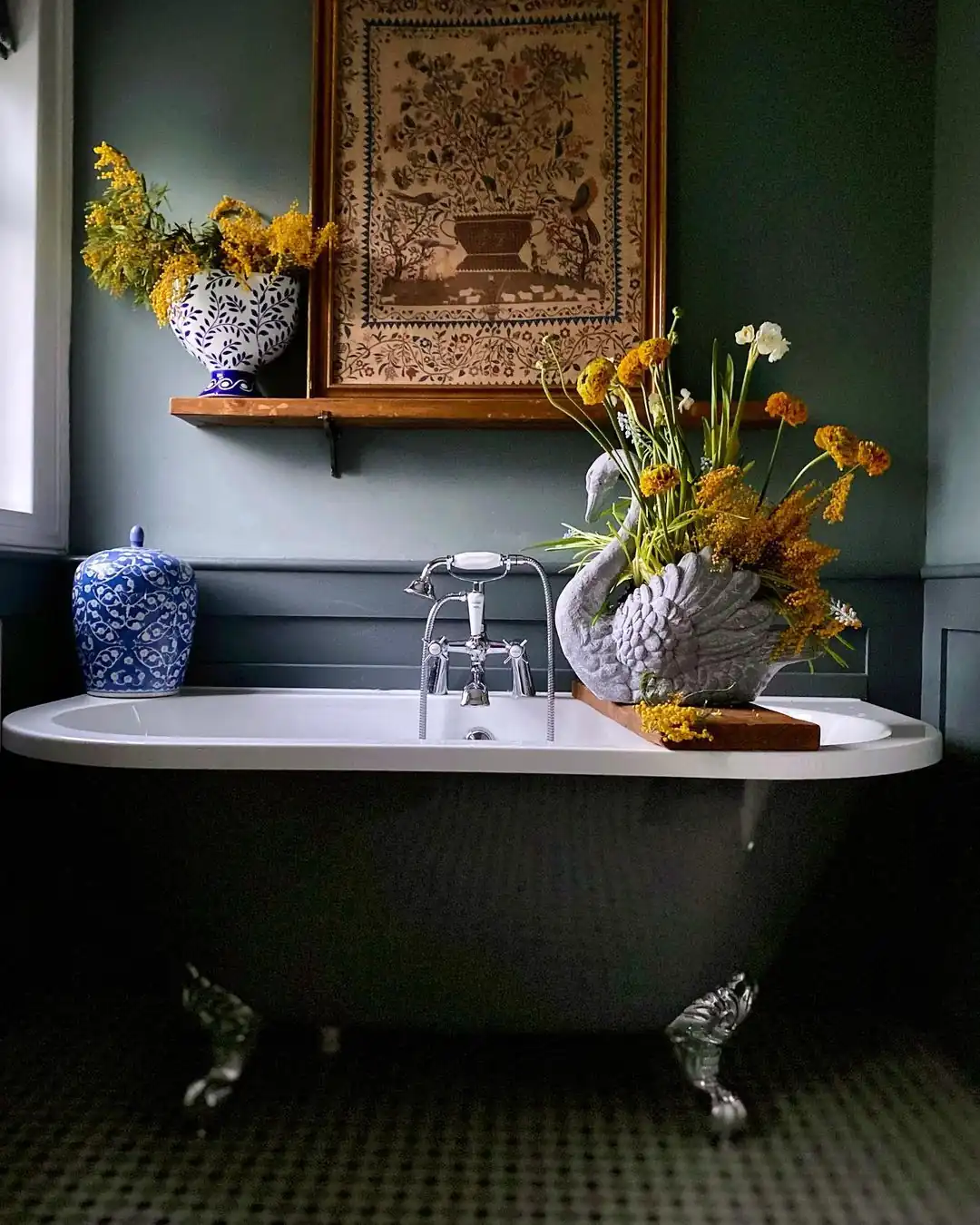
This clawfoot tub is where the moody half of the group lives: a black tub with silver feet against a deep green wall, panelled wainscot below, blue-and-white porcelain on the rim, a swan-shaped planter full of yellow flowers, and a big framed print on a wooden shelf above. It is an owner bathroom with painted walls, and the honest renter lesson is that almost none of the mood comes from the paint. It comes from dark textiles, low light, porcelain with a pattern, and objects that look inherited rather than bought in a set.
The grandmillennial half is the same instinct in a lighter key: floral patterns, pleats, blue and white, needlepoint-style details, the look of a loved grandmother house kept on purpose. Where moody goes dark and candlelit, grandmillennial goes patterned and bright, and a rental can do either without touching a wall, because both styles live in fabric, porcelain and small furniture. This group builds a moody corner, layers the pattern, and finishes with wall texture that peels off again.
A word of comfort for renters with the standard white box bathroom: these are the two best styles for you. Both were built by people decorating rooms they could not rebuild, layering textiles and objects over plain bones. That is not a compromise version of the styles. That is the styles, working as designed.
Group 4: Layered, not built
Moody: dark towels, low light, one pale contrast kept
Pattern: floral fabric, blue and white, wicker and lace
Walls: period texture from panels that peel off again
10. Build a Moody Corner With Dark Towels and Candlelight
Back to the candlelit sink, this time for its mood rather than its styling. In the evening light the room runs on glow: two candles on the sink rim, a candelabra sconce reflected in the mirror, a shaded wall light, dark patterned curtains at the edge of the frame, and a cream towel on a brass bar. The walls of this bathroom are pale. Every bit of the mood arrives with the light level and the textiles, which is the most hopeful fact in this whole group for a renter.
Build the corner where you already stand longest: the sink. Swap the towel set for a dark one, deep green, charcoal, burgundy or black, and hang a second dark layer, a hand towel or a dark bath mat below, so the darkness has depth. Put a candle in a glass holder on the rim or the stool for the evening, or a flameless candle on a timer if flames near towels worry you, and let the main light stay off during a bath. Low light is the whole trick; the room does the rest.
Keep one pale thing in the corner so the dark reads as chosen: the cream towel in the photo, a white soap bar on a dark dish, the porcelain sink itself. Moody is a contrast, not a blackout. And keep candles honest, in glass, away from the curtain and the towel ends, on the tray or the stool rather than the rim if your sink is narrow. The corner takes one evening to build and about a minute to reset each night, which is why it survives longer than most decorating ideas.
Moody rule: mood is a light level and a towel colour, not a paint colour. Dark textiles, a candle in glass, the main light off. The pale walls you already have are fine.
11. Layer Grandmillennial Pattern: Floral, Blue and White
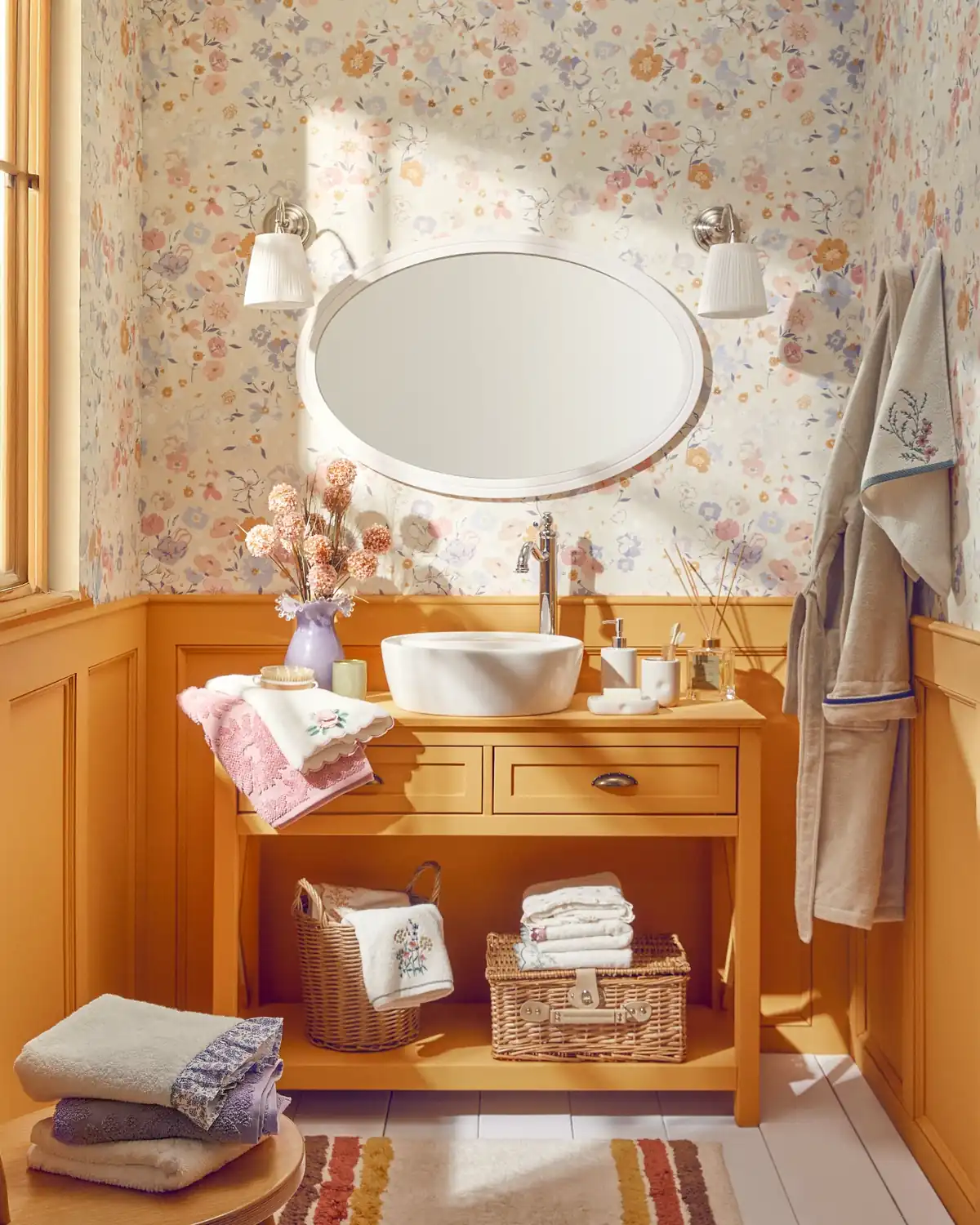
Floral climbs the walls of this bathroom in pink, blue and peach, and everything below it joins in: a honey wood vanity with a white bowl sink, an oval mirror lit by two sconces with little pleated shades, wicker baskets under the counter holding embroidered towels, lace-edged hand towels folded over the counter edge, and a striped rug on the floor. It looks inherited, layered by a family over years, and nearly all of that layering is fabric, baskets and one mirror, which means nearly all of it is renter work.
Start with the floral where fabric can carry it: the shower curtain. A ditsy floral curtain is the grandmillennial wallpaper of a rental, big, patterned and gone in minutes at move-out. Add blue and white next, the style anchor colours: a blue-and-white soap dish, a ginger-jar style pot holding brushes or a plant, a striped towel in the same blue. The clawfoot room earlier in this group runs the same porcelain note against its green wall, which is why blue and white works in both the moody and the bright version of this look.
Finish with the small soft details the style is known for: a pleated or scalloped edge somewhere, lace-trim hand towels, an embroidered guest towel folded where it can be seen, a wicker basket for the spare rolls. None of it needs to match; it needs to rhyme, floral with floral, blue with blue. Secondhand shops are the natural source, because the style literally celebrates objects with a past. One warning: pattern has a budget in a small room. Curtain, towels and one rug is a full hand; a fourth pattern is where collected turns into cluttered.
Grandmillennial layers
1. Floral first, on the shower curtain, the rental wallpaper
2. Blue and white second, in porcelain and striped towels
3. Soft details last: pleats, lace edges, one wicker basket
12. Give Walls Period Texture With Beadboard-Look Panels
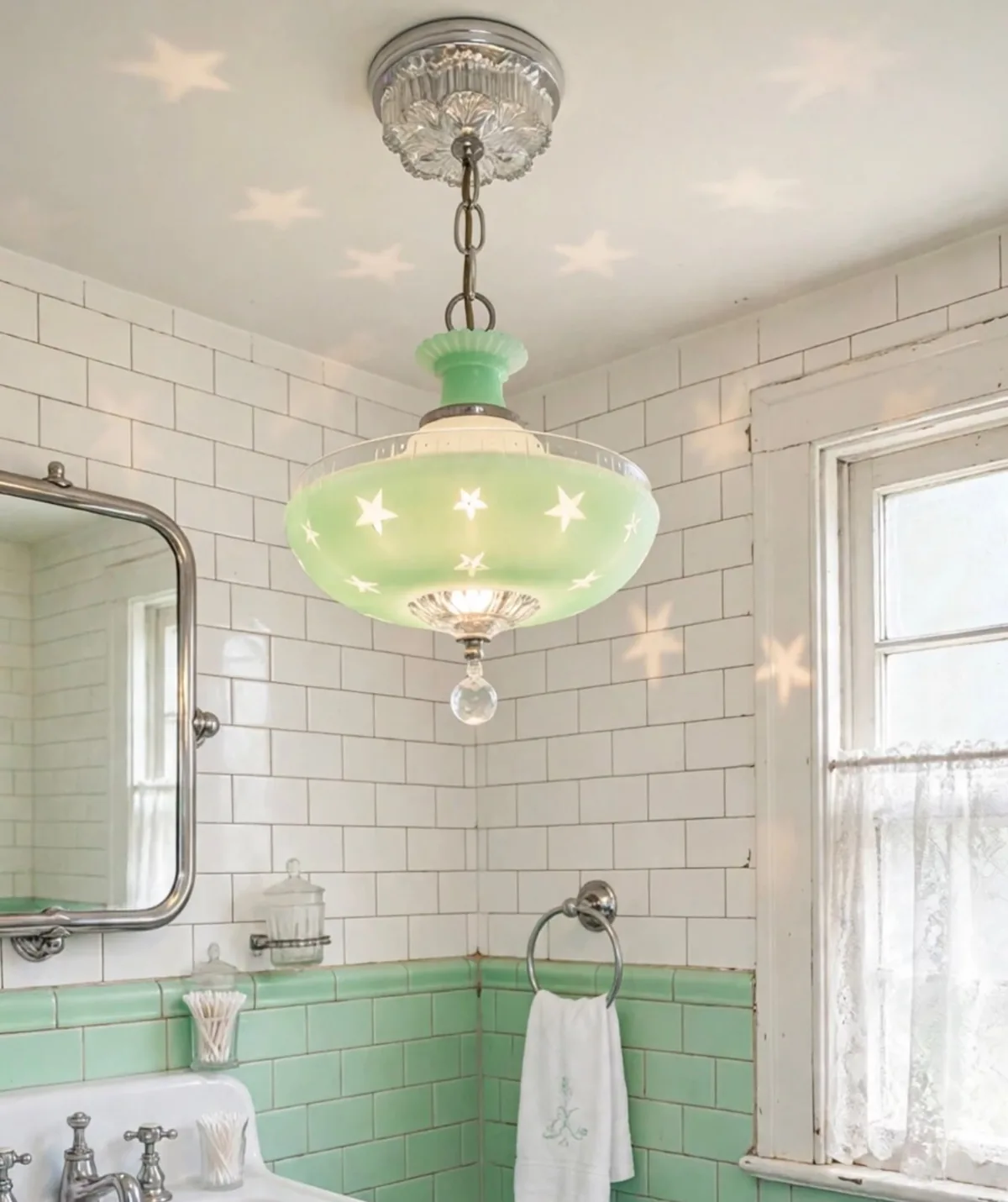
Half of this bathroom corner is texture doing quiet work: white subway tile above, mint green tile below in a wainscot line, a lace curtain at the window, and a green glass pendant with star cutouts throwing soft shapes on the ceiling. The lower wall reads as panelling even where it is tile, because the eye loves a horizontal line with a different material below it. That line, the chair-rail line, is one of the oldest period details there is, and it is the part worth borrowing.
The renter version comes as beadboard-look panels made to peel and stick, or as a paint-free cheat: a wainscot-height run of peel-and-stick tile in a second colour, the way this corner pairs mint below with white above. Either way the room gains a lower half with texture and an upper half left plain, which is most of what period bathrooms are doing. Panels and tile sheets cut with scissors, stick over the existing surface, and peel away at move-out; the peel and stick tile guide method for floors is the same habit of clean, dry, measured work.
Place the line with care. Wainscot height is roughly the lower third of the wall, and in a bathroom it should clear the splash zone behind the sink or meet the tile that is already there. If your rental already has a tile border or a change of material, echo it rather than adding a second line at a different height, because two competing lines look like a mistake while one looks like architecture. Finish with the small soft things from the photo: a lace or cafe curtain at the window and one coloured glass note, a green soap dish or bottle, to sit against the mint.
Wainscot logic
Period bathrooms draw a line at the lower third of the wall and change material below it. A peel-and-stick panel or tile run draws the same line, and one line reads as architecture while two read as a mistake.
Renter-Safe Vintage Bathroom Swaps (No Renovation Needed)
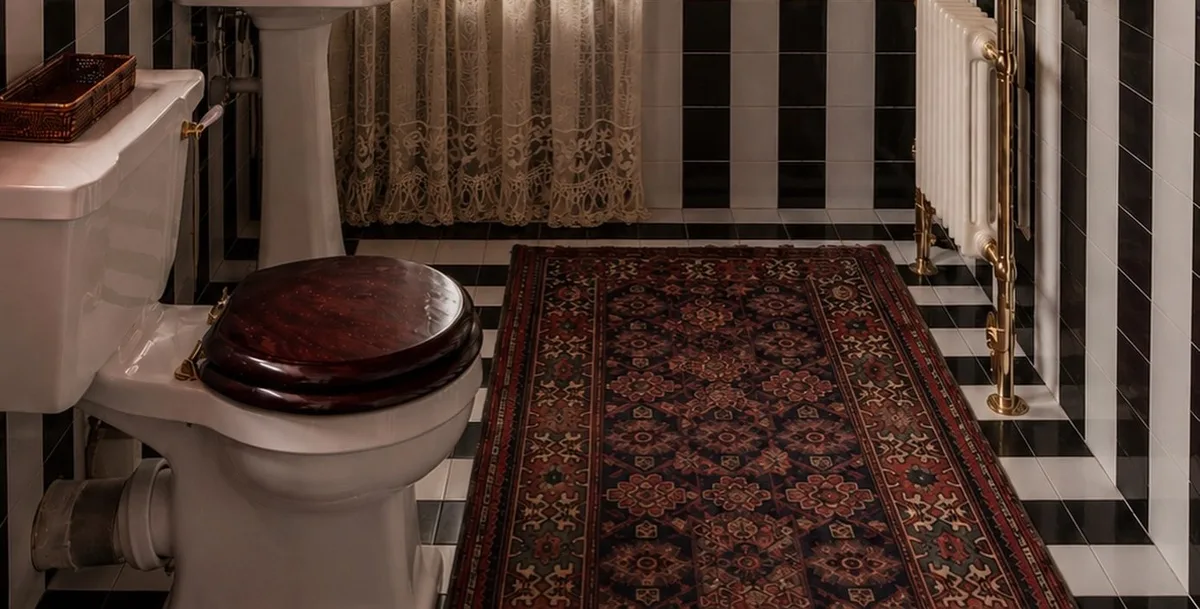
Everything in this group is a swap, and this floor shows why swaps work. A black-and-white checkerboard with a deep red patterned runner laid over it, a dark wooden toilet seat, brass rails on the radiator, and the hem of a lace curtain: the floor was tiled by an owner, but the warmth in the frame is the rug, the seat and the textiles, the three layers a renter can change in an afternoon. The most vintage square metre in this article might be this one, and most of it just lies there, un-fixed.
The three swaps are ordered by speed. The shower curtain, rings and bath mat change the room in one afternoon and carry the brief product focus with them. The hardware swap, knobs and hooks to aged brass, takes a screwdriver and a labelled bag. The textiles, Turkish towels and a small rug, take a wash and a fold. None of them needs permission, a plumber or a repair at the end, and together they can move a plain bathroom a full era in a weekend.
Keep the evidence as you go. Original knobs and hooks go in a labelled bag in a safe drawer the day they come off, screws with them, so move-out is a swap back rather than an argument. Photograph each fitting before you change it if your memory for which knob lived where is anything like most people. The swaps in this group are the article promise kept at its smallest: vintage character, zero holes.
Group 5: The swap list
Afternoon: curtain, rings and bath mat, changed as one set
Screwdriver: knobs and hooks to aged brass, originals bagged
Laundry: Turkish towels and a small washable rug
13. Swap the Shower Curtain, Rings and Bath Mat in One Afternoon
The runner in this photo is doing the same job a bath mat does, only better dressed: a deep red patterned rug over a checkerboard floor warms the whole lower half of the room and gives bare feet a soft landing. Treat the tub zone as one outfit and change it together: curtain, rings and mat, chosen as a set. When the three arrive in the same colours, the end of the bathroom where most of the water and most of the looking happens becomes the era statement, and the rest of the room can stay exactly as the landlord left it.
This is where the article single buy lives: a vintage-style shower curtain set with brass rings. The brass rings matter more than they sound. They are the metal note from the Deco group, repeated twelve times at eye level, and they turn a curtain change into a hardware change for free. Choose the curtain for your era, Deco fan, 50s floral, 70s stripe, grandmillennial ditsy print, and let the mat pull one colour out of it, the way the runner here pulls the reds out of the room around it.
Do the swap in the right order and it takes an afternoon at most: curtain down, rings swapped, new curtain up, old mat out, new mat down, towels changed to match. Keep the landlord curtain, if there was one, washed and folded in a cupboard, because it goes back up on the last day. Washable mats and curtains only, since this zone is washed more than any other fabric in the home, and a vintage look that cannot survive the laundry is a photograph, not a bathroom.
The one-afternoon swap
1. Curtain down, rings swapped to brass, new curtain up
2. Old mat out, new mat down in a colour pulled from the curtain
3. Towels changed to match, landlord curtain washed and stored
14. Swap Knobs and Hooks to Aged Brass, Keep the Originals Bagged
Look at the vanity in this photo again, at hand height: three round brass knobs down the drawers, warm and slightly aged, doing more for the room period feel than the big mirror above them. Beside the sink there is even a small gold-framed painting, because once the metal is right the eye starts forgiving everything else. Knobs and hooks are the smallest hardware in a bathroom and the most touched, which is why swapping them changes the feel of the room out of all proportion to their size.
The swap itself is a screwdriver job. Vanity knobs unscrew from inside the drawer, towel hooks and robe hooks usually turn on one or two screws, and aged brass replacements are sold everywhere in the same standard sizes. Measure the screw spacing on hooks before buying, keep every original screw with its original knob, and store the whole set in one labelled bag per room. If a hook is sealed or a knob is glued, leave it: the rule of this group is that everything must swap back in minutes, and a fitting that fights you is a fitting to decorate around instead.
Finish the metal story with the things that need no screws at all: a brass towel ring or rail that hangs over a door or hooks onto the existing rail, a brass tray on the counter, brass curtain rings from the swap before this one. Three or four brass notes, some swapped, some simply placed, and chrome-era fittings stop dominating the room. On the last day of the lease the bag comes out, the originals go back in the order they came off, and the bathroom hands back exactly as found.
Aged brass palette: warm gold, old bronze, deep brown and the cream of the porcelain it sits on. Aged, not shiny, is what reads vintage.
15. Layer Vintage Textiles: Turkish Towels and a Small Rug
In the wood bathroom from group three, look past the architecture to the soft layer: a plain white towel hangs folded at the counter, a woven mat sits underfoot in the cabin photo from that group, and the textiles are the only things in either room that a renter could have carried in under one arm. That is the closing lesson of the swaps. After the curtain and the knobs, the fastest vintage layer left is the one you can fold: towels with texture, and a rug where rugs are not expected.
Turkish towels are the era textile that still earns its keep: flat woven, fringed, quick to dry, and patterned in stripes that read vintage in any of the eras in this article. Hang a set where they will be seen, bath towel over the rail, hand towel by the sink, and fold a spare stack on the stool from group three so the texture shows in three places. Thin towels also solve a rental problem nobody mentions: they dry fast in a bathroom with a weak fan, so the room smells fresher and the towels last longer between washes.
The small rug is the last move. A runner or a small patterned rug in front of the sink or along the tub, like the one on the checkerboard floor in this group header, warms the floor, catches the drips and gives the room its collected, lived-in note. Choose washable, low pile, and a grip under it, since bathroom floors are wet by definition; our flooring guide covers rug grip and floor protection for the whole home. Roll it up on cleaning day, shake it outside, and the most vintage layer in the room is also the easiest to keep honest.
Textile logic
Towels and a rug are the only decor layer you can change in a wash cycle. Texture in three places, towel, hand towel and folded stack, and the room reads collected instead of fitted.
5 Mistakes That Ruin a Vintage Bathroom Look
1. Mixing every era at once. A Deco mirror, a 70s stool and a grandmillennial curtain in one small room do not average out into vintage; they read as a junk shop. Pick one era per room, two at most where they share colours, and let the rest wait for another home.
2. Painting or papering what you cannot undo. The vintage look tempts people into permanent moves, coloured grout, painted tile, glued panels, and every one of them is a deposit problem. If it cannot peel, unhook or lift away, it is not a renter idea, however pretty the photo was.
3. Buying modern white plastic into a vintage room. A white plastic bin, caddy or soap dish fights every era in this article at once. The swap costs very little: wood, metal, porcelain or woven versions of the same objects, most of them cheaper secondhand than the plastic was new.
4. Forgetting the light temperature. Cool white bulbs make Deco look like a clinic and moody look like a car park. Warm white bulbs everywhere, and the lowest light you can shave by, are half the vintage effect for the price of a bulb swap you can reverse in minutes.
5. Losing the originals. Swapped knobs, hooks and the landlord shower curtain have a way of vanishing by move-out day. Bag them, label the bag, and store it somewhere boring and safe the day each swap happens, not the week you leave.
FAQs About Vintage Bathroom Ideas
How can I get a vintage bathroom look in a rental without renovating?
Work in the order this article uses: pattern and colour first, through peel-and-stick floor tile, a bold shower curtain and matching textiles; then the small metal and porcelain pieces, brass dishes, a framed mirror, swap-in knobs; then light, warm bulbs and a candle for the evening. Nothing is tiled over permanently, plumbed or painted, and every piece either peels off, unhooks or packs into a box on moving day.
Which era is easiest for a small plain bathroom?
The 1920s look, because it runs on pattern and contrast rather than on furniture. A checkerboard floor, black-framed mirror and prints, and brass-toned small pieces turn the standard white box into the best starting point of any era here: white tile and chrome are already period neighbours. The 1950s look is a close second if the room already has any colour in its tiles or tub to build a duet around.
Can peel-and-stick tile really carry the checkerboard idea?
Yes, and the floor is where it works best, because bathroom floors are small, mostly flat, and seen from directly above, which is where the checkerboard pattern does its work. Our peel and stick tile guide covers measuring, cutting around a toilet base and lifting the tiles cleanly at the end of a lease. Keep spare tiles from the same batch for repairs, and keep the floor dry for the first day while the adhesive settles.
What if my bathroom has no window and no natural light?
Lean into the moody group. A windowless bathroom takes dark towels, low warm light and candlelight better than any other room, because there is no daylight fighting the effect. Use warm white bulbs, a flameless candle on a timer for the glow without the worry, and keep the porcelain and the mirror glass spotless, since in low light the shine of clean surfaces does the work windows do elsewhere.
Where do I find vintage pieces without spending much?
Secondhand first: charity shops, market stalls and house clearances are full of the exact stools, brass trays, porcelain dishes and wicker baskets these ideas use, usually for less than modern copies. Check anything electrical with care or skip it, wash textiles hot before their first use, and let one good find set the era rather than buying a roomful at once. Our budget decorating ideas orders small buys like these by impact when money needs pacing.
Will these swaps really all come back off at move-out?
Yes, that is the test every idea here was chosen by. Peel-and-stick lifts, hooks unhook, knobs unscrew back to the bagged originals, and textiles wash and pack. The wider version of the same promise, room by room, is the feel-like-yours guide, which runs the same no-damage rules across the whole home. Photograph the bathroom on the day you finish each swap and again on the day you reverse it, and the deposit conversation stays short.
Are vintage bathrooms back in style?
Yes. These vintage bathroom ideas are back in style in 2026, and the most copied looks are the 1920s checkerboard floor, the 1950s pink-and-mint pair and the warm 70s wood-and-curve mix. The trick is to borrow one era at a time and keep the rest of the room plain, so the room reads as classic rather than a museum set. A few old pieces, a brass tap and one patterned tile moment are enough to make the style feel current.
What did a 1930s bathroom look like?
A 1930s bathroom was usually black and white, with subway tile, a checkerboard or hexagonal floor, chrome taps and a pedestal sink with clean straight lines. Colour came from small things, a green or blue tile border, a coloured bath mat or a painted medicine cabinet, rather than from the fixtures. If you like that look, copy the black-and-white base and add one soft colour, exactly as the 1920s group in this article does.
One Last Thing
A plain rental bathroom is not a room without character; it is a room whose character has not been carried in yet. Pick your era, borrow its floor, its colour and its metal in the removable versions, and keep the originals bagged for the day it all swaps back. If you buy one thing from this whole article, make it the vintage-style shower curtain set with brass rings: it covers the largest surface in the room, it sets the era in one hanging, and the brass rings repeat the metal note at eye level twelve times over. Everything here peels, lifts or folds away, so the bathroom you hand back is the one you were given, and the one you soaked in was entirely yours.

Elora Vania here, founder and Senior Editor of Home Aure. With years of experience in interior styling and home decor, I created this site to bring thoughtful, practical design advice to real homes—helping you create spaces that feel warm, personal, and beautifully lived-in.