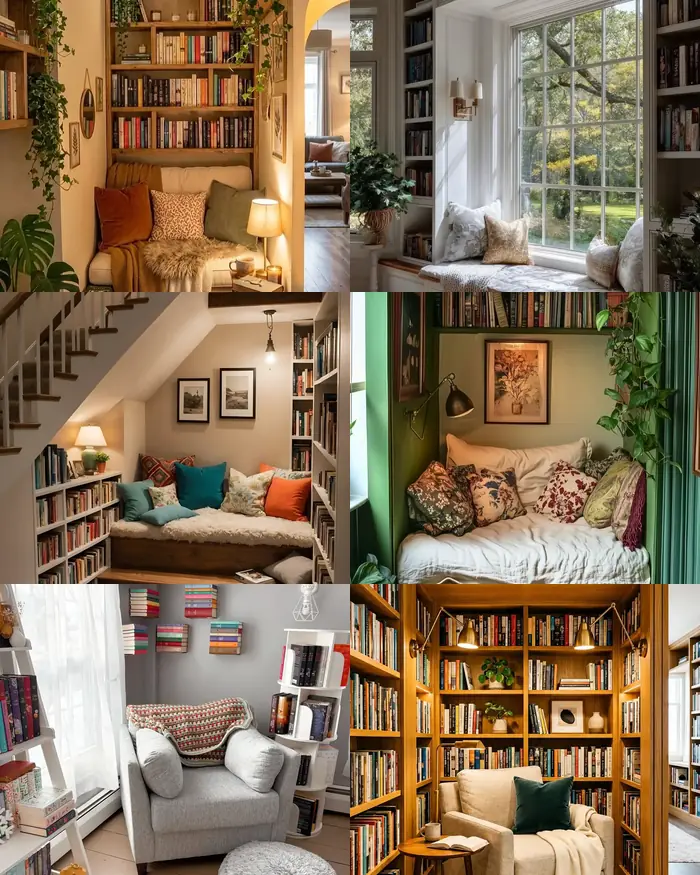
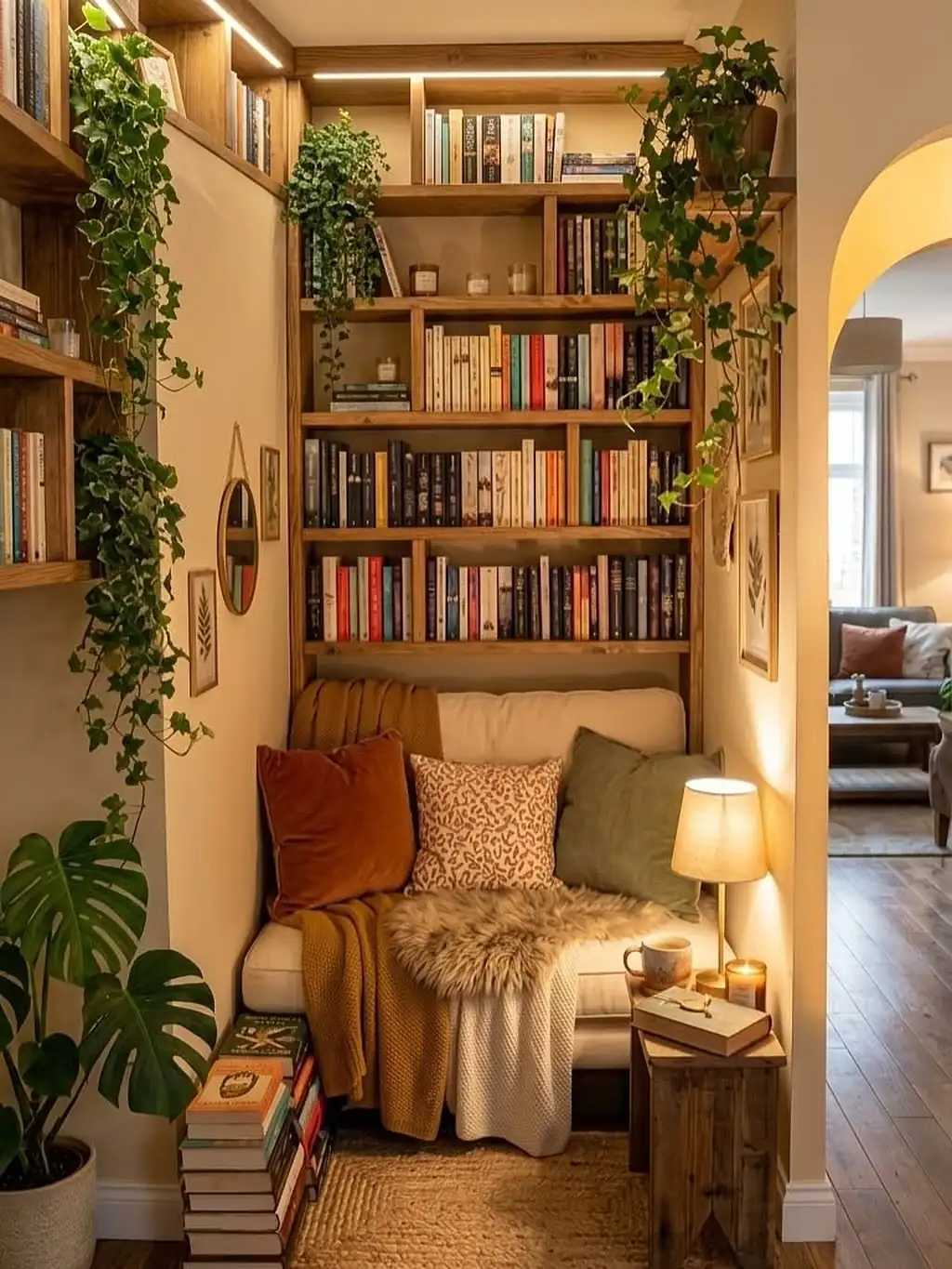
Every home has one corner that does nothing. It holds a laundry basket, or a plant that is slowly giving up, or nothing at all except dust and good light. That corner is where you can create a reading nook, if you know where to start. A nook is not a room and it is not furniture shopping on a grand scale: it is a seat you love, light you can read by, and one small surface for a book and a cup. Get those three right and almost any patch of floor starts behaving like the best seat in the house. The corner in the photo shows the full recipe in a space no wider than a sofa: shelves within reach, a daybed deep enough to curl up on, plants trailing overhead and a lamp glowing at shoulder height. This article walks through 15 small corner ideas, grouped so you can find your kind of space fast: classic corners first, then borrowed spaces like stairs and landings, then the styling details that turn a chair in a corner into a place you actually retreat to. Every version is renter friendly. Nothing here needs a drill, a built-in or a landlord’s signature, and most of it packs up in an afternoon when you move.
Table of Contents
- How to Create a Reading Nook: Five Rules Before You Claim a Corner
- 1. Create a Reading Nook Around Bookshelves and a Daybed
- 2. Create a Reading Nook Under the Stairs
- 3. Create a Reading Nook in the Tallest Window Seat
- 4. Float the Shelves and Keep the Floor Clear
- 5. Create a Reading Nook by Painting the Alcove Deep
- 6. Wrap an Alcove in Shelves on Three Sides
- 7. Turn the Stair Landing Into a Reading Pause
- 8. Create a Reading Nook With One Armchair, a Lamp and a Table
- 9. Go Dark and Built-In-Looking With Banquette Seating
- 10. Create a Reading Nook With the Light on the Wall
- 11. Line a Hallway Bench With Storage Baskets
- 12. Create a Reading Nook With a Green Library Wall
- 13. Create a Reading Nook in a Rustic Window Bay
- 14. Curve a Bench Beneath the Staircase
- 15. Stretch a Banquette Under an Arched Window
- 5 Reading Nook Mistakes That Make a Reading Nook Go Unused
- FAQs About How to Create a Reading Nook
How to Create a Reading Nook: Five Rules Before You Claim a Corner
Rule one: light decides the corner, not the furniture. A nook lives or dies by its light. Daylight from the side is best for daytime reading, and a warm lamp at shoulder height takes over after dark. If a corner has neither and cannot borrow either, it is a storage corner, not a reading corner, however good the chair looks in it.
Rule two: the seat must fit the reader. Sit in the chair the way you actually read: legs up, sideways, curled. A beautiful chair you perch on will host exactly three reading sessions before the sofa wins. Depth matters more than style, and a footrest, pouf or the corner of a daybed counts as part of the seat.
Rule three: one surface within arm’s reach. A book, a cup, glasses, a phone charger. If you have to get up for any of them, the nook leaks. A stool, a crate, a stack of big books or a narrow side table all qualify; it does not need to match anything.
Rule four: softness comes in layers. One cushion is furniture. A cushion, a throw and something soft underfoot is a nook. Layers are also what make a borrowed corner read as a separate place instead of a chair that drifted.
Rule five: keep it out of the walkway. A nook should sit beside the traffic of the home, not in it. Corners, alcoves, landings and the ends of rooms work because people pass by them, not through them. Our wider sofa corner decor ideas make the same point for living rooms: the dead corner is the opportunity, the through-route is not.
Corner Nooks
1. Create a Reading Nook Around Bookshelves and a Daybed
Start with the classic, because it works every time: two walls of shelves meeting in a corner, and a daybed or deep bench tucked under them. The photo’s version is the one people save and dream about, and the secret is how little floor it takes. The seat is the width of a single bed and the depth of a bookshelf-lined alcove, yet it holds a reader, a pile of cushions, a lamp and more books than most of us will read this year.
The renter’s version swaps the built-ins for two freestanding bookcases pushed into the corner at right angles. Leave a low gap between them for the seat: a daybed if the corner allows, a bench with a thick cushion if it does not, or two floor cushions on a small rug for the smallest rooms. The shelves do double duty here. They store the books, and they make the walls of the nook, which is why this seat feels like a room inside the room.
Light it from inside the corner. A small table lamp on the shelf beside the seat, like the one glowing in the photo, keeps the light where the book is and leaves the rest of the room calm. Trailing plants on the top shelf are the finishing move: they soften the hard corner where the shelves meet, and they tell everyone who walks past that this spot is alive and claimed.
Sit in a few corners before you commit to one, book in hand, at the hour you usually read. The right corner announces itself: your shoulders drop, the light lands on the page, and the room’s noise feels one step further away. Trust that ten-minute test over any photograph, including the lovely one above.
The corner recipe, in order
1. Two bookcases at right angles, tops level.
2. Seat in the gap: daybed, bench or floor cushions.
3. Lamp on the shelf at shoulder height.
4. One trailing plant where the shelves meet.
2. Create a Reading Nook Under the Stairs
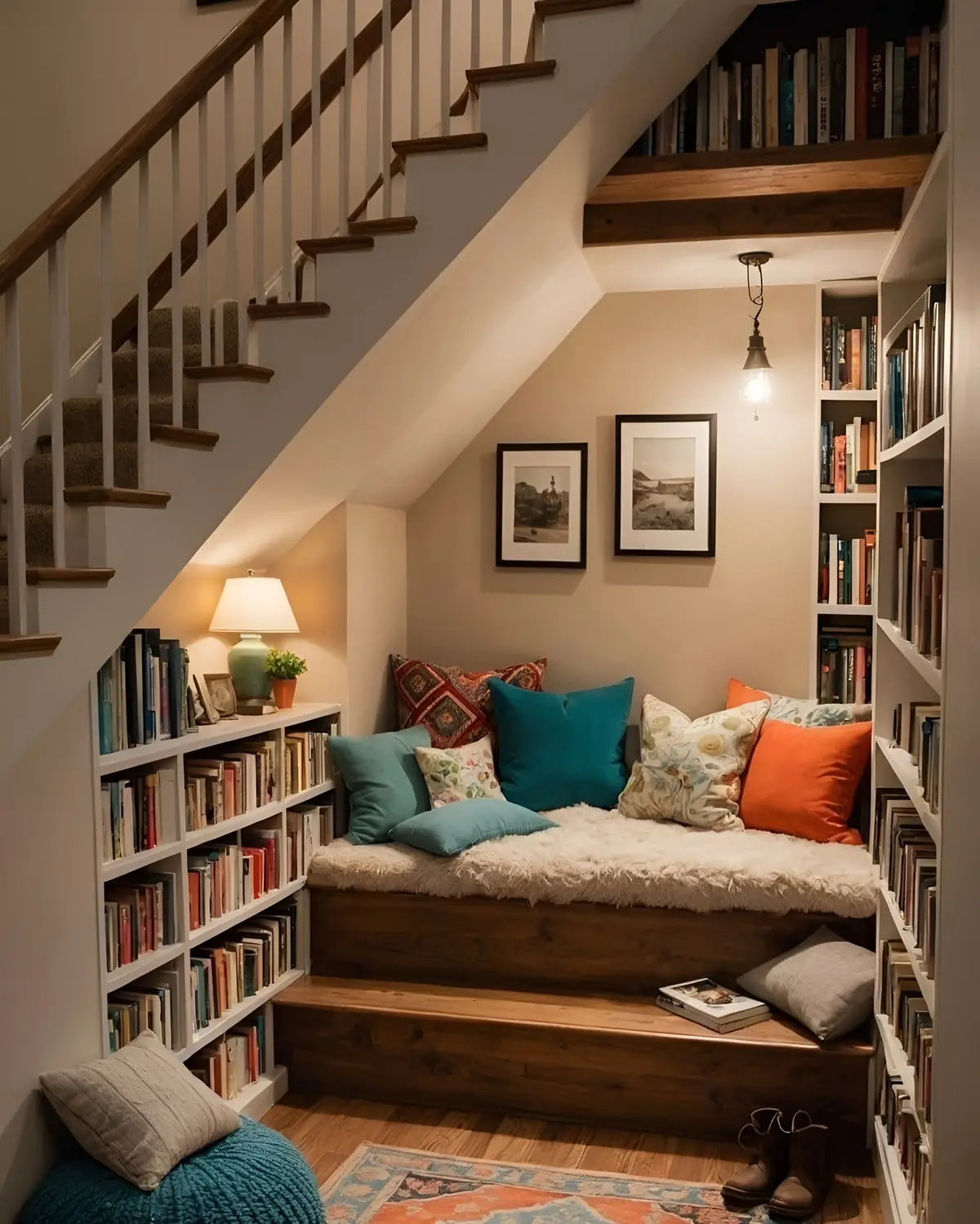
The space under a staircase is the most wasted square metre in most houses, and this photo shows what it wants to be: a raised daybed fitted into the slope, cushions in a cheerful muddle of colours, low shelves running along the wall and just enough room to stretch out with a long book. The slope that makes the space useless for standing makes it right for lying down.
Renters cannot build the platform, but they rarely need to. A low futon, a single mattress on a pallet base, or a deep bench cushion laid on storage crates copies the shape honestly. The crates earn their place twice: they lift the seat to a comfortable height and they swallow blankets, board games and the books that have not earned shelf space yet.
Two honest warnings from everyone who has done this. First, dust drifts down stairs, so pick fabrics you can shake out and wash. Second, the light under stairs is borrowed light at best, so plan a lamp from the start: a clip light on the shelf edge or a small plug-in wall light on an adhesive mount. Do those two things and the dead space under the stairs becomes the seat guests ask about.
Measure the slope before you buy anything for it. The useful part of an under-stairs space is the part where a lying reader’s knees and book clear the angle, and that is usually a shorter stretch than the staircase suggests. Put the pillows at the high end and your feet toward the slope, and even a modest triangular space reads as generous.
Under-stairs checklist
Seat raised on crates or a pallet ✓ washable fabrics ✓ a lamp planned before the first book ✓ the slope used for pillows, not headroom.
3. Create a Reading Nook in the Tallest Window Seat

A wide window with shelves on both sides is a nook that has already been designed; it only needs its seat. This one pairs a deep cushioned bench with tall bookcases that frame the glass like a proscenium, and the effect is part library, part lookout. If your home has a bay or a wide window with wall space flanking it, this is the layout to copy first.
Build the seat from what you have. A low storage bench, two sturdy crates with a board across them, or a hope chest all become a window seat under one long cushion or a folded duvet in a washable cover. Flanking shelves can be freestanding cases, and they do not need to match the window or each other as long as their heights are close. The small round table in the photo is doing quiet, vital work: a window seat without a surface becomes a place you sit once, photograph and abandon.
Mind the practical side of glass. Daylight is the best reading light there is, but a south-facing seat needs a sheer or a blind for midday glare, and cushions in natural fabrics fade slower than bright synthetics. On cold nights the glass is the chilly wall of the nook, which a long bolster cushion along the back solves while looking like pure styling.
One more quiet advantage of the window seat: it teaches the household where reading happens. Children climb up beside you, partners bring the second cup without being asked, and the seat collects the family’s slow hours the way a kitchen table collects its fast ones.
Window seat, three heights
Seat: knee height, so feet rest flat or curl up.
Shelves: taller than the window if you can, to frame it.
Table: level with the cushion top, within one lean.
4. Float the Shelves and Keep the Floor Clear

Not every reader wants a daybed. This corner keeps it upright and airy: one good armchair, a ladder shelf leaning beside it and a cluster of floating shelves carrying books like artwork. The floor stays almost empty, which is why the corner feels bigger than it is, and why this layout suits a rented room where the nook shares space with everything else you own.
The floating shelves are the headline, and they come with an honest renter’s footnote. True floating shelves need fixings into the wall, so renters should copy the look with what they are allowed: a leaning ladder shelf, picture ledges on existing fixings, or adhesive-shelf systems rated for paperbacks only. The effect the photo is really selling is books stored upward, in small colourful groups, instead of in one heavy case that eats the corner.
Furnish around the chair with a light hand. A round floor cushion gives a second reader somewhere to land, a small rug marks the territory, and the chair’s own throw does the softness work. Because nothing here is fixed, this whole nook can migrate to another corner in ten minutes when the room changes its mind.
Books as colour: group a few shelves by spine colour, like this corner does, and storage turns into the nook’s artwork.
5. Create a Reading Nook by Painting the Alcove Deep

An alcove painted deep green, a daybed piled with floral cushions and ivy trailing in from the room outside: this is the cocoon school of nook design, and it works because the dark colour makes the small space feel intentional instead of leftover. Shallow alcoves, old chimney recesses and the gap beside a wardrobe all qualify.
Renters will hear the catch already. Painting an alcove needs permission, and many leases say no. So borrow the effect with things that leave: a large piece of deep-coloured fabric or a removable wallpaper panel on the alcove’s back wall, dark cushions and a dark throw doing the colour work, or a bookcase painted green that you own and take with you. The cocoon comes from the contrast between the nook and the room, not from the paint itself.
Inside the nest, keep the dressing soft and slightly old-fashioned: florals, stripes, a quilt if you have one. A small wall lamp or a clip lamp at the head of the daybed is the one fixture that matters, because deep colours drink light. Hang it, clip it or stand it, but put the warm light inside the alcove with you.
If your alcove is shallow, dress it like a stage set rather than a room: the dark back wall, the daybed across the front and one cushion in a bright print to stop the scheme going solemn. Shallow nests read best from the doorway, so check yours from there before you call it done.
Cocoon without paint
Deep fabric or a removable panel on the back wall. Dark cushions and throw. Warm lamp inside the alcove. One plant trailing over the edge.
The room stays pale; the nook goes dark; the contrast does the rest.
Borrowed Spaces
6. Wrap an Alcove in Shelves on Three Sides

If the corner nook is a seat near books, this is a seat inside them: shelves on three sides, one armchair in the middle and a little table wedged beside it. It is the library fantasy at the scale of a single chair, and it asks for nothing more exotic than three bookcases and the corner of a room.
Arrange two cases against the wall and one at a right angle to make the third side, leaving a gap wide enough to walk into with a cup in hand. The chair faces out into the room, which keeps the nook sociable: you are tucked away, not facing a wall. A small table matters even more here than usual, because every other surface is vertical.
Heat and light are the two things to check before you settle in. A three-sided book alcove holds warmth nicely in winter and can feel stuffy in summer, so leave the top of the cases open rather than boxing the seat in. For light, a battery picture light or a small lamp on the middle shelf behind the chair gives the over-the-shoulder glow readers have wanted since candles.
Three-shelf alcove, the measurements that matter
Gap to walk in: a comfortable arm’s width. Chair: centred, facing out. Lamp: behind the shoulder, never in the eyes. Books within reach on at least two sides.
7. Turn the Stair Landing Into a Reading Pause

A wide landing is a room the house forgot to name. This one earns its keep with a single armchair beside the window, open shelves on the wall and a runner softening the boards: a pause between floors that turns out to be exactly where a reader wants to be at the end of the day. Landings work because nobody lingers there by accident, so the chair is never in anyone’s way.
Keep the footprint honest. The chair must leave the full width of the stair path clear, which usually means a compact armchair or a slipper chair rather than a deep recliner. A wall of low shelves or a single bookcase against the landing wall holds the library without stealing floor.
Landings also solve a household problem nobody talks about: the reader who wants company nearby but not conversation. A landing nook sits between the living room and the bedrooms, close to the life of the house and just far enough from it. If your stairs pass a window, the seat goes there, as the wider hallway decor ideas for renters argue for passages generally: light first, then furniture.
A landing nook has one more gift: it is neutral territory. It belongs to no room and no person, so it becomes the seat everyone uses and nobody monopolises, which in a busy house is the rarest kind of chair there is.
Landing rules
Clear: the stair path stays fully open, always.
Seat: compact chair, back to the wall.
Soft: a runner underfoot warms boards and quiets steps.
8. Create a Reading Nook With One Armchair, a Lamp and a Table
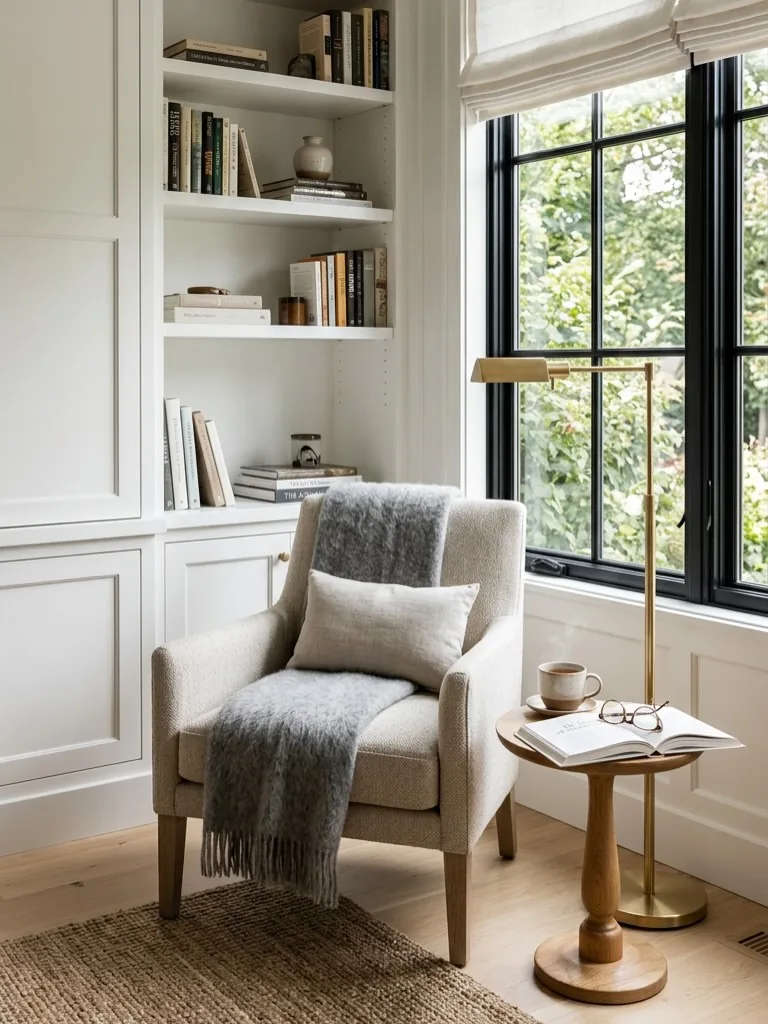
Strip the idea to its bones and this is what remains: an armchair, a tall lamp bending over it, a tiny table holding the book and the tea, and a window doing the daytime work. No shelves, no daybed, no building of anything. If you have one corner and one chair, this is your nook, and it is a better nook than many grander ones because every piece in it is used every single day.
The lamp is the piece to get right. It should stand behind or beside the chair and throw its light over your shoulder onto the page, at about the height of your head when seated. The brass lamp in the photo also earns its keep as the corner’s one handsome object: a nook this simple needs one thing with a bit of shine, or it reads as a chair waiting for the rest of the furniture.
Set the table on your book-hand side and keep it ruthlessly small. A table that only fits a book, a cup and your glasses will stay clear; a bigger one collects the post, the post collects the week, and the nook becomes a desk with cushions. A throw over the chair arm finishes the kit.
This is also the most honest nook for a small budget. The chair you already own, a lamp moved from a desk, a stool borrowed from the bathroom: the whole arrangement costs an afternoon of rearranging, and if the corner fails the light test, everything walks back to where it came from.
The three-piece nook
Chair: the most comfortable you own, moved without guilt.
Lamp: over the shoulder, warm bulb, page height.
Table: book, cup, glasses. Nothing else is allowed to live there.
9. Go Dark and Built-In-Looking With Banquette Seating

Dark shelves, a banquette running under the windows and one velvet armchair pulled up to it: this is the grown-up end of nook design, closer to a small library in a London club than to a cushion in a corner. It is included because renters can fake more of it than they think, and because a dark nook in a pale rental is a brave, brilliant contrast.
The fake is in the furniture, not the walls. A long low bench or two storage ottomans pushed together copy the banquette. A tall bookcase in a deep colour, one you own and can repaint at home, stands in for the built-in shelves. The armchair angled into the corner, rather than square to the room, is what makes the arrangement feel designed instead of stored.
Dark nooks live on their lighting. In the photo the windows do the day shift and the scheme stays moody without going gloomy because the cushions carry pale patterns against the navy. Copy that balance: for every dark metre, one pale textile. Our entryway decor ideas for apartments use the same trick in small dark hallways, where a pale runner saves a deep scheme from cave territory.
The dark nook palette: deep navy, warm wood, cream textiles and one brass or gold glint for the lamp.
10. Create a Reading Nook With the Light on the Wall
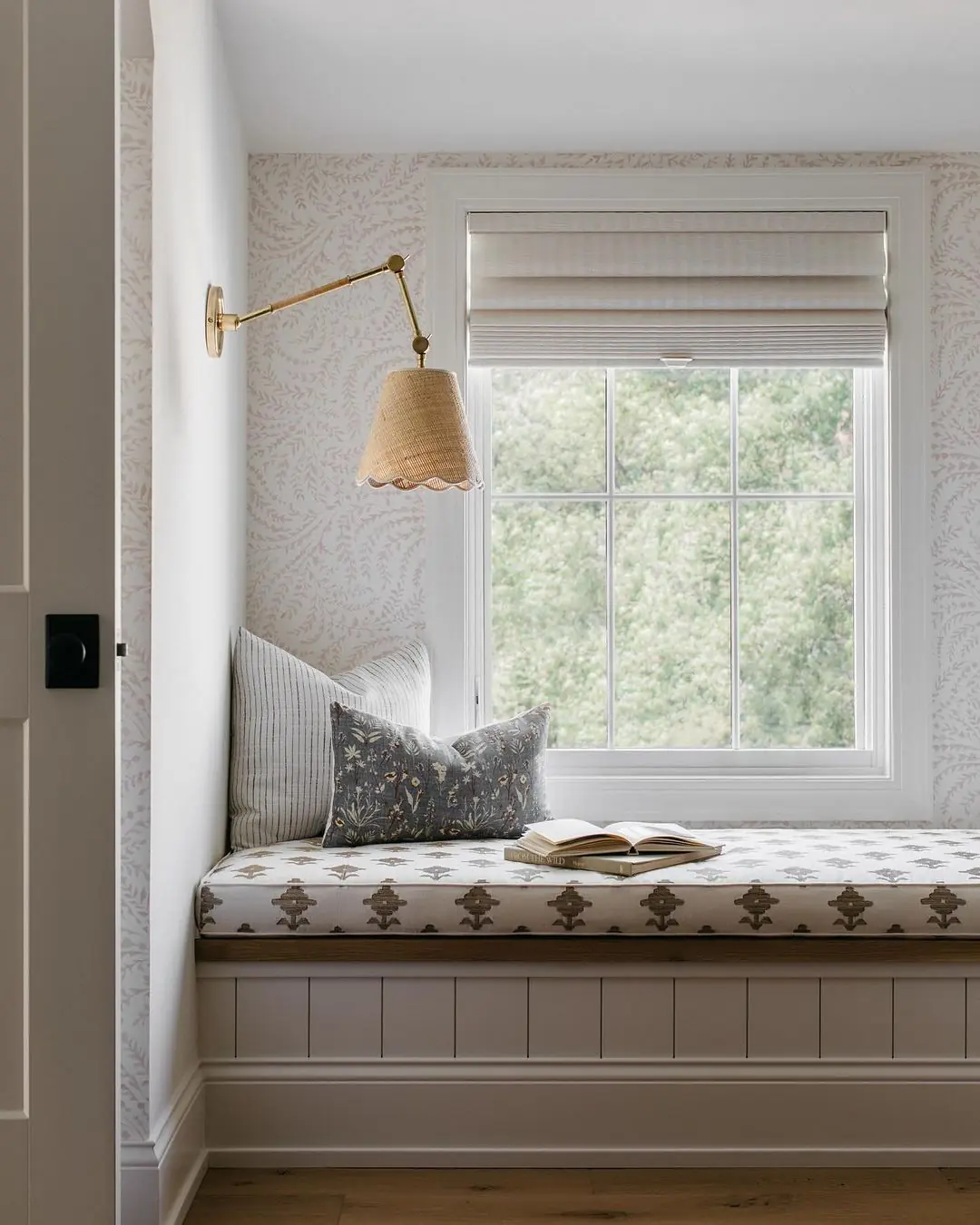
The smallest nooks cannot spare floor for a lamp, and this window seat shows the tidy answer: a swing-arm wall light above the seat, angled down at the page. Everything else here is cushion and daylight. The seat sits in a shallow alcove, books stack in the corner of the bench, and the whole arrangement takes less room than a wardrobe.
Renters should translate the sconce carefully. A wired-in wall light is the landlord’s business, but plug-in swing-arm lamps exist for exactly this problem and mount on a single small bracket, and battery picture lights with remote controls need no fixing at all beyond adhesive pads. What matters is the position: above and slightly behind the reader’s shoulder, close enough that its pool of light lands on the book, not the room.
A wall light also changes how the nook feels at night. Lamp light from above reads as a pool, a small lit stage, and the seat inside it feels claimed in a way a corner lit by the room’s ceiling light never does. Pair it with the scent of something warm nearby and the evening version of this nook out-reads its daytime self; our candle and reed diffuser ideas were practically written for this seat.
Light without floor space
Plug-in swing arm on one bracket, or a battery picture light on adhesive pads. Angle it over the shoulder. Warm bulb, always: cool light makes every nook feel like a waiting room.
The Details That Make It a Nook
11. Line a Hallway Bench With Storage Baskets
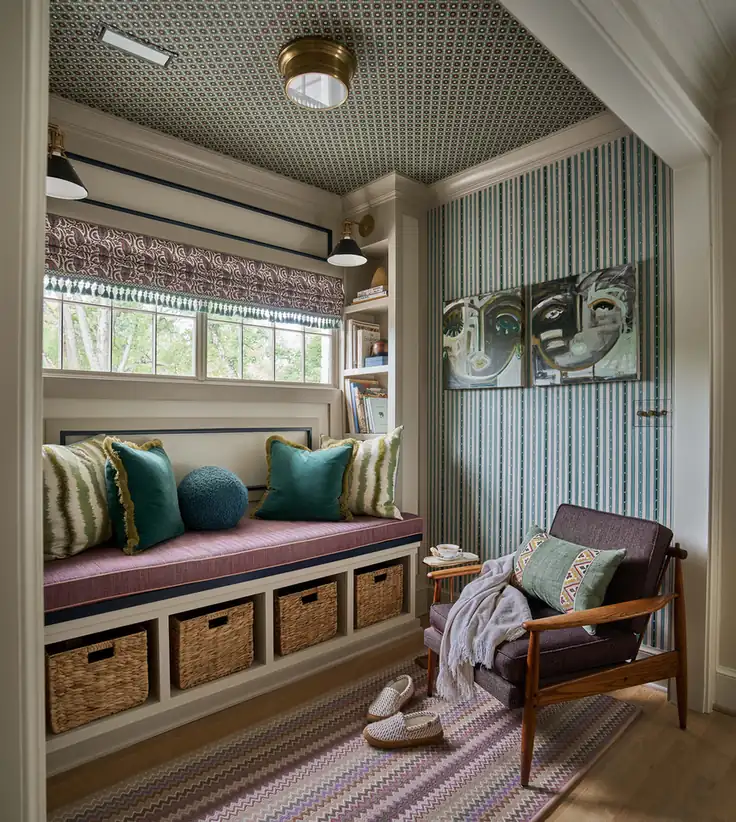
A bench with a striped cushion, baskets lined up underneath and shelves floating above: this nook is built for the end of a hallway, the wall of an entry or the foot of a bed, anywhere a long low shape fits better than a chair. It reads as furniture, works as storage and seats a reader sideways with their back against the wall, which some of us will tell you is the correct reading position.
The baskets are the engine. Each one takes a job: current books, blankets, chargers and the reading glasses that otherwise vanish. Because the storage is open and visible, it stays tidy almost by itself; things in baskets get put back, while things in drawers get lost. Choose baskets that match each other and clash with nothing.
Above the bench, shelves hold the library and a few calm objects. Keep the lowest shelf for books in progress so the bench can be sat on within seconds of walking past it. That speed matters. A nook that takes five minutes to set up is a weekend project; a nook you can fall into is a daily habit.
Hallway nooks earn a small extra: they are the first thing you see when you come home. A bench that holds books instead of post and shoes tells you, at the door, what kind of evening this house intends to have.
Basket jobs, one each
Books in progress. Blankets and the spare cushion. Chargers, glasses, bookmarks. Finished books waiting to go back to their shelves.
Four baskets, four jobs, no junk basket. The fifth basket is where nooks go to die.
12. Create a Reading Nook With a Green Library Wall
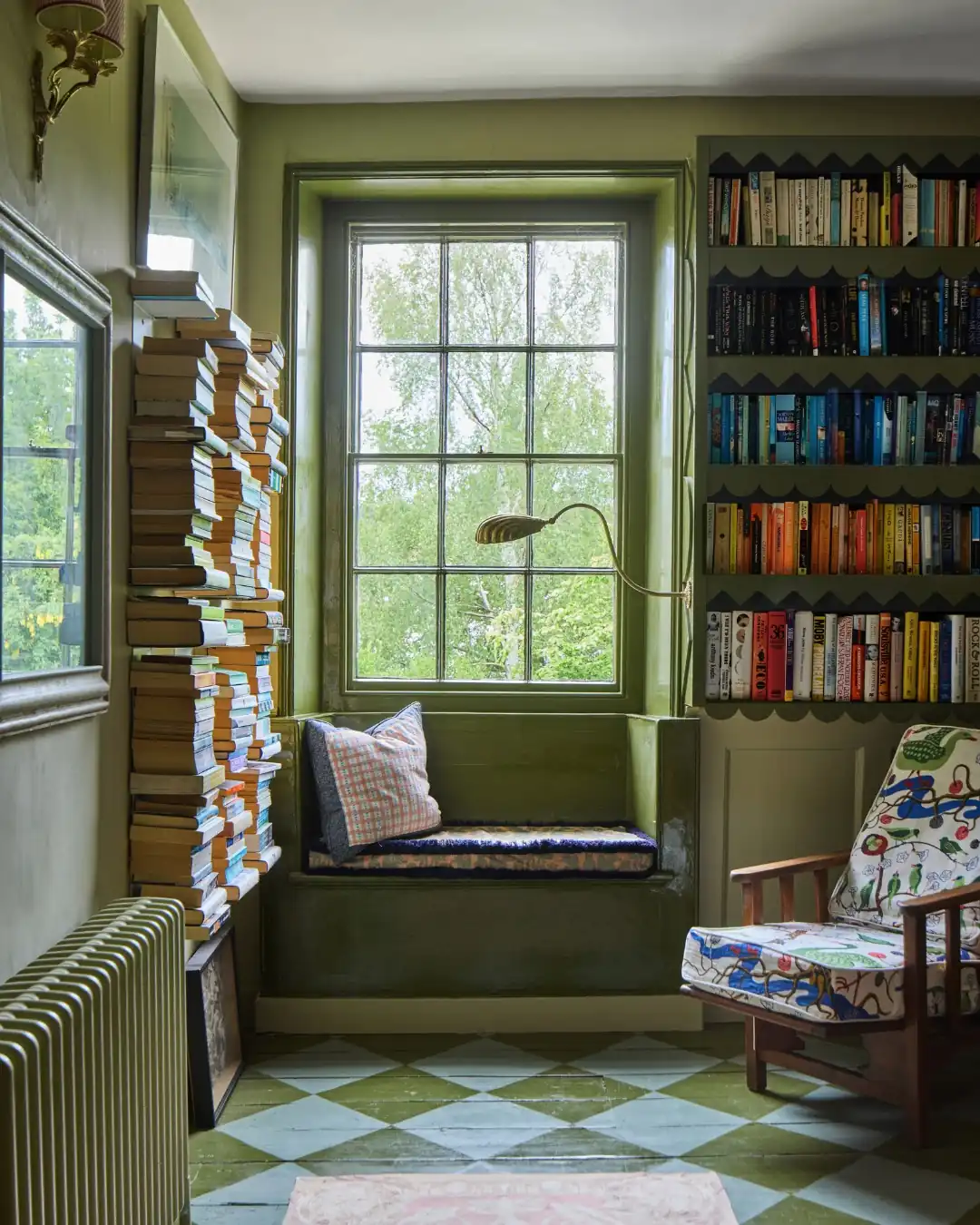
Green shelves, a window in the middle and a bench seat under it: this is the nook as a garden room, and it proves the books do not have to flank the seat symmetrically to work. Here the shelves climb both sides of the window in a deep green that makes every book spine look richer, and the bench below the glass is dressed simply, with cushions in the same calm family.
The renter’s route to a green library wall is a bookcase you paint yourself, in your own home, in a colour you can take with you. One tall case painted deep green against a pale wall gives eighty percent of this photo’s effect. Two cases, one each side of a window or a door, give the rest. Peel and stick wallpaper in a botanical print behind open shelves is the other honest shortcut, and it leaves with you.
Plants belong in this version more than any other. The green scheme invites them, the window feeds them, and a reader surrounded by leaves reads slower in the best way. Keep one plant on the seat’s level, where you can see it over the page, rather than only up on the high shelves.
A green nook also forgives a mixed book collection. Against deep green, battered paperbacks, library sales and childhood hardbacks all look like a proper library, which is another way of saying the colour does the styling work your shelves cannot.
Green wall, honestly rated
Effort ▮▮▮▯▯ one case to paint, a weekend of drying
Calm added ▮▮▮▮▮ the deepest retreat feeling on this list
Removal ▮▮▮▮▮ the case is yours; it simply moves out with you
13. Create a Reading Nook in a Rustic Window Bay
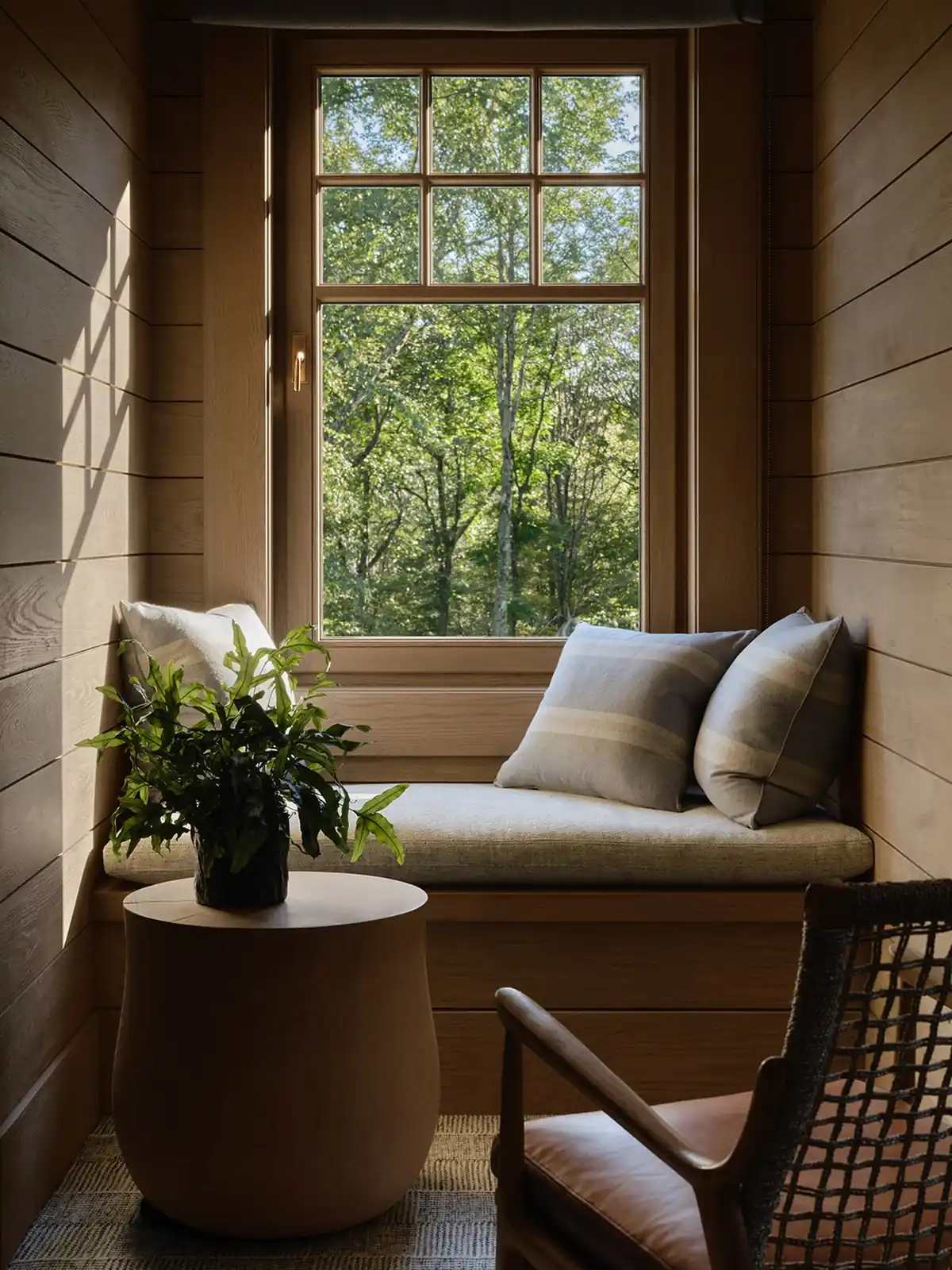
Wood-panelled walls, a plaid cushion and a daybed looking out at the trees: this nook belongs to the slow end of the list, the one for long books and longer afternoons. A bay or a deep window recess is doing most of the work, but the idea underneath it travels well: give the seat a view, and reading becomes only half the point of the chair.
Most rentals will not offer panelling and a forest, so copy the bones instead. A daybed or chaise placed across a window, rather than against a wall. Cushions in one plaid or check to give the plain seat its character. A small round table that can hold a pot of tea without crowding. The view can be a garden, a street tree or even a well-dressed balcony; it only has to be something alive to rest your eyes on between chapters.
This is also the nook that hosts best. A daybed by a window seats two with cushions at each end, which makes it the natural overflow seat when the living room fills up. The wider thinking about making every corner of a rental earn its place runs through our guide to making a rental feel like yours.
In winter this seat becomes the house’s sun trap, and the reading shifts with it: morning books in the bright cold light, a blanket added by afternoon. If your bay faces the street, a sheer curtain keeps the view and returns your privacy.
The view rule
Turn the seat toward something alive: a tree, a garden, the street’s comings and goings. Eyes rest between chapters, and a nook with a view is used twice as often as a nook facing a wall.
14. Curve a Bench Beneath the Staircase
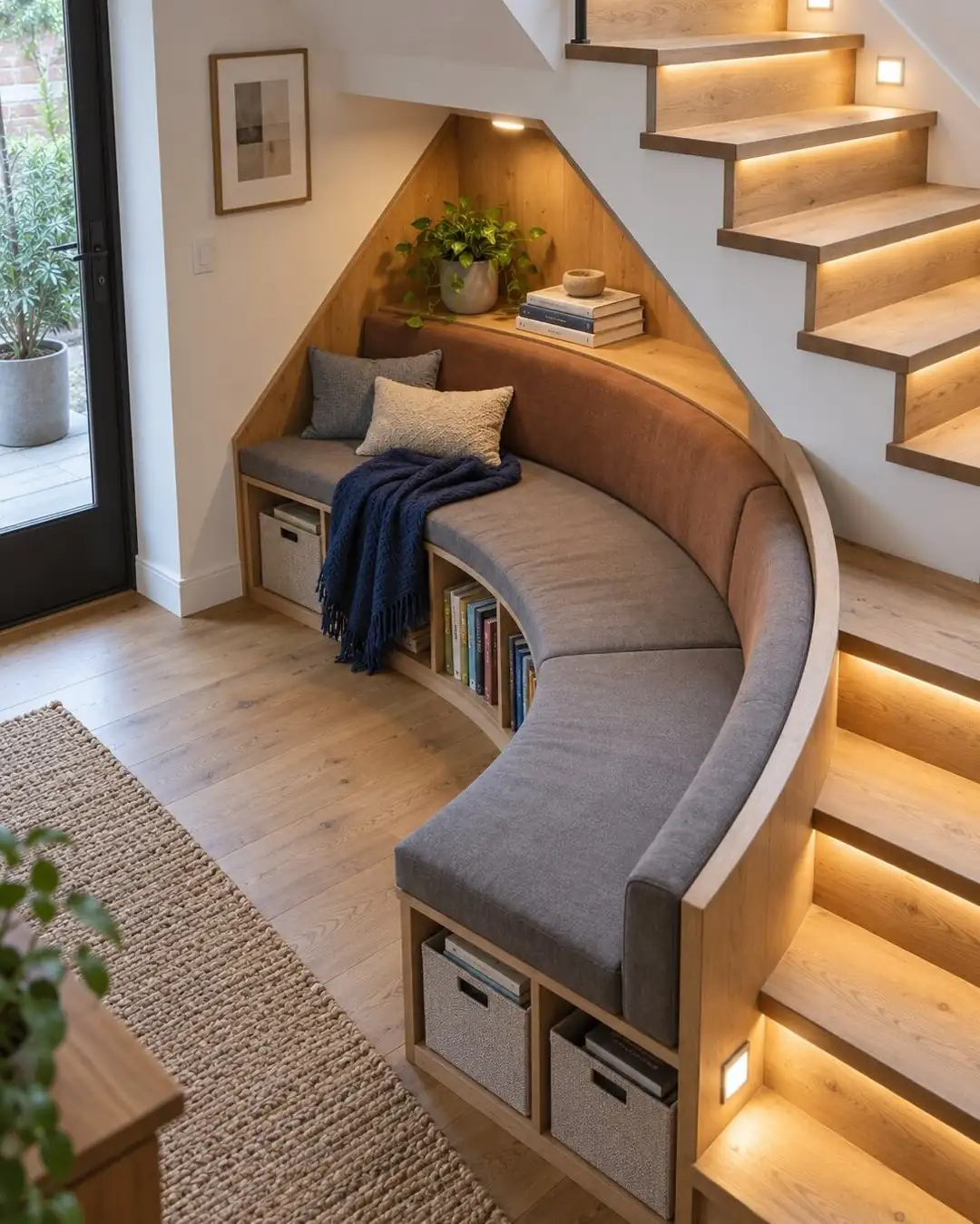
The under-stairs idea returns in its tailored form: a long cushioned bench following the line of a modern staircase, lit warmly from the steps themselves, with storage built along its length. Where idea two was the cosy, make-do version, this is the same square metre wearing its best clothes, and it is worth studying for one reason: it treats the nook as part of the architecture.
Renters copy the feeling, not the joinery. A row of low storage benches or ottomans along the stair wall follows the same line. Warm light is the real luxury here, and it is cheap: a string of warm battery lights along the stair edge, or a small lamp at the bench’s high end, turns the slope from a shadow into a glow.
Notice what the bench is not: it is not deep, and nobody is pretending you can curl sideways on it. It is a perch nook, for one reader sitting longways with their back against the high end and their feet up along the bench. In a home short on seats, that longways perch is often the most fought-over spot in the house, especially with the hallway traffic passing at a polite distance.
Perch nook, set up in an hour
Low benches in a row along the stair wall. One long cushion or two that meet neatly. Cushion stack at the high end for a backrest. Warm light along the slope.
Sit longways, feet up, book against your knees. That is the whole design.
15. Stretch a Banquette Under an Arched Window
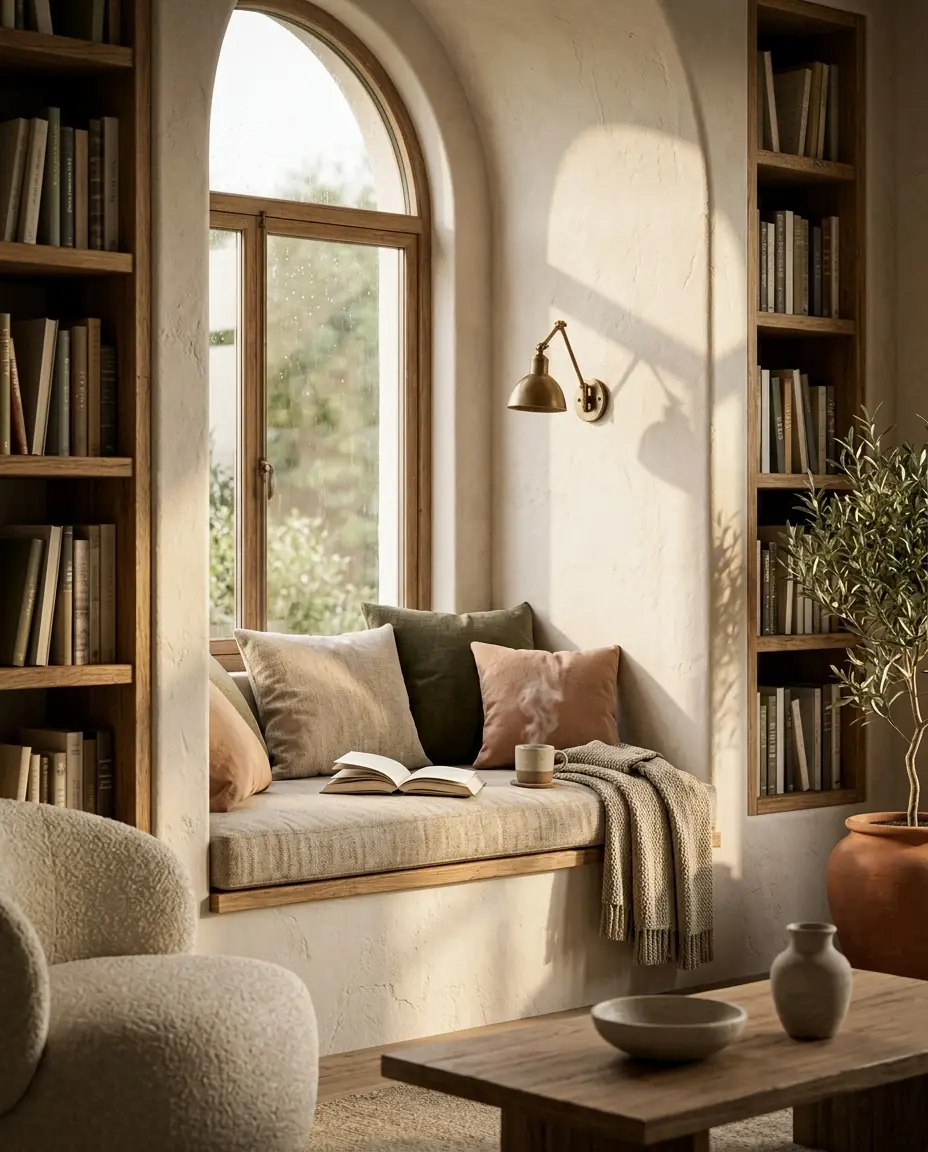
Finish with the nook that feels like a small cafe in a library: a banquette stretched under a tall arched window, shelves climbing the wall beside it, a low table in front and cushions in warm, faded colours. It seats a reader across its length, or two readers at either end with the table between them, and it turns the brightest wall of a room into the house’s headquarters.
The rental translation is a bench plus a table, placed with intent. The bench goes under the best window you have, back cushions stand along the wall, and the low table sits close enough that a book and a cup rest within reach of someone sitting sideways. Shelves on one side only are fine; symmetry is a magazine habit, not a reading need.
Choose this layout when the nook has to share a room gracefully. A banquette hugs the wall, leaves the middle of the room free and doubles as extra dining or desk seating when life demands it, the same space-saving logic as our rental flooring guide applies to ground you cannot change: work with the edges, keep the middle clear, and let one good piece do three jobs.
Banquette nook, the three jobs
Reading: sideways seat, feet up, table in reach.
Hosting: two ends, two readers, one shared table.
Everyday: dining overflow and laptop perch between books.
5 Reading Nook Mistakes That Make a Reading Nook Go Unused
1. Choosing the corner by looks instead of light. A photogenic corner with poor light hosts three reading sessions and a year of guilt. Test the light at the times you actually read before you move a single chair.
2. A chair you cannot curl up in. Upright dining chairs and stiff occasional chairs are where nooks go to fail. The seat must take your legs, your slouch and your Sunday length of book.
3. Nowhere to put the cup. If the book, the tea and the glasses cannot all land within arm’s reach, you will read on the sofa instead. The small surface is not an accessory; it is half the nook.
4. Building it in the walkway. A nook in the path of the house gets bumped, borrowed and tidied away. Corners beside the traffic keep their reader and their cushions.
5. Styling it finished and never touching it. A nook arranged like a shop window quietly forbids use. Leave the throw rumpled, the book open and the cushion dented: a used-looking nook is an invitation, a perfect one is a display.
FAQs About How to Create a Reading Nook
How much space do I need for a reading nook?
Less than you think. A single armchair with a lamp and a small table needs roughly a metre square of corner, and a window seat or hallway bench can be slimmer still. If a chair fits with room to stretch your legs onto a pouf or cushion, a nook fits.
What chair is best for a small reading nook?
A deep armchair you can sit sideways in, with a back tall enough to lean your head on. In tight corners, a slipper chair or an armless accent chair gives the same curl-up comfort in less width. Test any chair with a real book for twenty minutes before it earns the corner.
How do I make a reading nook in a rental without drilling?
Everything in this article avoids the drill: freestanding bookcases make the walls, leaning ladder shelves hold the books, plug-in or battery lamps give the light, and tension, weight and furniture placement do the rest. Keep the landlord’s walls exactly as you found them.
What lighting is best for reading?
Daylight from the side by day, and a warm lamp over your shoulder by night. The light should land on the page, not in your eyes, and a warm bulb keeps the nook feeling calm. Avoid relying on a ceiling light across the room; it flattens the corner and tires your eyes faster.
Can I make a reading nook in a bedroom corner?
Yes, and bedroom corners are some of the best nooks going: quiet, private and already soft. One chair angled into the corner, a small lamp and a stack of books on a stool is the whole recipe. It also gives early risers and night readers a place that is not the bed.
How do I keep a reading nook from looking cluttered?
Give every object one job and one home: books on the shelf or in the basket, the throw on the chair, the cup on the table. Rotate the book pile instead of growing it, and clear the surface each night. A nook reads as calm when its few things are in their places.
What is a good depth for a reading nook?
To create a reading nook that fits, match the depth to how you sit. An armchair nook needs about 60 centimetres from the wall to the front of the chair, enough for a small table and a lamp beside it. A daybed or window seat you want to curl up on needs about 90 centimetres. Measure your knees, not the furniture: if you can sit sideways with your feet up and still reach the lamp, the depth is right.
How to create a cosy reading nook?
To create a reading nook that feels cosy, layer softness at every level: a deep cushion, a throw, something warm underfoot, and a lamp glowing at shoulder height. Add books within reach, one scent you like, and a plant trailing overhead. Cosy comes from enclosure as much as from fabric, so tuck the seat into a corner or an alcove and let the walls hold the warmth in. If your shoulders drop when you sit down, it is done.
One Last Thing
A reading nook is the smallest room you will ever build, and possibly the one you will use most. Pick the corner with the best light, move your favourite chair without asking anyone’s permission, and let the lamp and the little table follow. The rest, the shelves and baskets and green walls, can arrive one idea at a time. If the corner you claimed belongs to the living room, our sofa corner ideas pick up exactly where this article leaves off, and the newest seat in the house deserves the same care as the door that leads to it, which our door decor ideas cover from wreath to draft stopper. Now go and read something in it. That is the only review a nook ever needs.

Elora Vania here, founder and Senior Editor of Home Aure. With years of experience in interior styling and home decor, I created this site to bring thoughtful, practical design advice to real homes—helping you create spaces that feel warm, personal, and beautifully lived-in.