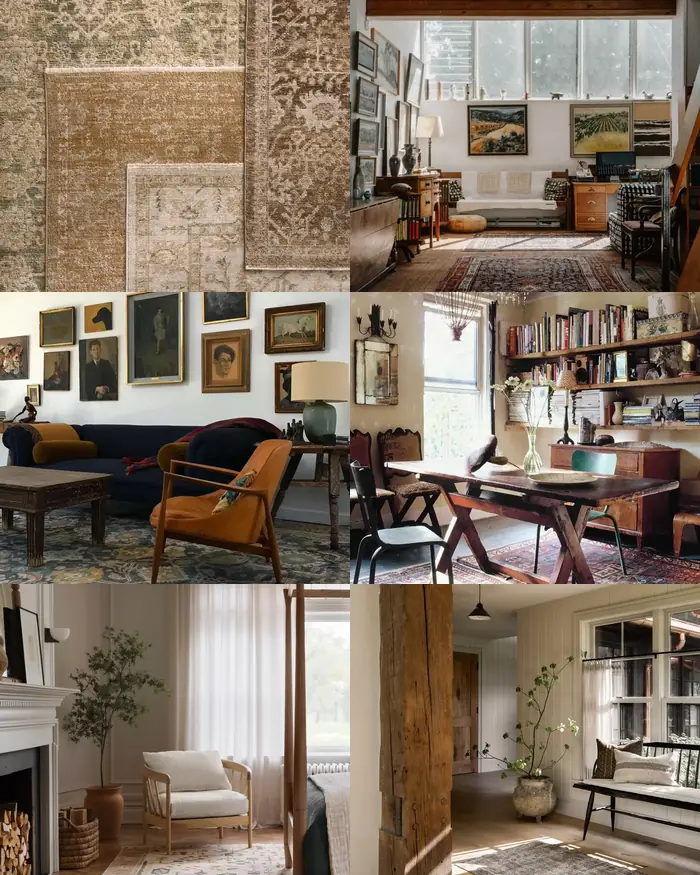
How to layer rugs is the renter answer to a floor you cannot change. One rug covers a patch; two rugs, a big flat base with a smaller softer one on top, cover the room, and they do it while adding the warmth, quiet and pattern that a bare rental floor never offers. This guide walks the whole job in the order it actually happens: why layering works, how to choose the base and the top, the sizes that make the stack look designed, the placement rules for the living room, bedroom, dining area and hallway, how to pair colours without a fight, and the grip that keeps two rugs behaving like one floor. No glue, no damage, no permission to request, and on move-out day the whole thing simply rolls up and leaves with you.
One promise before the measuring starts: nothing in this method needs the landlord permission, a tool or a free weekend. The slowest part is choosing the pair, and the guide saves its pairing rules for exactly that moment.
Households with pets layer happily, with one adjustment: the top rug becomes the sacrificial layer, chosen washable and patterned enough to hide the evidence between washes. The base stays protected underneath, which is the entire economic point of the system.
Table of Contents
- Why Layer Rugs Over Rental Floors
- The Base Layer: Big, Flat and Boring on Purpose
- The Top Layer: Where the Style Lives
- Rug Layering Sizes: The Measurements That Make It Work
- How to Layer Rugs in the Right Order: Floor, Pad, Base, Top, Furniture
- How to Layer Rugs in the Living Room
- How to Layer Rugs in the Bedroom
- How to Layer Rugs Under a Dining Table
- How to Layer Rugs in Hallways and Entryways
- Colour and Pattern Pairing Without Tears
- Rug Layering Grip and Safety: Pads, Tape and Curling Corners
- Care, Rotation and Move-Out Day
- Angles, Offsets and Round Rugs
- How to Layer Rugs on a Budget: Where the Money Goes
- How to Layer Rugs in Small Rooms and Studios
- Renter Rules: Protecting the Floor and the Deposit
- 5 Rug Layering Mistakes That Ruin a Layered Rug Stack
- FAQs About How to Layer Rugs
Why Layer Rugs Over Rental Floors
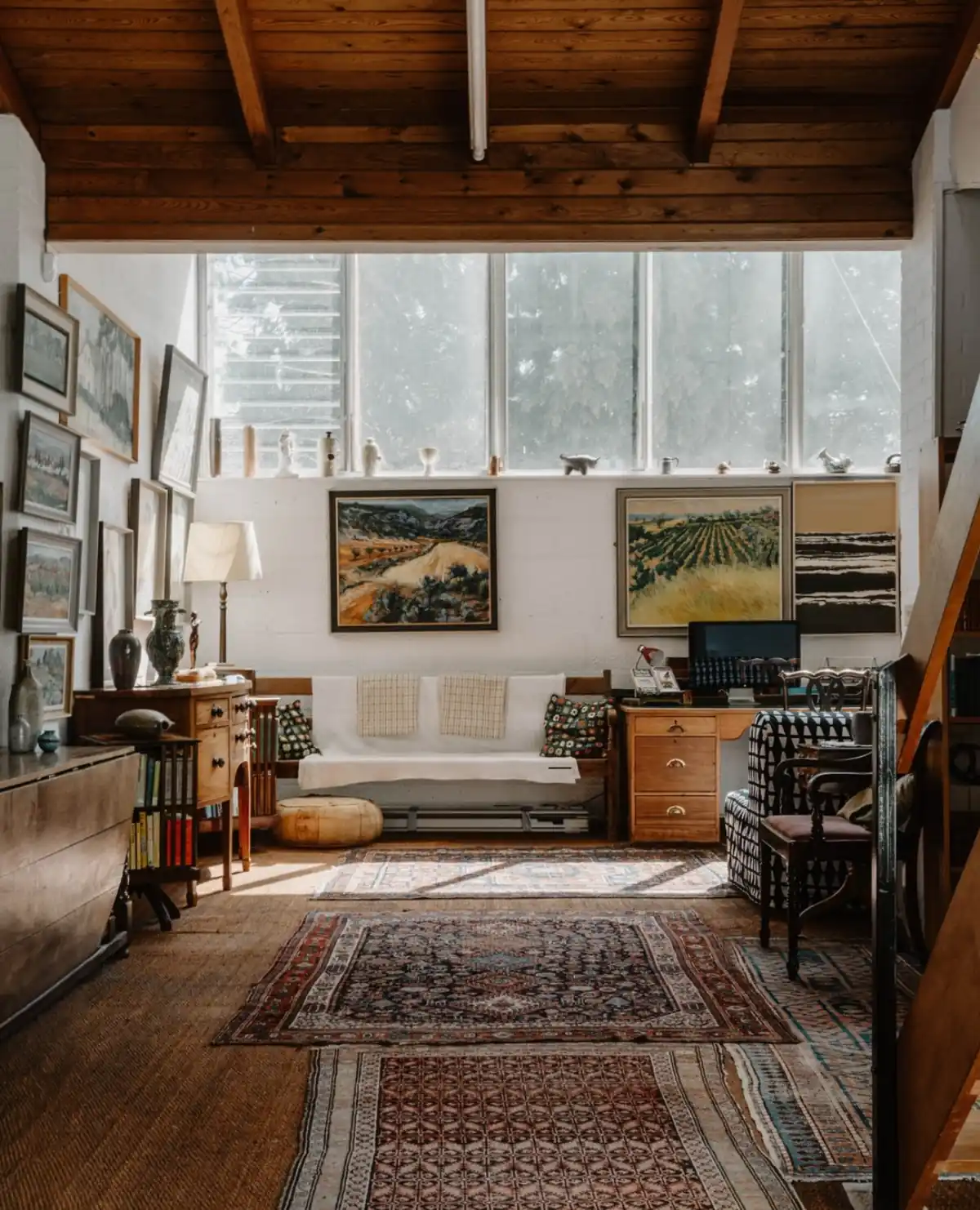
Start with what layering is for. A rental floor is usually the one surface in the home you cannot change and did not choose: scratched boards, tired laminate, carpet in a colour nobody would pick twice. One rug covers part of it. Two rugs, layered, cover most of it, and the top one gets to be beautiful while the bottom one does the hiding. This long studio room runs layered vintage rugs down its whole length, and the floor underneath simply stops being part of the conversation.
Layering also solves the two practical problems a single rug cannot. Size: big rugs are expensive, but a large cheap base plus a smaller lovely top rug gives the same coverage for far less. Warmth and sound: two layers insulate a cold floor and quiet your footsteps for the neighbours below, which in a flat is a form of diplomacy. And when the top rug tires you, you change the small one, not the whole floor.
What layering is not: it is not two rugs because neither was big enough, and it is not a small rug dropped in the middle of a big one by accident. The difference between layered and merely stacked is intention, and intention shows in the border, the pairing and the grip. Get those three right and even cheap rugs look deliberate.
A word on cost. The base is the largest textile in the room and the one nobody compliments, so it is the place to be ruthless: flat-weave basics, sale ends, natural fibre workhorses. The top rug carries every compliment the floor receives. Splitting the budget this way, most of the money on the smallest piece, feels backwards in the shop and completely right in the room.
The layering equation: base hides the floor, top carries the style, pad stops the movement. Miss one and the stack fails in a different direction.
The Base Layer: Big, Flat and Boring on Purpose
The base rug has one job: disappear usefully. These flat-laid neutrals show the profile to look for, thin, flat-woven, quiet in colour, with the pattern dialled down to texture. Jute, sisal, flat-weave cotton and low-pile synthetics all work. What the base must never be is fluffy: a deep pile base makes the top rug surf, wrinkle and wander.
Buy the base bigger than feels sensible. It should reach under the furniture and still show a border around the top rug on every side. Colour-wise, the base is the supporting actor: natural fibre tones, stone, wheat, faded grey. If the landlord floor is carpet, the base still earns its place, because it gives the top rug a flat, grippy stage instead of a spongy one.
Bases also forgive the rental carpet problem in a way a single rug cannot. A beautiful rug laid straight on spongy landlord carpet wrinkles within a week, because carpet pile moves underfoot. The flat base acts as a raft: it spreads the movement, gives the top rug a firm deck, and turns a marsh into a floor.
Where the base meets the wall matters less than people fear. Leave a border of real floor showing around the base, a hand width or more, so the stack reads as furniture rather than a carpet replacement. If the base reaches every wall, visitors stop seeing layers and start seeing flooring, and the landlord may start seeing it too.
Base rug checklist
Flat weave, low pile, no fringe to fight the top rug. Big enough that the top rug floats with a border on all four sides. Boring on purpose.
The Top Layer: Where the Style Lives
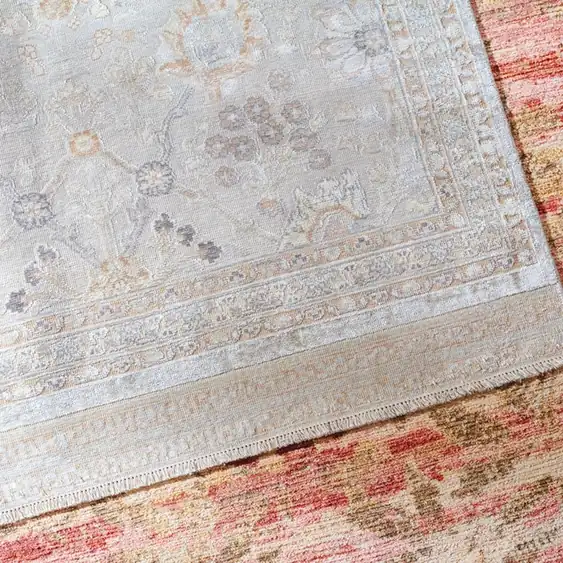
The top rug is the one people see, compliment and photograph, like this pale patterned corner lying over a warmer textured base. It can be the vintage find, the bold pattern, the soft wool, because the base underneath has already handled coverage and flatness. Spend the taste budget here and the money discipline on the base.
Proportion is the whole skill. The top rug should float on the base with a visible border of base on all four sides, roughly a hand width to a forearm length. Centred is the classic; off-centre and angled both work when they look chosen rather than dropped. If the top rug is nearly the size of the base, the stack reads as a mistake. If it is far smaller, it reads as a mat. The border is what makes it read as design.
Vintage and second-hand rugs make the finest top layers, because their patterns are busy, their colours are softened by age, and small sizes are exactly what charity shops and markets have. A top rug also hides its own wear better than a wall-to-wall piece, since the eye reads the pattern first.
Before buying the top rug, lay a sheet or towels on the base at the size you are considering and live with the outline for a day. Proportion errors are invisible in a shop and glaring at home. The sheet test costs nothing and has saved more stacks than any measuring guide.
Top rug tests
Border test: a hand width of base showing on every side
Weight test: heavy enough to lie still, light enough to lift for washing
Traffic test: pattern busy enough to forgive a busy hallway
Rug Layering Sizes: The Measurements That Make It Work
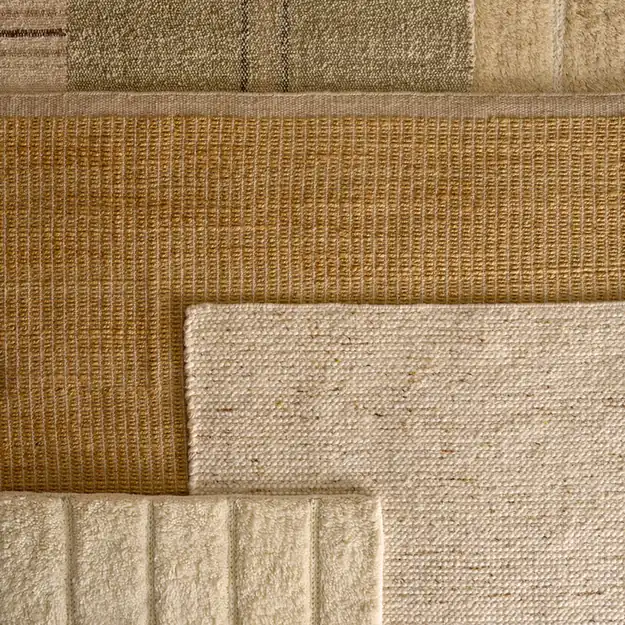
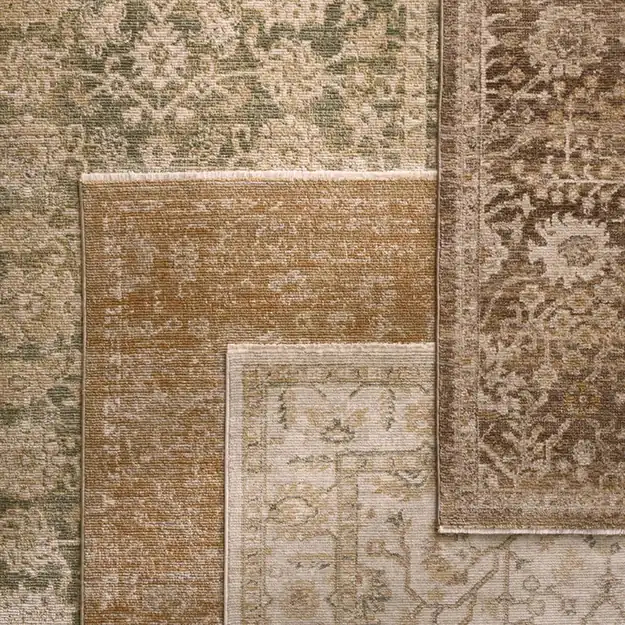
Work in room terms. The base rug should sit under the main furniture grouping with its edges clear of the walls; wall-to-wall reads as carpet and loses the point. The top rug then defines the inner zone, the conversation area in a living room, the landing zone beside a bed. These stacked edges show the real hierarchy: thickness belongs to the top layer, spread belongs to the base.
Standard sizes pair kindly: an 8 by 10 foot base under a 5 by 8 top, a 9 by 12 base under an 8 by 10. In small rentals, a 5 by 8 base with a 3 by 5 top still layers honestly in a reading corner or beside a bed. When in doubt, size the base up and the top down; a generous border forgives, a cramped one accuses. Tape the outline on the floor before buying if the room is awkward, and walk the tape for a day.
In rental rooms the furniture rarely centres on the room, so centre the stack on the furniture, not the architecture. A stack aligned to the sofa and chairs looks designed even when it sits a few inches off the room own centre. The eye forgives asymmetry to walls; it does not forgive a rug floating unrelated to the seating.
Runners layer too: a long flat base runner with a shorter patterned one over its first half gives an entryway a designed threshold. And in open-plan flats, one base can host two top rugs in two zones, which ties the zones together more cheaply than matching furniture ever will.
The border rule
Top rug smaller than the base on all four sides, by roughly a hand width to a forearm length. Equal sizes read as one rug wearing a hat; a clear border reads as design.
How to Layer Rugs in the Right Order: Floor, Pad, Base, Top, Furniture

Assembly order sounds obvious until the first time you try to slide a pad under an already placed rug. The sequence is: bare floor, rug pad, base rug, top rug, furniture. In this Mediterranean room a round rug softens a patterned floor covering beneath the seating, and a round top layer is worth stealing for square rooms, because the curve relaxes all those right angles.
Two habits make the stack behave. First, let each layer settle flat for a few hours before adding the next; new rugs curl at the corners out of the roll, and stacking on a curl builds the curl in. Weights on the corners overnight fix most of it. Second, vacuum the floor and the underside of the base before assembly. Grit trapped under a rug is sandpaper with a long memory, and it is the landlord floor that pays.
Test the stack before the furniture lands. Walk it, jump on it lightly, drag a chair across it. A stack that creeps in the first ten minutes will creep forever, and it is far easier to add grip under an empty stack than under a furnished one.
Unrolling order helps too: unroll the base against its curl, weight the corners, and let it rest overnight if time allows. Rental life rarely allows, in which case walk the corners down, place the pad well, and let the furniture do the pressing.
Photograph the stack from the doorway before the furniture goes on. The doorway view is the one you will live with, and it is the view that shows a crooked base or a wandering top rug while both are still easy to fix.
Order of work: floor, pad, base, top, furniture. Furniture goes on last and acts as the final anchor. Rearranging means lifting the stack in reverse order, and yes, it is a workout.
How to Layer Rugs in the Living Room
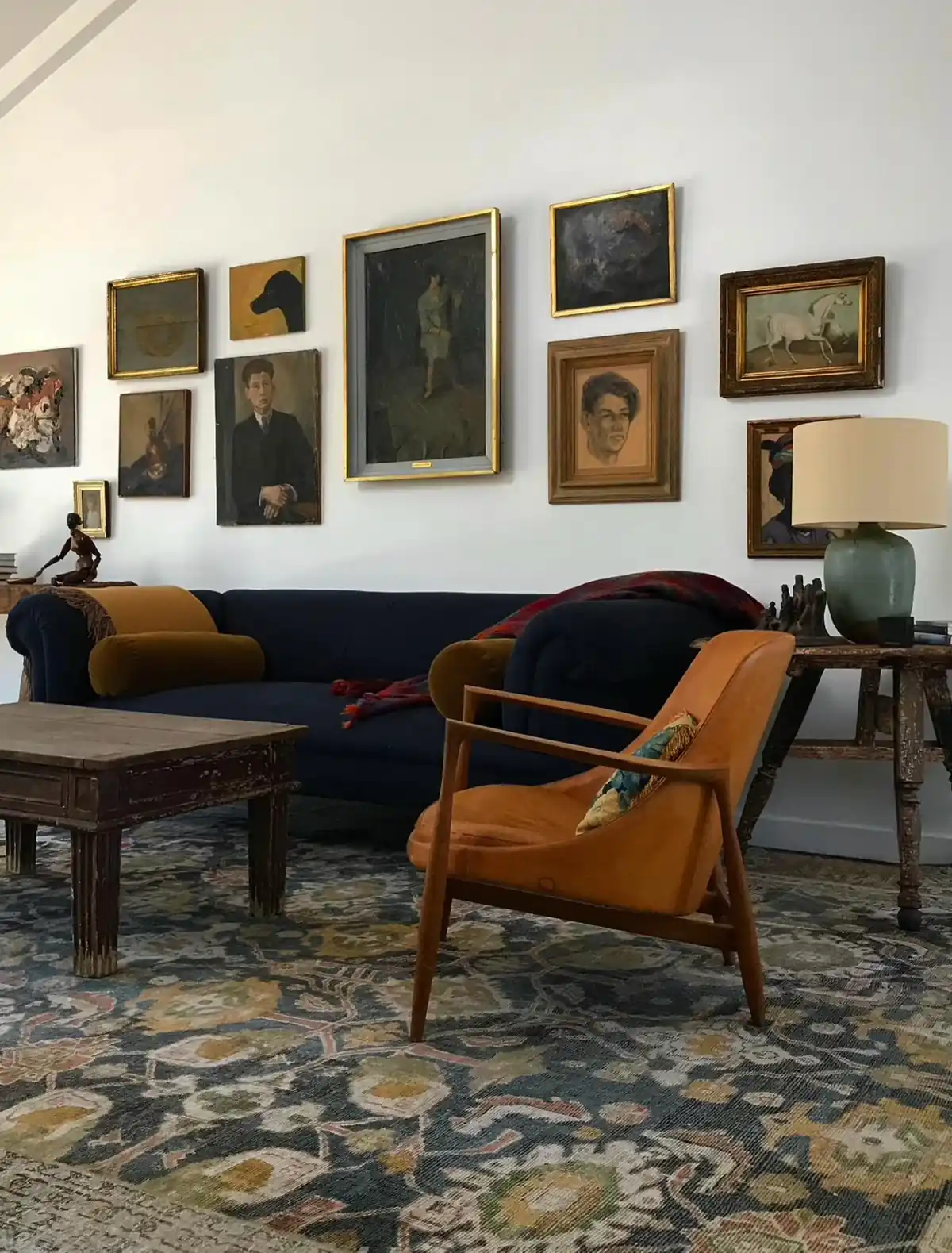
The living room is where layering earns its keep, because it is the biggest floor and the most seen. This eclectic room spreads a large floral rug under a navy sofa and lets pattern do the covering work; imagine its plainer twin underneath and you have the full stack. The base extends the zone, the top carries the flowers.
Anchor rules matter more than colours here. The sofa front legs stand on the top rug, side chairs put their front legs on or stay fully off, and the coffee table sits centred on the top layer, pinning it. A top rug that no furniture touches will travel, slowly and then suddenly. If your seating floats in the middle of the room, the stack defines the island: base as the shore, top as the room within the room. Our living room layouts guide starts from the rug for exactly this reason.
Small living rooms layer differently: the base can run nearly wall to wall, because the room needs the coverage, and the top rug then marks the seating island inside it. In a studio flat the same trick separates living from sleeping without a wall, the base as one country, the top rugs as its two cities.
Pattern scale follows room scale. A large floral or medallion wants a room that can step back from it; in a small room choose a smaller repeat or a faded vintage pattern, which reads as texture at close range. The navy room here is generous, so its flowers can afford to be loud.
Living room anchors
Sofa: front legs on the top rug, always
Chairs: front legs on, or fully off, never one leg each
Table: centred on the top layer, it is the stack anchor
How to Layer Rugs in the Bedroom
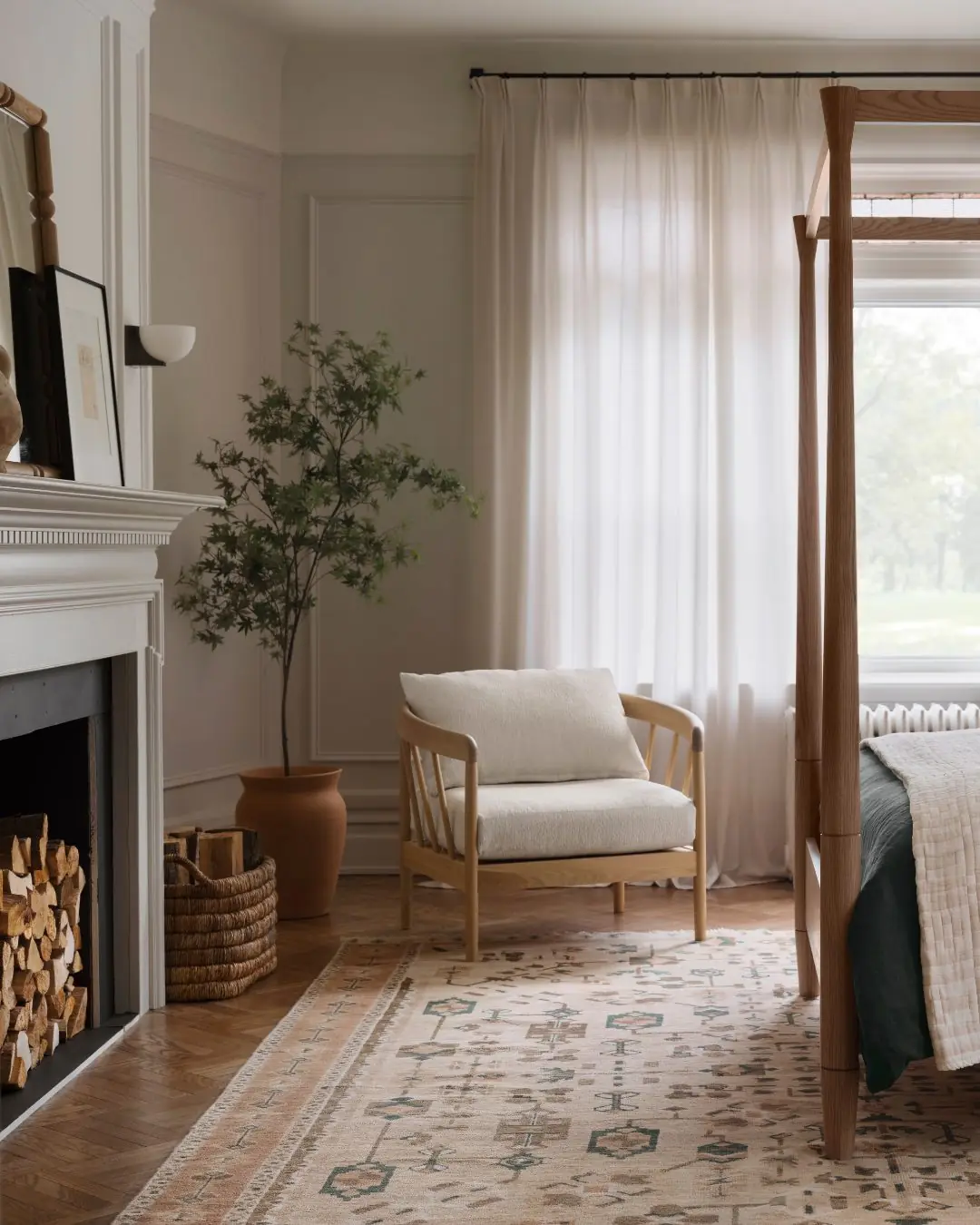
A bedroom layer stack is graded by bare feet at 7 a.m. This calm room runs a big vintage rug under the bed area and the armchair, so the first steps of the day land on pattern and pile instead of cold board. In most bedrooms the honest layering is one generous base under the bed, extending on both sides, with a smaller soft top rug on the side where you actually get out.
If budget forces a choice, layer only your own side. A runner over the base on the getting-out side gives the luxury where it is felt and skips the side nobody walks on. Keep the top layer low enough that the door still swings, and check the stack height against the bed frame if you use under-bed storage boxes; two rugs plus a pad raise the floor by more than people expect. The rest of the room can follow the calm bedroom rules: quiet colours, hidden storage, soft light.
Guest rooms and spare rooms are the low-stakes place to learn layering. The traffic is light, the audience forgiving, and a stack that is slightly wrong teaches more than a guide can. Start there if the living room feels too public for a first attempt.
For children rooms, layer with washability first: a flat base that tolerates everything, a small soft top that fits in the machine. The stack will be tested by juice, paint and time, and the design that survives is the one that can be washed in pieces.
Bedroom layer palette: wheat base, warm wood tones, cream bedding, one green accent. The feet meet warmth; the eyes meet calm.
How to Layer Rugs Under a Dining Table
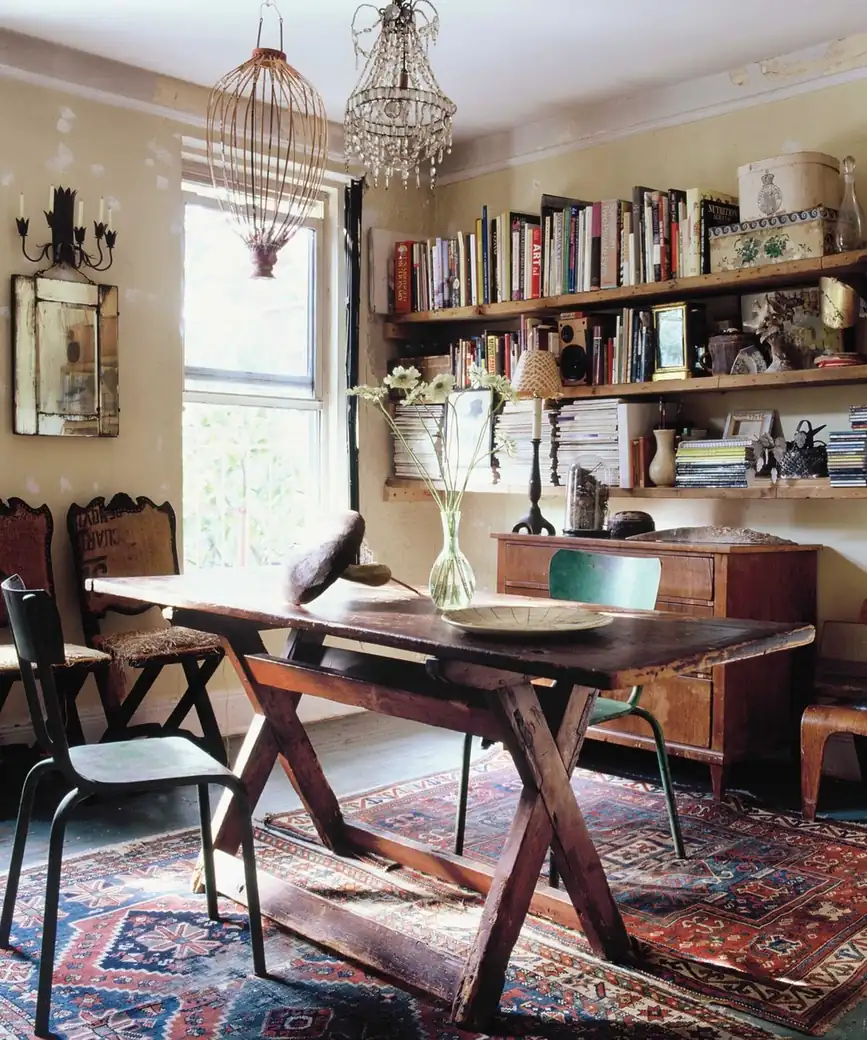
Dining is the hardest room to layer and the one where renters most want the floor hidden, since dining areas in flats are often just a corner of tired laminate. This book-lined dining room puts a vintage rug under the whole table setting, chairs included, which is the non-negotiable part: every chair, pulled out with a person sitting down, must stay on the rug.
Layering under dining chairs asks for restraint. Keep both layers flat and skip pile entirely; chair legs catch, drag and chew anything soft, and a wrinkled top rug under a table is a tripping argument waiting for guests. A flat base with a flat patterned top, or even a single flat rug over the landlord carpet, behaves best. Choose pattern with movement in it, because dining rugs receive a rain of crumbs and small spills that plain colours announce.
Measure the dining stack with the chairs in use, not at rest. Sit, push back, stand: the chair travels further than the tidy photograph suggests. Add that travel to the rug size on every side, or accept the wobble of back legs on bare floor, which over a year of dinners chews both the chair and the floor edge.
A glass or light table changes the choice, because the rug becomes the visible centrepiece of the room. Flat pattern under glass reads like a framed textile. It is the one dining case where a bolder top layer earns its keep even in a small flat.
Washable flat-weave tops are the dining layer that survives real life: the whole top rug can go in a big machine or out to the line, while the base stays home. Under a table that hosts children, this is not a detail, it is the design.
Dining clearance
Rug stack extends beyond the table on all sides by enough for a pulled-out chair to stay on fabric. Chairs half on and half off wobble, catch edges and chew fringes.
How to Layer Rugs in Hallways and Entryways
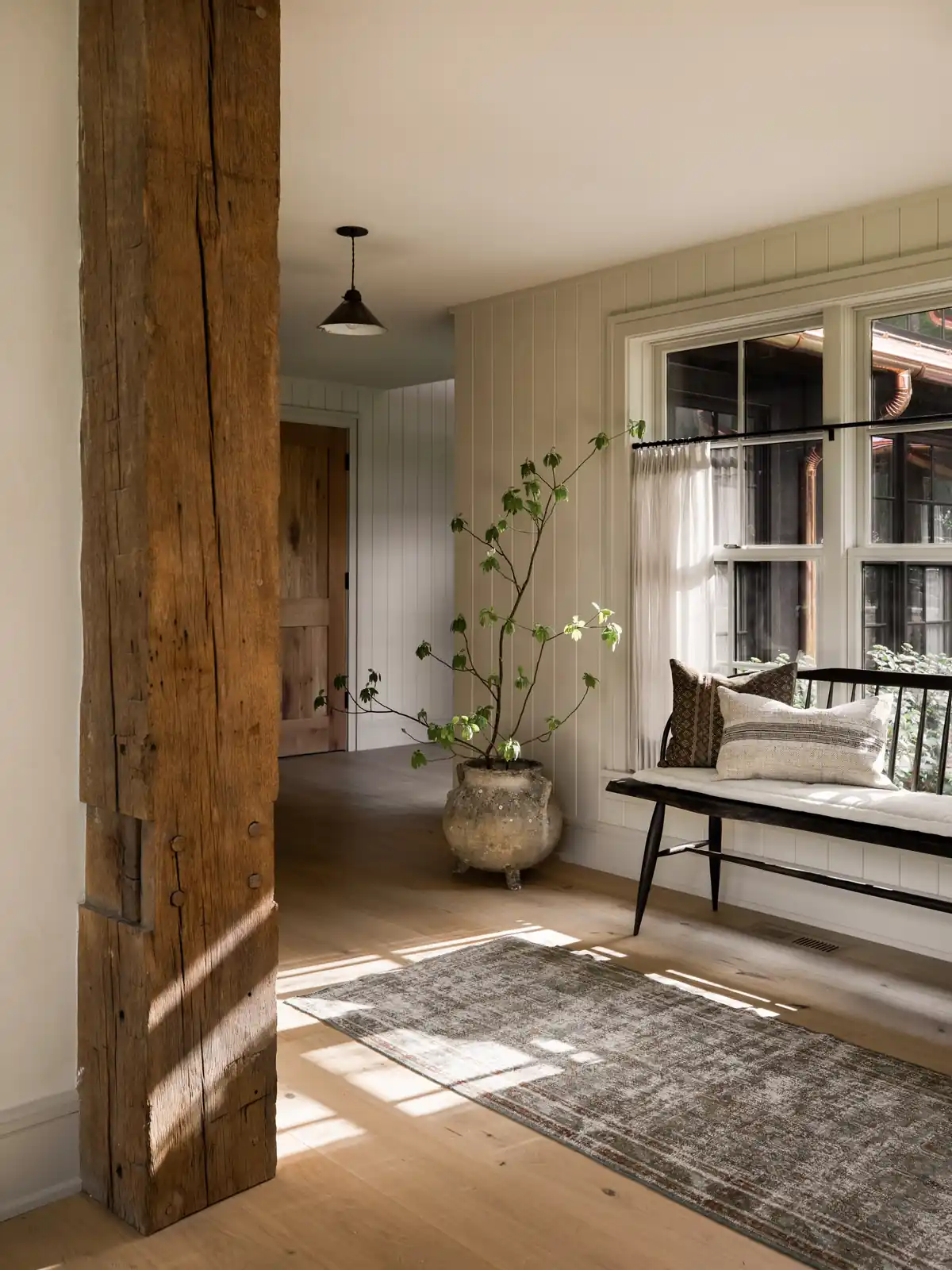
Halls and entryways are where rental floors suffer most and where a layered runner quietly saves the deposit. This faded vintage runner on pale boards shows the entryway version: long, flat, forgiving in pattern, and exactly on the path every shoe takes. A runner over a base mat at the door catches grit in two stages instead of letting it walk through the home.
Hallway layering is mostly about thickness discipline. Keep the stack low, watch the door swing clearance, and grip the runner properly, because a sliding runner in a hall is the one genuinely dangerous rug in the house. Our entryway ideas treat the runner as the first piece of furniture for the same reason. Washable wins here over beautiful; the hall rug is a working rug.
At the front door itself, a washable mat on top of the runner end does the dirty work and shakes out over the step in seconds. Think of the entry stack as three speeds: mat for grit, runner for the walk, base for the look.
Long halls in old rentals often slope or ripple, and a layered runner hides a multitude of sins while announcing none. Keep the pattern forgiving and the edges taped, and the hall stops being the part of the tour you apologise for.
Hallway rule: runners are the front line of a rental. They take the grit, the wet shoes and the landlord inspection path. Choose the washable one and let it be a little brave.
Colour and Pattern Pairing Without Tears
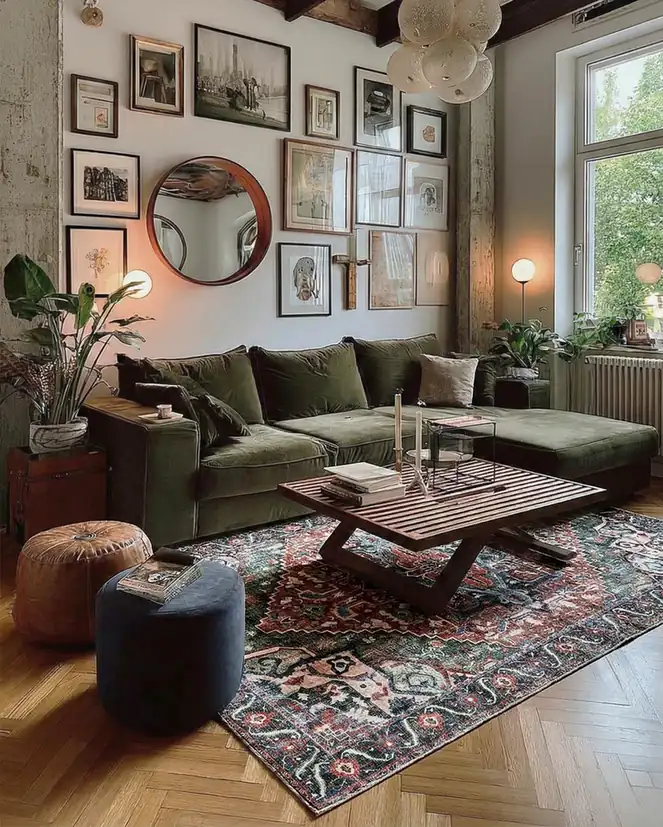
Pairing rules are simpler than the shops suggest. One pattern per stack. The other layer stays plain or textured, like the big patterned rug grounding the green sofa here. If the top rug shouts, the base whispers in a tone pulled from the top rug quietest colour. If both layers are plain, contrast their textures instead: flat jute under soft wool, smooth cotton under a nubby weave.
Colour temperature should agree even when colours differ. Warm rusts, golds and creams layer happily together; cool greys and blues form their own family; mixing families is where stacks start to look accidental. When a pairing is nearly right but not quite, a third small element in the room, cushions or a throw in the base colour, usually votes it into place. Trust the daylight test: judge the pair at noon and at lamplight before deciding.
Texture pairing has its own short grammar. Rough under smooth looks rustic and calm. Smooth under rough looks deliberate and rich. Two roughs fight; two smooths slide, visually and literally. When a stack feels wrong and the colours are fine, texture is almost always the argument.
Borrow the pairing from the room when stuck: if the sofa is a bold colour, the top rug can pick its quietest neighbour, and the base takes the floor tone. A stack that answers something already in the room never looks like an import.
Safe pairing: a gold-toned patterned top over a dark plain base, cream in the furniture, charcoal in one small dose. Pattern up top, quiet underneath.
Rug Layering Grip and Safety: Pads, Tape and Curling Corners
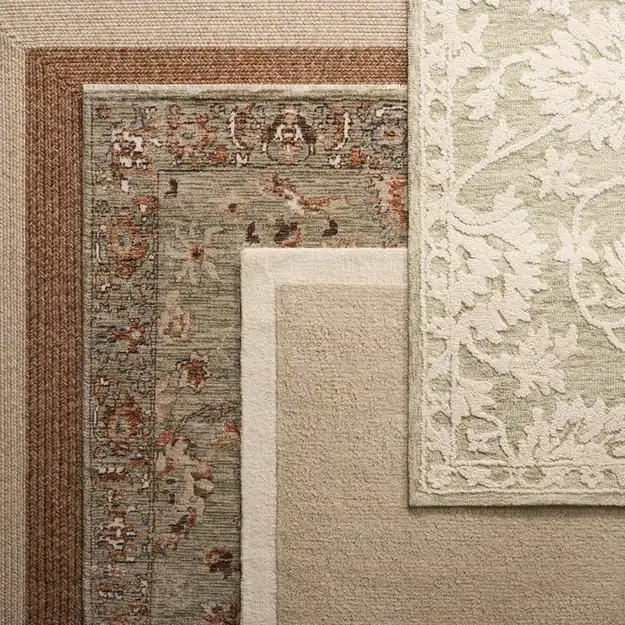
A layered stack has two slip planes: base on floor, and top on base. This cheerful patchwork shows why it matters, because every edge and corner in a stack is a place a toe can catch. The pad under the base is the main defence; choose felt with rubber, or a rubberised pad on hard floors, and a carpet-to-carpet gripper when the landlord floor is carpet.
For the second plane, rug tape at the top layer corners, or a thin non-slip mesh between the layers, keeps the top rug from creeping. Creep is slow and directional, so check the border weekly; a shrinking border on one side means the top rug is travelling. Corners that curl get weights overnight, double-sided tape as a last resort, or the honest fix: the rug is too light for the spot and swaps with a heavier one.
Door clearance is the grip issue nobody lists. A pad plus two rugs raises the floor by a centimetre or more, and doors in old rentals were trimmed for the old floor. Test every door swing over the stack before the furniture goes on; a door that planes the top rug daily will win.
In homes with elderly visitors or toddlers, be stricter than the guides: no loose top layers in walkways at all, tape every corner, and choose stacks that read as one rug. Beauty that trips a grandmother is not beauty, it is a liability with fringe.
Grip, in order of strength
Pad: a felt or rubber pad under the base, the real fix
Tape: rug tape at the top layer corners for light stacks
Weight: furniture legs as anchors, free and final
Care, Rotation and Move-Out Day
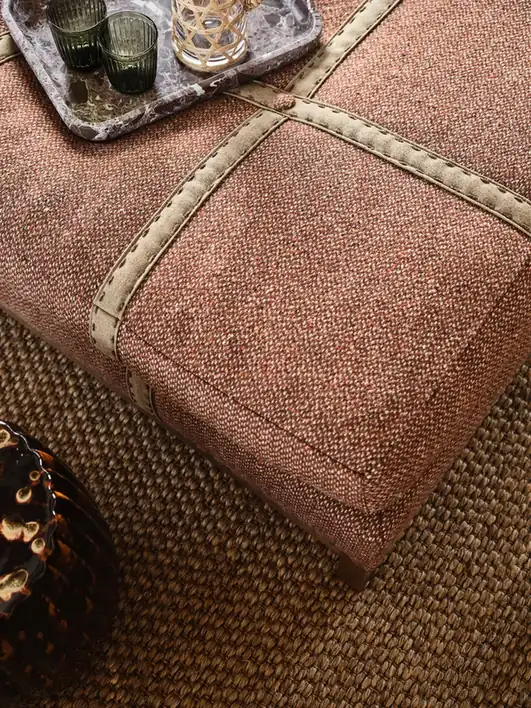
Layered rugs ask for a rhythm rather than effort. Vacuum the top rug weekly with the beater bar gentle or off for vintage weaves, vacuum the base monthly by folding the top back, and twice a year lift everything, vacuum both sides, and let the floor breathe. This close-up of a bound corner over a natural base is the view to inspect: edges and corners show wear, grit and curl before anywhere else.
Rotate the top rug a half turn every season so traffic and sunlight spread evenly, and rotate the base once a year. On move-out day the whole system shows its rental genius: roll both rugs, and the floor beneath is the floor the landlord remembers, often cleaner than the day you arrived. For the rest of the floor story, from peel-and-stick to boards, see how to cover ugly rental floors. Layering is the softest chapter of that book.
Spills follow the layers down, so treat from the top and blot, never scrub, working inward. A spill that reaches the base is a reason to lift and clean the same day; left between layers, it mildews in the dark and announces itself a month later.
Store a spare top rug rolled, not folded, when seasons change. Layering makes seasonal decorating cheap: the base stays all year, and the top swaps between a summer cotton and a winter wool, so the room changes its temperature without changing its furniture.
Care rhythm
Vacuum the top weekly, the base monthly, both sides twice a year. Lift and check under the stack each season: trapped grit is sandpaper working on the landlord floor.
Angles, Offsets and Round Rugs
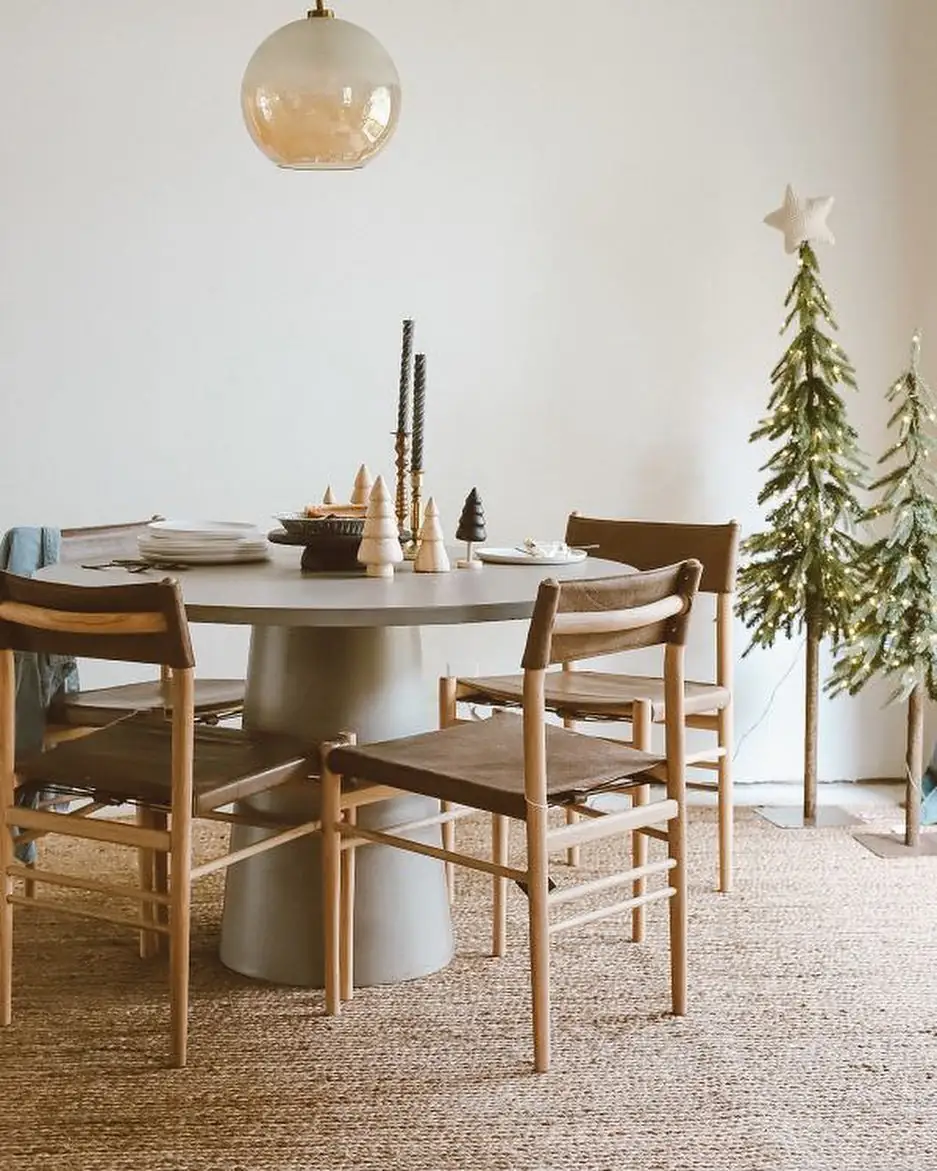
Not every stack is a pair of rectangles in perfect register. A top rug set at a slight angle over its base is the oldest decorator trick in this guide, and it works because the diamond of pattern energises a plain room and forgives a base that is not quite square to the walls. This dining setting keeps things simple with one natural layer under a round table, but picture a patterned round rug on top and the geometry starts to play.
Round top rugs deserve their own sentence in a renter guide: a circle over a rectangular base softens boxy rooms, suits round tables, and never shows a crooked edge, because it has no long straight edge to betray it. Offsets work too, a top rug pushed toward the sofa rather than centred, as long as the furniture agrees with the decision. The rule that survives every variation is the border: some base must show on the sides the eye compares.
Round rugs also rescue the awkward corner: a round top on the base where a room turns a corner gives the turn a centre, and a plant or a floor lamp standing on the circle completes the smallest room in the house.
Angle rules
A slight angle reads as style; a large one reads as an accident. Five to fifteen degrees, echoed by nothing else in the room, is the safe band.
How to Layer Rugs on a Budget: Where the Money Goes
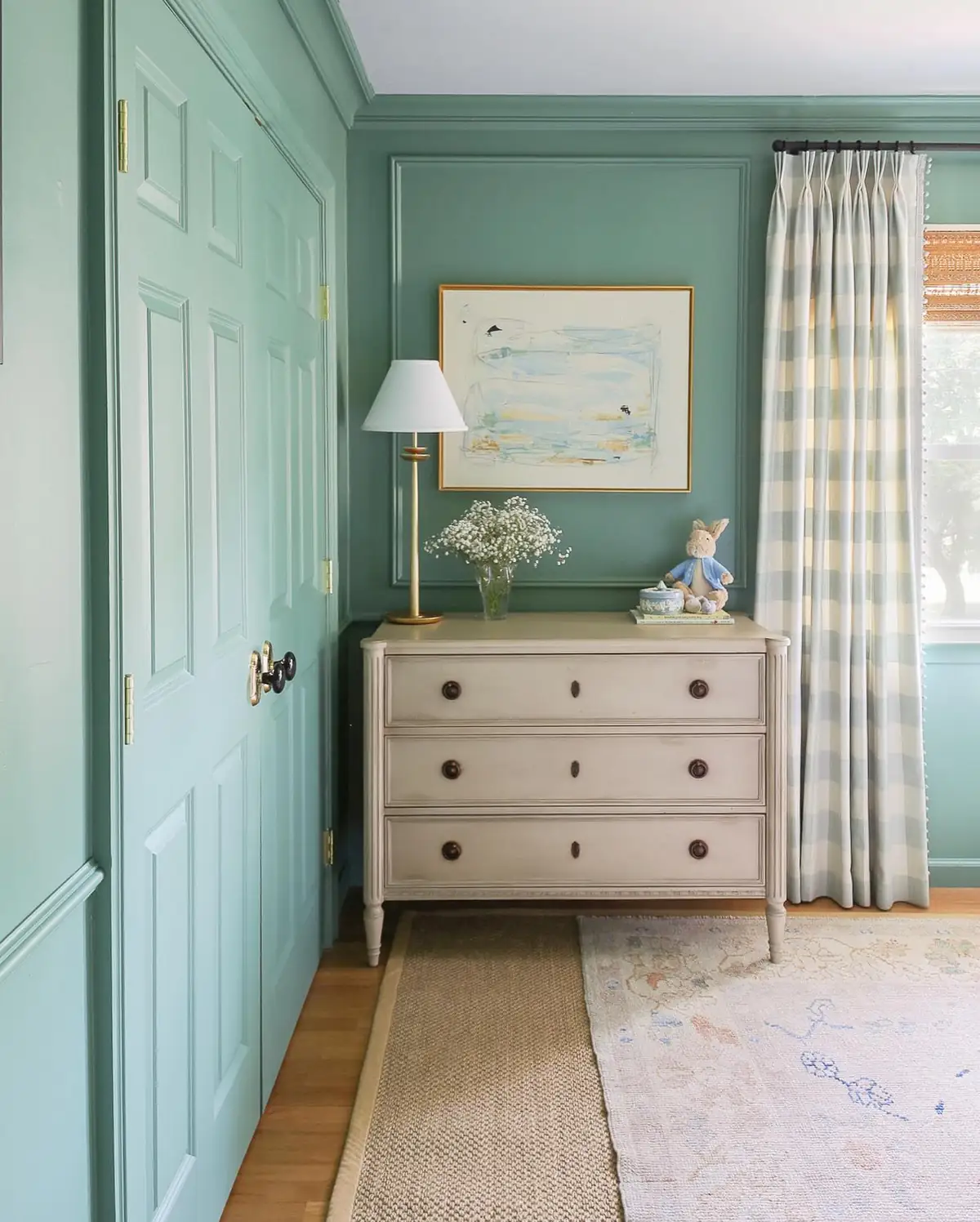
Layering sounds like buying two rugs instead of one, which sounds like spending more, until the sizes are priced. A large base in a plain flat weave is the cheapest floor covering per square foot that exists, and the top rug, the expensive taste, is bought small. This mint bedroom runs a simple natural runner along the bed, the budget version of the whole idea: coverage from the plain piece, pleasure from the placement.
Spend in this order: pad first, because it protects everything; base second, the biggest and plainest; top last, when the room has told you what it wants. Second-hand markets are full of small beautiful rugs and nearly empty of large ones, which is the market quietly agreeing with the layering method. A renter who layers rarely needs to buy a large lovely rug ever again.
There is one more budget trick hiding in plain sight: the top rug from a previous home, too small for the new room, is rarely too small to be a top layer. Layering is how beloved small rugs survive a move to a bigger floor.
Budget order: pad, base, top. If the money runs out after the base, the room still works, and the top rug can arrive on its own schedule.
How to Layer Rugs in Small Rooms and Studios
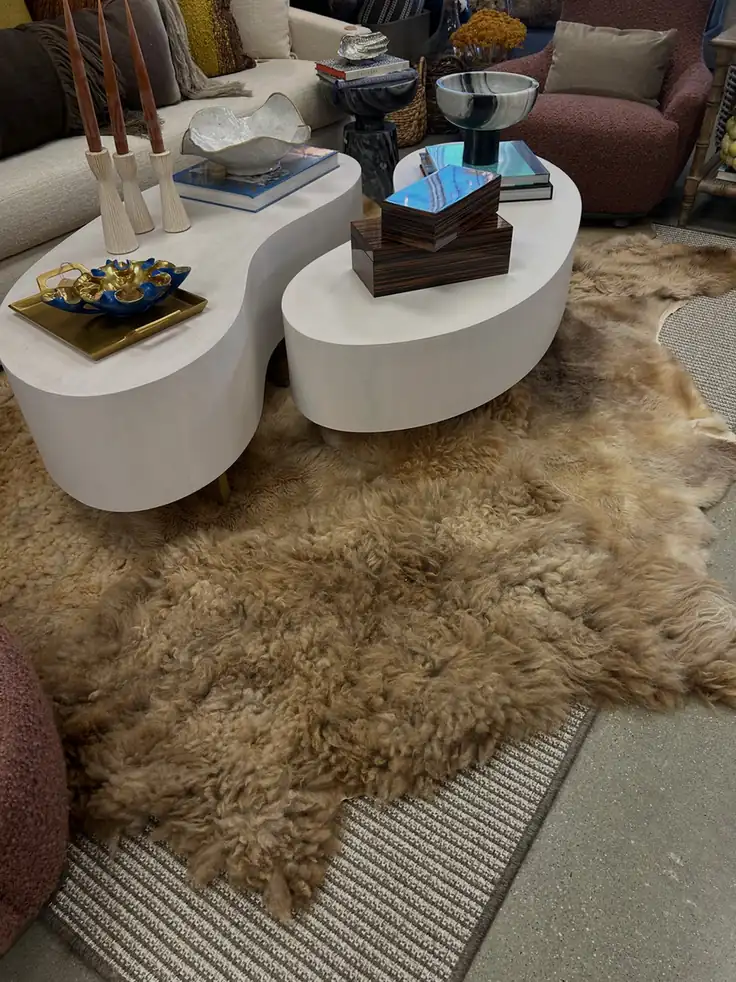
Small rooms layer with a lighter hand. The base hugs the floor wall to wall or nearly, and the top layer becomes a soft island where life happens, like the sheepskin thrown over the rug in front of these sofas. A hide or a small thick rug on top of a flat base is the small-space stack at its most honest: all the texture, none of the bulk, and the top piece lifts away for shaking in seconds.
In a studio, layering draws the map. One base across the living zone, a top rug under the sofa end, a runner by the bed, and the single room gains districts without a single screen or shelf. Keep the stack low in the walkways between zones, and let the borders of the rugs, not the furniture, do the dividing.
In the smallest studios the base can even run under the bed and out the other side, so the living stack and the sleeping runner share one foundation. It reads as one designed floor rather than two competing ones.
Small room stack
Base: as large as the room allows
Top: one soft island, hide or thick small rug
Walkways: kept to base thickness only
Renter Rules: Protecting the Floor and the Deposit
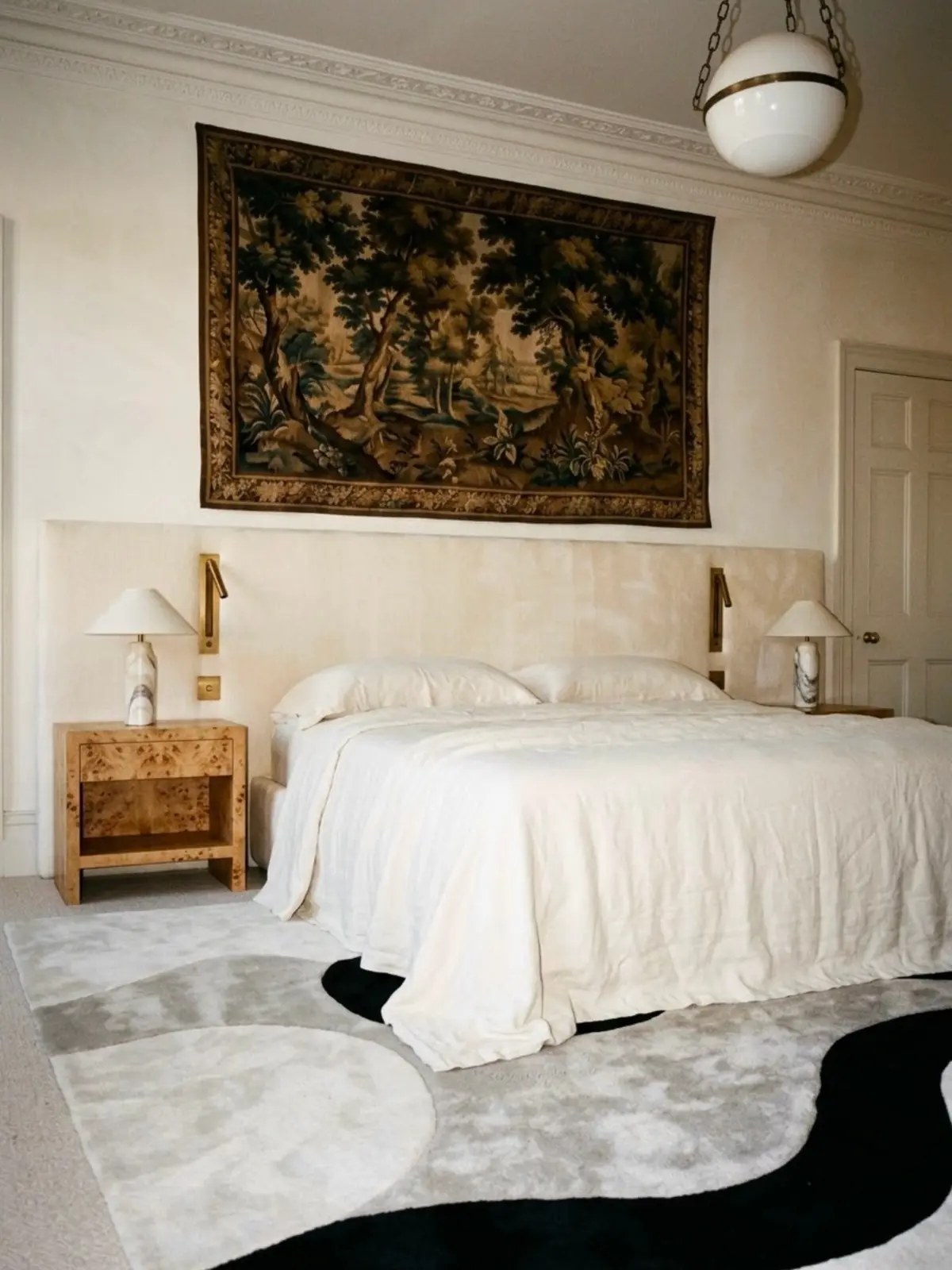
Everything in this guide is reversible, but reversible is not the same as careless. This bedroom pairs its wall tapestry with a shaped rug floating on the floor covering, and both pieces make the renter point: decor that touches nothing, fixes to nothing, and leaves nothing behind. Under a rug stack, the pad is the deposit protection, because some rug backings scratch boards and some dyes transfer to pale carpet under pressure and time.
Photograph the floor before the stack goes down and after it comes up, the same habit as the move-in inventory. Keep the pad between every rug and every floor, never let a rubber backing sit directly on pale carpet for a year, and lift the stack once a season to check. The landlord should find the floor exactly as documented, and ideally cleaner.
One honest caution about dye: a new, deeply dyed rug over a pale landlord carpet should spend its first month with a plain cotton sheet between the layers. Most dyes are fixed and harmless; the one rug in fifty that is not will announce itself on the sheet instead of the carpet.
Deposit palette: pale floor, wheat pad tones, warm wood, deep accent. Nothing in the stack should be able to stain, scratch or mark what lies beneath.
Sound deserves a line of its own: two rug layers and a pad noticeably dull the echo in a hard-floored room and the thump that reaches the flat below. In thin-walled rentals, a layered floor is sometimes the difference between neighbours who nod and neighbours who knock.
5 Rug Layering Mistakes That Ruin a Layered Rug Stack
1. Two patterns at war. One patterned layer per stack. When both rugs have designs, the floor argues with itself all day.
2. A fluffy base. Deep pile under a top rug makes it surf and wrinkle. The base must be flat, always.
3. No border. A top rug the same size as its base reads as a mistake, not a layer. Keep a visible border of base on all four sides.
4. Skipping the pad. Two rugs without a pad creep, curl and eventually slide. The pad is the cheapest part of the stack and does the most work.
5. Furniture floating off the rug. A top rug untouched by furniture legs will travel across the base. Anchor it with the sofa, the bed or the table.
FAQs About How to Layer Rugs
Can you layer rugs over carpet?
Yes, and it is one of the best reasons to layer. Use a carpet-to-carpet gripper under the base rug so the stack does not creep, keep the base flat and firm, and let the top rug carry the colour the landlord carpet lacks. The stack hides the carpet almost completely while staying fully removable.
What size should the top rug be compared to the base?
Smaller on all four sides, with a visible border of base showing, roughly a hand width to a forearm length. Common pairings are an 8 by 10 foot base with a 5 by 8 top, or a 9 by 12 base with an 8 by 10 top. Equal sizes read as one thick rug, not as layers.
What kind of rug works best as the base layer?
Flat, low and plain: jute, sisal, flat-weave cotton or a low-pile synthetic, in a quiet natural tone. The base is there for coverage and grip, not for attention. Save the pattern, the wool and the budget for the top layer.
How do I stop the top rug sliding on the base?
Start with a proper pad under the base, then add rug tape at the top layer corners or a thin non-slip mesh between the layers. Furniture legs on the top rug anchor it further. If the border keeps shrinking on one side, the top rug is creeping, so reset it and add more grip.
Is layering rugs safe, or a trip hazard?
Done properly it is safe: flat layers, a pad, taped or weighted corners, and low stacks in walkways. The risks come from curling corners and thick piles in traffic paths, which is why hallways get the flattest stacks and the most grip.
Will layered rugs damage the floor underneath?
No, when the pad is in place and grit is vacuumed out regularly. The pad protects the floor from the base rug backing, and the stack protects the floor from everything else. Check underneath each season, because trapped grit, left alone, is the only real danger.
What is the 70% rule for rugs?
The 70% rule says the top rug should cover about 70% of the base rug, so roughly a third of the base stays visible as a border. An 8 by 10 foot base with a 5 by 8 top is close to that ratio. Use the number as a guide, not a law: when the top covers almost the whole base, the layers read as one rug, and when it covers less than half, it looks like a mat dropped on a rug. Aim for most of the base covered, with a clear border on every side.
How do I layer two rugs in my home?
How to layer rugs in two layers is simple: start with a pad under the base rug, lay the biggest flat rug down first, then centre a smaller patterned rug on top so a border of base shows on every side. Put furniture legs on the top rug to hold the stack still, and walk the room before you call it done. Two layers are the sweet spot for renters: three rugs start to look and feel lumpy, and the door may not clear them.
One Last Thing
A layered floor is a decision you can unmake in twenty minutes, which is exactly what rental decorating should be. Base down, top on, furniture anchoring the corners, and the room has a floor that looks chosen. Start with the room whose floor bothers you most, measure honestly, and let the border show. If the floor itself needs heavier help first, our guide to covering ugly rental floors covers every stronger option.
Keep the receipts and a note of the sizes that worked. Rental homes change, rooms change with them, and a written record of your base and top sizes turns the next move from a fresh puzzle into a shopping list you already solved.
If you layer only one room this year, make it the one whose floor you apologise for when guests arrive. That apology is the truest measuring tool in this entire guide.

Elora Vania here, founder and Senior Editor of Home Aure. With years of experience in interior styling and home decor, I created this site to bring thoughtful, practical design advice to real homes—helping you create spaces that feel warm, personal, and beautifully lived-in.