
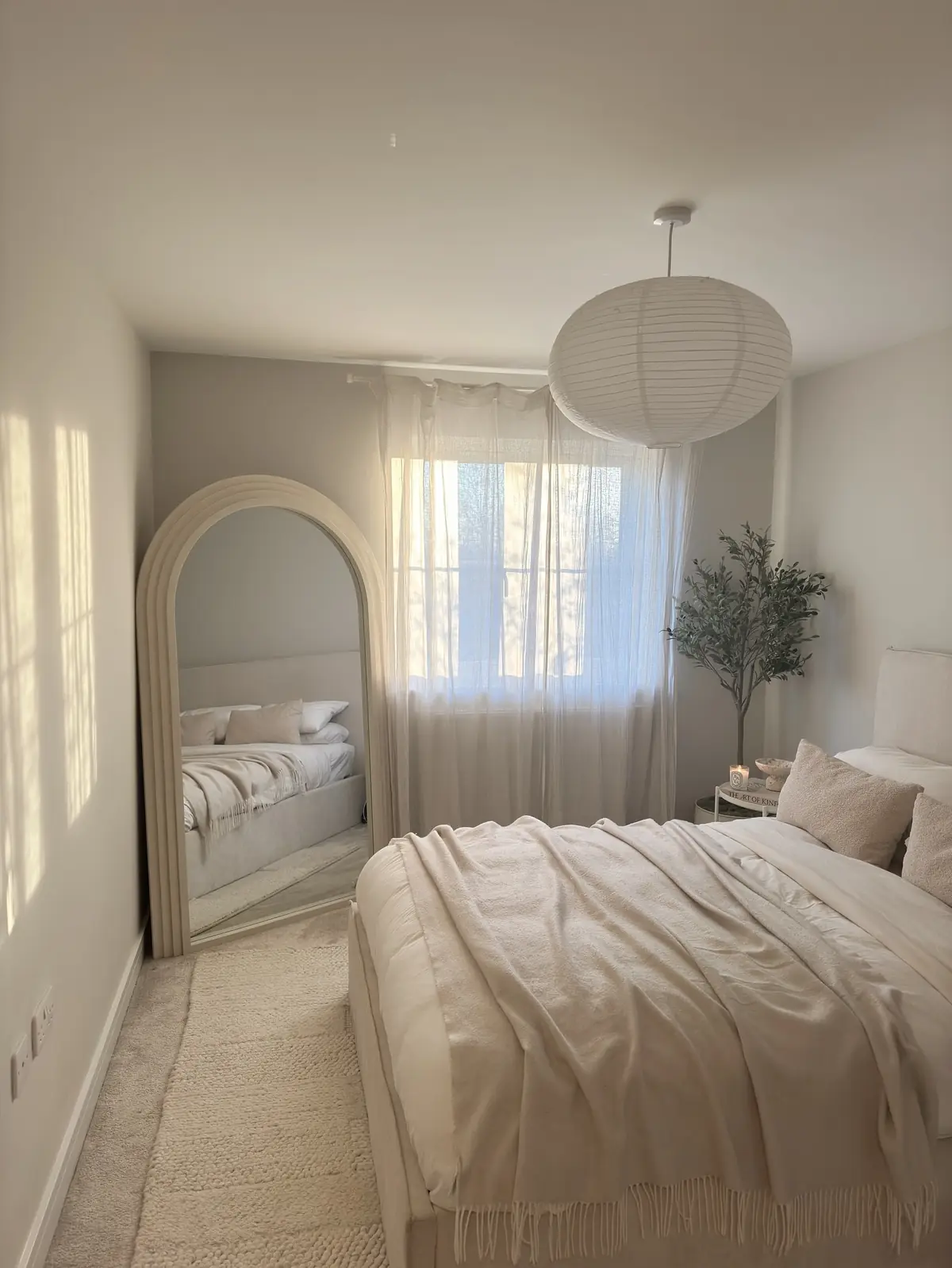
Most bedrooms do not feel restless because they lack nice things. They feel restless because too many things are visible at once: clothes on the chair, chargers across the floor, a bed made of four clashing colours, light that glares instead of glows. Calm is not a style you buy. It is what is left when the noise is removed. These bedroom decor ideas work in the order a calm room is actually built: the bed first, because it fills most of the room and sets every colour; then light and colour, the two things your eyes meet last at night; then storage, because clutter is only ever storage that failed; and finally a few chosen details. The cream room in the photo is the whole lesson: one palette, sheer curtains, bedding in soft layers, a mirror leaning where the light lands, and nothing in the frame that does not earn its place. Everything below is renter friendly, and most of it costs less than the duvet cover you already own.
Table of Contents
- Calm Bedroom Decor Ideas: Five Rules Before the Decor
- Dress the Bed in Layers, Not Piles, for a Calm Bedroom
- Give the Bed a Headboard for a Calm Bedroom, Real or Implied
- Let the Bedding Set the Palette: Bedroom Decor Ideas for Colour
- Keep the Bedside Down to Three Things: Calm Bedroom Decor Ideas
- Dim the Light in Layers: Bedroom Decor Ideas for Better Sleep
- Choose Colour Like a Volume Knob: Calm Bedroom Decor Ideas
- Dress the Window for Sleep: Calm Bedroom Decor Ideas
- Put One Green Thing in the Room
- Hide the Everyday in Closed Storage: Bedroom Decor Ideas for Clutter
- Work the Space Under the Bed: Bedroom Decor Ideas for Storage
- Give Clothes a Route That Is Not the Chair
- Let One Wall Carry the Personality
- Soften the Floor Beside the Bed
- Add Scent and Sound, Quietly
- Keep a Small Corner That Is Not for Sleep
- 5 Bedroom Decor Ideas Mistakes That Make a Bedroom Feel Cluttered
- FAQs About Bedroom Decor Ideas for a Calm Bedroom
Calm Bedroom Decor Ideas: Five Rules Before the Decor
Rule one: the bed is the room. In most bedrooms the bed takes up half the floor and nearly all of what you see from the door. Whatever the bed looks like, the room looks like. Spend your effort there first and the rest of the room needs half as much.
Rule two: calm is a count, not a colour. A beige room with thirty objects on show feels louder than a green room with ten. Decide how many things may be visible, then let storage absorb the rest. Colour helps, but counting helps more.
Rule three: every surface gets a limit. The nightstand holds three things, the dresser top holds a group, the floor holds furniture and one rug. Limits sound strict until you notice they are what hotel rooms do, and hotel rooms are what everyone photographs.
Rule four: light low, warm and never overhead at night. The last light you see shapes how the room feels. A small warm lamp at bed height is worth more to a bedroom than any picture on the wall.
Rule five: nothing in the bedroom should need apologising for. The broken blind, the bag waiting for the charity shop, the box that has lived in the corner since the move: each one is a small daily noise. Fix it, move it or hide it behind a closed door. Our greenery bedroom ideas start from the same discipline on the plant side: fewer things, each one placed on purpose.
The Bed Itself
Dress the Bed in Layers, Not Piles, for a Calm Bedroom
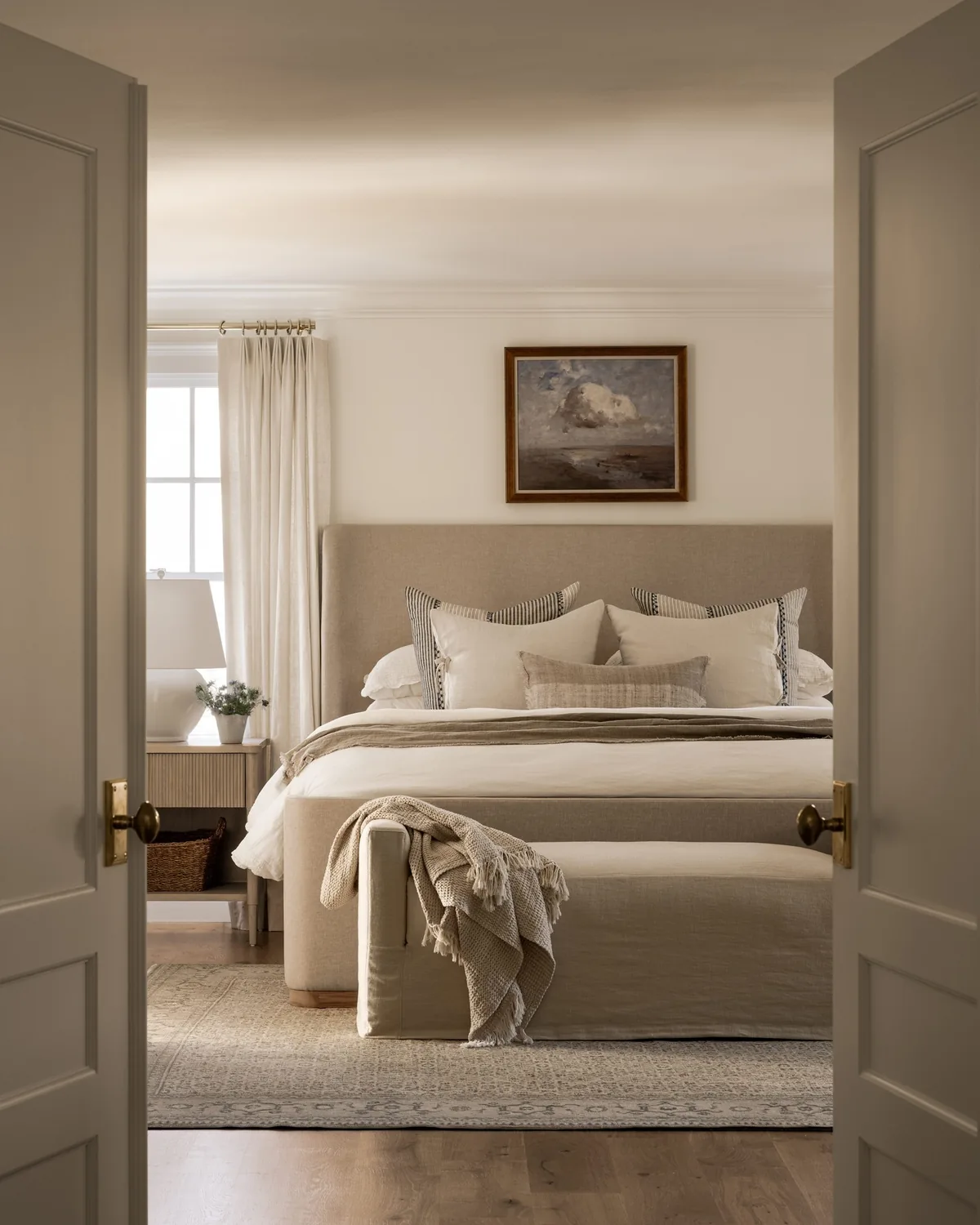
Walk through the doorway of this room and the bed does all the talking: tall soft headboard, white bedding in visible layers, a throw folded along the foot, a bench standing where a pile of clothes would love to live. Nothing here is patterned, nothing is loud, and the bed still looks generous. That is layering doing the work that piles pretend to do.
A layer is a full-width piece with a job: the sheet, the duvet, one throw or light blanket folded across the lower third, and sleeping pillows plus at most two cushions in front. A pile is the same items added without a stopping rule, until sitting on the bed means excavating it. The difference shows from the doorway, which is where a bedroom is judged every single morning.
Keep the layers in one family of tones, as this room does, and let texture supply the variety: smooth cotton against a nubby throw, linen against a flat weave. When the colours are cousins, three layers look restful. When every layer is a stranger, even two look busy.
The layers also have a season setting. In summer the duvet folds back and the throw becomes the top layer; in winter the throw goes over the duvet and a blanket joins between sheet and duvet where nobody sees it. The bed keeps the same face all year while its warmth changes underneath, which is exactly how a calm room should handle weather.
Make the bed properly for one week and watch what happens to the room around it. A made bed shames the floor pile into the wardrobe and the nightstand into order, because nothing looks right next to it until it behaves. It is the cheapest tidy in the house.
The layer count
Sheet. Duvet. One folded throw across the foot. Sleeping pillows, plus two cushions at most.
If a guest cannot see the sheet, there are too many layers. If the bed looks flat, there are too few.
Give the Bed a Headboard for a Calm Bedroom, Real or Implied

This bed is not even made, and it still looks composed, because the rattan headboard and the round woven hanging above it draw a frame around the bed and tell the eye where the bed ends and the wall begins. A bed without a headboard looks temporary, like camping indoors, however good the bedding is.
Renters have more headboard options than the furniture shops admit. A woven or upholstered panel leaning behind the pillows. Two large cushions in a firm fabric propped as a soft wall. A tapestry, a flat weave rug or a set of framed prints hung low in a row, marking the bed’s territory. Even a wash of removable wallpaper in a panel shape behind the bed does the framing job.
A headboard also buys the wall behind the bed some protection, taking the rub of pillows and hair that would otherwise mark paint you may not be allowed to repaint. In a rental, that quiet protection is worth as much as the look.
What matters is the outline: something wider than the pillows and taller than them, in a material that contrasts gently with the wall. Keep it light enough to move without help, and keep anything heavy off the wall directly above sleeping heads unless it is fixed by someone who knows fixings. In a rental, lean it, do not load it.
The implied headboard test
Stand in the doorway and squint. If you can still see where the bed zone ends and the wall begins, the headboard, real or implied, is working.
Let the Bedding Set the Palette: Bedroom Decor Ideas for Colour

Rooms that feel calm usually took their colours from the bed and repeated them twice more, nowhere else. This sage room works exactly that way: green walls, green cushions, neutral linens with a knit throw, wood tones underneath, and a woven mirror echoing the natural fibres. Count the colours and you will run out of fingers on one hand.
Start with the duvet cover, because it is the largest patch of colour in the room. Choose the palette there, two main tones and one accent, then repeat the accent in one cushion and one small object across the room, a book spine, a plant pot, a frame. Repetition is what turns three colours into a scheme instead of an accident.
Boho rooms prove this is not about being plain. The patterns in our Afrohemian bedroom ideas and in the boho bedroom guide look rich, yet they still run on a short palette repeated with discipline. Calm comes from the repetition, not from banning colour.
Neutrals do their best work here. A white or cream base accepts sage this year and rust the next, because only the cushions and the throw need to change. Buy the expensive pieces, the duvet and the rug, in the quiet tones, and let the cheap pieces do the colour experiments.
Wash day is the hidden test of a palette. Keep a second duvet set in the same family of tones, so the spare set does not break the room every laundry day. Two sets that both belong to the palette cost little and keep the scheme alive all year.
This room’s palette: sage, cream, warm wood, one terracotta spark. The duvet chose it; everything else repeats it.
Keep the Bedside Down to Three Things: Calm Bedroom Decor Ideas
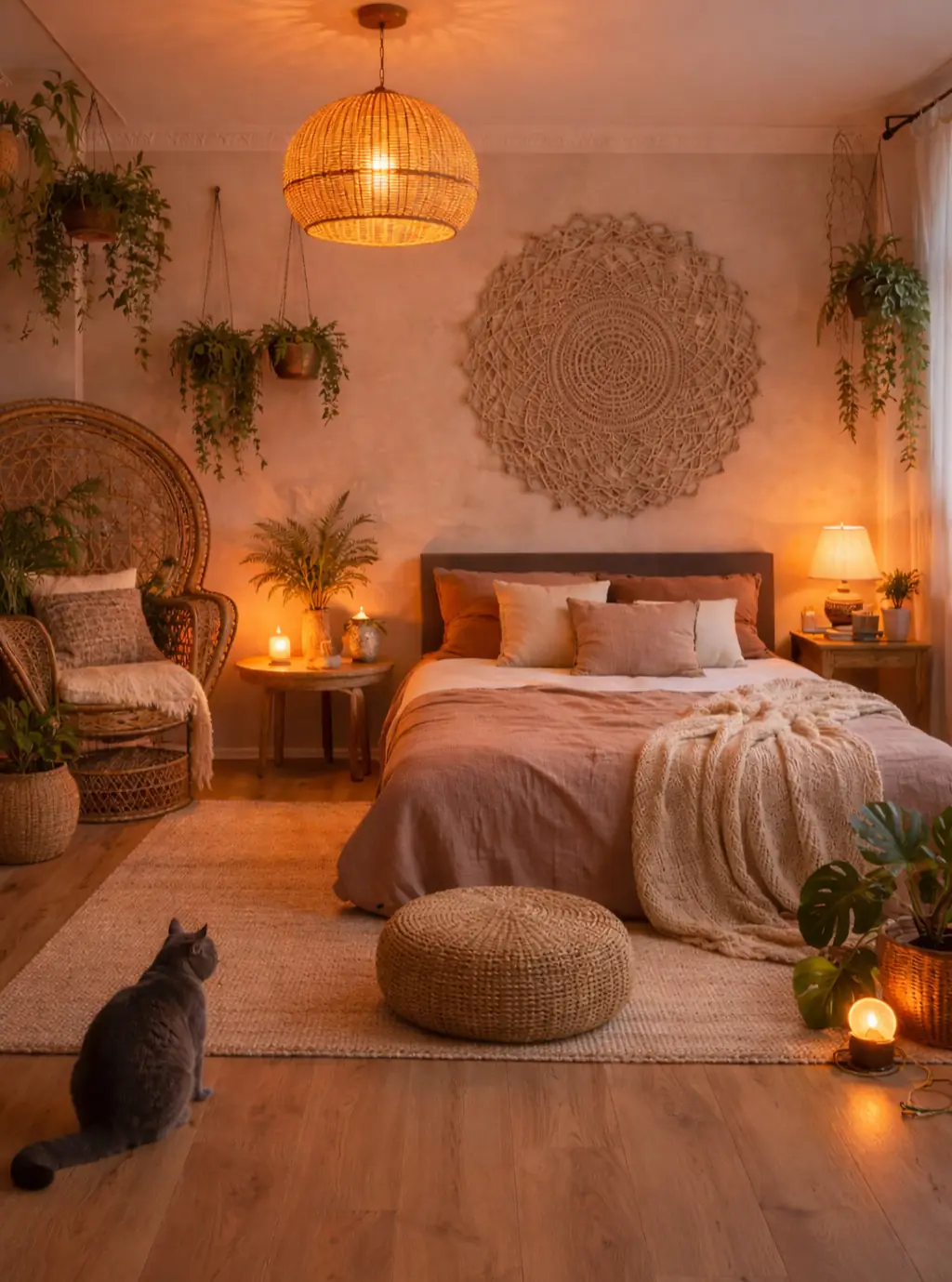
Evening is when the bedside earns its keep, and this room keeps it honest: a small table, a light, a plant nearby, lamplight doing the rest. The nightstand is where clutter starts in most bedrooms, because it is the closest surface to a tired person. Books, bottles, chargers, glasses, receipts: the table collects the day.
Set its population by rule. Three things live there: the lamp, the current book, and one small tray or bowl that catches the watch, the ring and the glasses. Everything else needs another home, and the charging cable belongs in the tray or behind the table, not across the pillow by morning.
If your nightstand has a drawer or a shelf, the rule gets easier: the three things stay on top and the rest goes inside, still edited. If it is an open stool or a stack of books doing table duty, the rule matters more, because everything on show is on show all night.
Height matters at the bedside more than size. The table’s top should sit near the mattress top, so a book or a glass lands safely at the reach of a half-asleep arm. Too low and things get knocked to the floor; too high and they get knocked onto you.
Look at the evening photo again and notice what the bedside does not hold. No phone glowing, no water glass army, no paperwork. The room feels like the end of the day because the day has been put away, and the little table by the bed is where that putting away starts.
Nightstand, population three
One: the lamp. Two: the book you are actually reading. Three: one tray for the small loose things.
Everything else is a guest, and guests go home.
Light, Colour and Air
Dim the Light in Layers: Bedroom Decor Ideas for Better Sleep
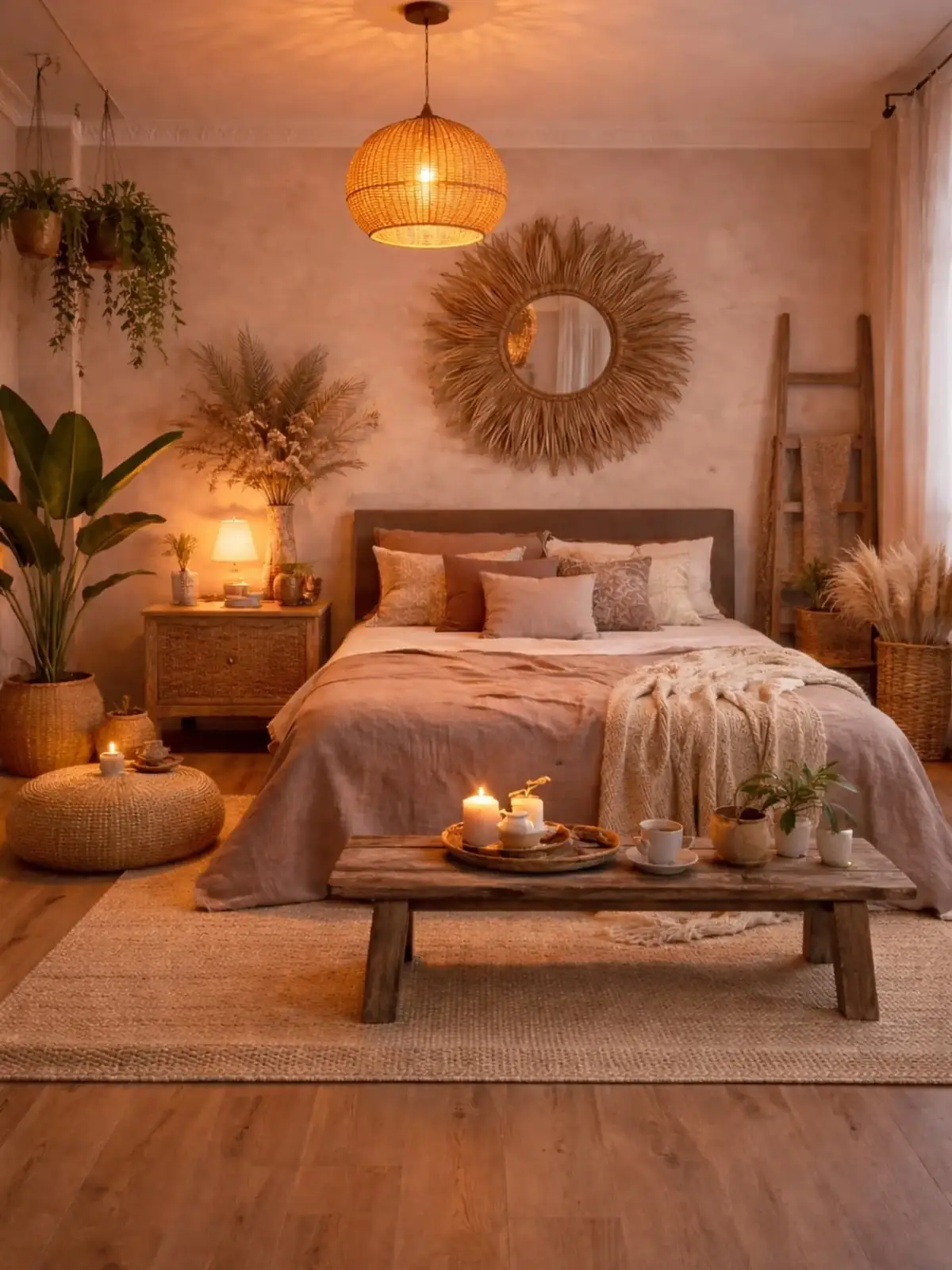
This room at night is a lighting diagram: pendant glowing low over the room, lamps at the bedside, small warm points in the corners, and nothing white or overhead anywhere. Bedrooms feel calm after dark in direct proportion to how low and warm their light is. The ceiling light is for finding socks, not for evenings.
Build two layers and you are most of the way there. A bedside lamp on each side, or one lamp plus a string of warm fairy lights where a second lamp will not fit, gives the living layer. A low glow, a candle on the dresser, a small lamp on a shelf, gives the mood layer. Use them together and the room reads lamplit; use the ceiling light alone and it reads examined.
Shades are half the lamp. A bare bulb, however warm, glares; a fabric or paper shade spreads the light and softens every edge it touches. If a bedside lamp feels harsh, change the shade before you change the bulb, and never point a lamp at the pillow from above.
Warmth is a number as well as a feeling. Bulbs in the bedroom should match each other and sit at the warm end of the scale, the ones sold as warm white. One cool bulb among warm ones sticks out like a dentist’s chair, and the mismatch is exactly the kind of small noise this guide keeps removing.
Renters can do all of this without touching a wire: plug-in lamps, battery candles, fairy lights on a timer. Put the bedside lamps on the switch you can reach from the pillow. A lighting scheme you have to get out of bed to turn off is a scheme that will be defeated nightly.
Two layers after dark
Living layer: bedside lamps at pillow height. Mood layer: one low warm glow in a corner.
The ceiling light is a tool, not a mood. Retire it after sunset.
Choose Colour Like a Volume Knob: Calm Bedroom Decor Ideas

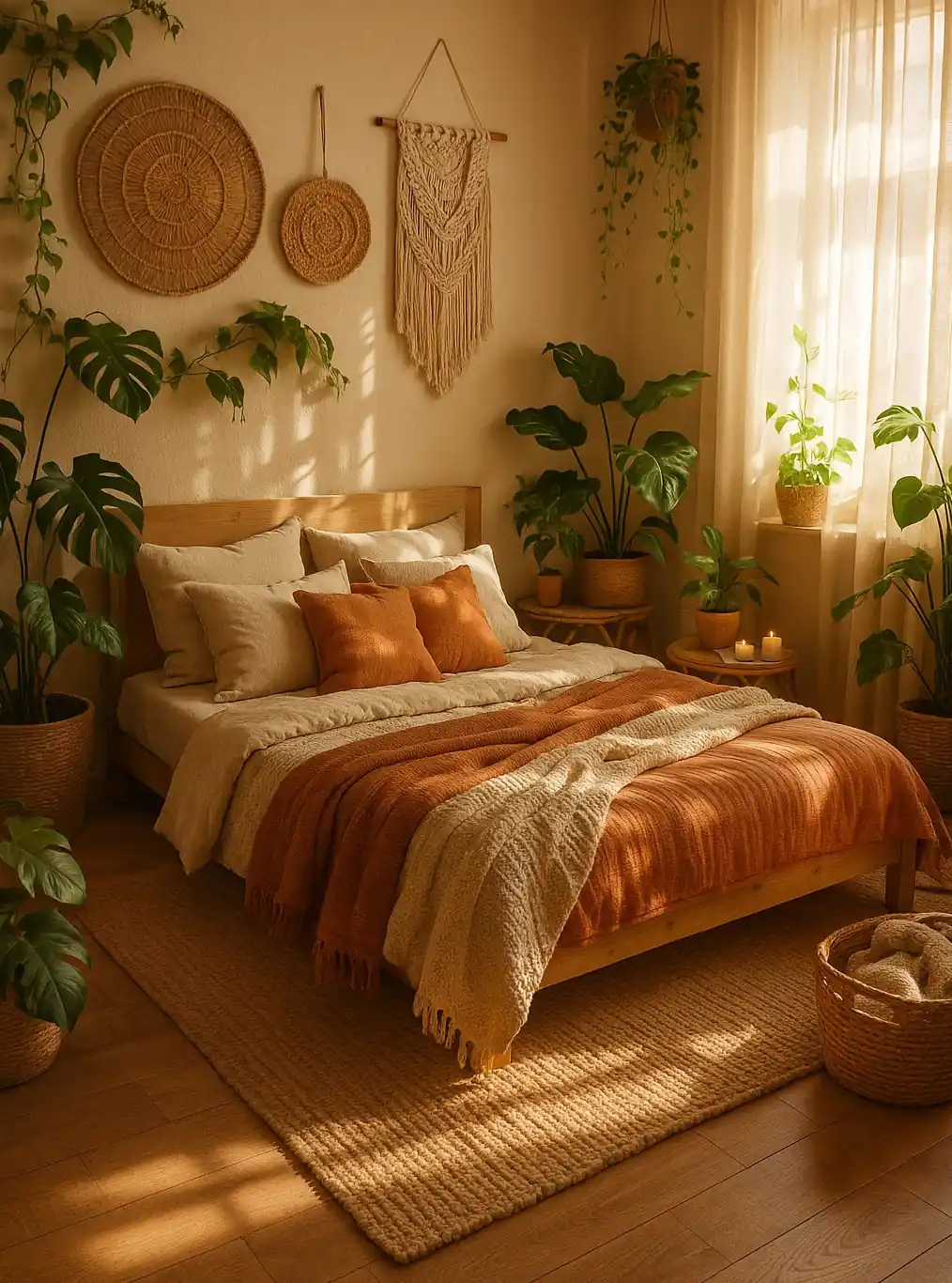
Colour in a bedroom behaves like volume. This room turns it up with rust bedding and orange-toned cushions, yet stays calm, because the walls, the rug and the throws stay quiet and the loud colour lives in one place only: the bed. The trick was never avoiding colour. It was deciding where the colour is allowed to shout.
Turn the knob by surface size. The bigger the surface, the quieter its colour should be, unless it is the one chosen loud piece. Walls and rugs cover the most area, so they carry the calm tones. Bedding can carry the accent because it can also be changed in ten minutes when the mood passes.
There is a middle setting that suits most renters: quiet walls you cannot paint anyway, mid-tone bedding, and colour in the two smallest, cheapest things, cushions and a throw. When the season or the taste changes, the room changes for the price of a cushion cover.
A word for dark colours, because calm is not a synonym for pale. A deep green or charcoal bedroom can feel like a cave in the best way, wrapping the room around the bed, if the bedding stays lighter than the walls and the lamps are warm. The volume rule still holds: one loud surface, quiet company.
Check the room in the light it is actually used in. Colours chosen under shop lights or midday sun can argue at lamplight. Live with a cushion cover for a week before committing to the matching curtains, and let the evening vote.
Volume, set sensibly: rust loud on the bed only, cream and linen quiet everywhere else, dark wood as the bass note.
Dress the Window for Sleep: Calm Bedroom Decor Ideas
The hero room earns a second look for its window alone: sheers that turn daylight into a soft wash, no glare, no hard shadows, the bed lit like a photograph all day. Window dressing is the bedroom’s light switch for the sun, and in a rented room it is also one of the few big soft surfaces you are allowed to change.
Work in two layers where you can. A sheer or light curtain for the day, filtering light and giving privacy without darkness, and a heavier curtain or a blackout liner for the night if street light or early sun steals your sleep. The sheer does the beauty work; the heavy layer does the sleep work; together they finish the wall the window sits in.
Renters hang them on tension rods inside the frame, on the landlord’s existing rod with better fabric, or on clamp and adhesive brackets where rods are banned. Length matters: curtains that reach the sill or the floor look settled, and ones that stop halfway down the wall look like they are waiting for the rest of the fabric to arrive.
Blackout has a renter’s shortcut worth knowing: a blackout liner clipped behind the existing curtain with ring clips, no new rod and no holes. It hangs from the same rail, hides behind the pretty fabric by day, and turns a bright street-lit room properly dark at night.
Keep the window’s own clutter at zero. Sills in bedrooms become shelves for mugs and mail because they are flat and near the bed. Give the sill one job, a plant or nothing, and the light comes in cleaner for it.
Two-layer window rule
Sheer for the day, heavy for the night. If you can only hang one, hang the sheer and add a sleep mask; the room will still look twice as calm by day.
Put One Green Thing in the Room

One plant changes a bedroom’s air in a way no object can copy, because it is the only thing in the room that is alive and unbothered. This white room keeps the count low and deliberate: hanging plants flanking one botanical print, a dark green throw answering them from the bed. Green appears twice, the room breathes, and nothing tips into jungle.
Choose by light and by honesty about watering. A bright room can carry most common houseplants; a north-facing room wants the shade-tolerant kinds. One plant that thrives beats four that are negotiating. If your record is poor, start with a single famously forgiving plant and let it earn you a second.
Pets edit plant choices the way they edit everything: anything within reach should be from the non-toxic lists, and the precious or fragile specimens go high, on the shelf or the hanging planter. A plant knocked off a nightstand at 3 a.m. is the opposite of the calm it was bought for.
Place it where the eye rests: on the dresser facing the bed, hanging beside the window, or tall in the emptiest corner. Keep it off the nightstand, which already has its population of three, and out of the walkway, which is sacred in every room this site writes about.
The greenery specialists on this site go further, with plants at three heights and whole planting schemes, in our greenery bedroom ideas. This broad guide keeps the claim small and true: one green thing, placed on purpose, is enough to change the room’s temperature.
One plant, three placement rules
Where the eye rests from the bed. Matched to the light you have, not the light you want. Off the nightstand and out of the walkway.
Green repeated once more, in a throw or a print, and the plant looks like a plan.
Storage That Hides
Hide the Everyday in Closed Storage: Bedroom Decor Ideas for Clutter

The deepest calm in this minimal room is not the grey bedding or the single picture. It is the floor: clear from wall to wall, nothing stored in view, nothing waiting in corners. That emptiness is not a lack of belongings. It is belongings with doors in front of them.
Open storage shows everything it holds and charges your eyes rent for all of it, all day. Closed storage, a wardrobe with doors, a dresser with drawers, boxes with lids inside a cupboard, charges nothing. In a bedroom, where the whole purpose is rest, the closed kind should win nearly every argument.
Renters cannot rebuild wardrobes, but they can close what is open: fabric boxes that turn an open shelf into a row of calm rectangles, a curtain on a tension rod across an open closet or shelving unit, lids on the baskets. Each cover removes a small crowd of visible objects from the room’s count.
Doors deserve a sentence of their own. A wardrobe door that will not close turns closed storage back into open storage visually, because the eye reads the gap. If a door is stuffed shut, the wardrobe is over capacity, and the honest fix is fewer clothes or one more box under the bed, not a stronger push.
Audit the room from the bed, the way you actually see it at night. Everything visible that is not beautiful or useful this week goes behind a door, into a drawer or out of the room. The view from the pillow is the view that decides whether a bedroom feels calm.
The pillow audit
Lie in bed. Look slowly around. Anything you can see that is neither lovely nor needed this week gets a door, a drawer or a new home.
Repeat monthly. Clutter returns quietly; the audit is the alarm.
Work the Space Under the Bed: Bedroom Decor Ideas for Storage
Under the bed in a small bedroom is a spare room lying on its side, roughly the size of the bed itself, and most households use it as a place where lost things gather dust. The calm room in the photo, with its bench at the foot and nothing underfoot, is what a bedroom looks like when the hidden storage is organised enough that none of it escapes into view.
Claim the space with containers that fit it: low boxes or soft zip bags on wheels or sliders, one category per container. Off-season clothes, spare bedding and the guest towels are the classic tenants, because they are needed rarely and missed never. Measure the clearance before buying boxes; bed frames vary and a box that almost fits fits nothing.
Vacuum bags earn a warning label here: they are wonderful for duvets and dreadful for anything with feathers or natural loft used weekly, and they make boxes odd shapes that stack badly. Use them for the deep archive, the things you touch twice a year, and keep weekly things in honest rectangular boxes.
Label the foot end of each box, the end you can see when you kneel. Future you, looking for the winter duvet in the dark, will be grateful. Keep the most-used container at the easiest corner and the archives at the far side.
If your bed sits low with no space beneath, the same thinking moves up: the top shelf of the wardrobe takes the rare things, in the same labelled boxes. The principle is not the under-bed. It is that seldom-used things should live in the least convenient storage, saving the easy places for daily life.
Under-bed tenancy rules
Rarely used only: off-season clothes, spare bedding, guest towels. One category per box, label at the foot end, most-used box at the easiest corner.
Give Clothes a Route That Is Not the Chair

Every bedroom knows the chair: the one that disappears under worn-once clothes until it is more wardrobe than furniture. This night room, for all its rumpled boho ease, has no chairdrobe in sight, and its calm at candlelight is partly that absence. Clothes in transit are the number one visible clutter in real bedrooms.
Give them a route with three stops. Worn once and clean: a small row of hooks or a slim rail on the wall or door back, where a few pieces can hang in the open without becoming a pile. Worn and finished: the laundry basket, ideally with a lid, in the corner where clothes actually come off. Clean and waiting: straight back to the wardrobe, skipping the chair entirely.
The basket’s lid is doing more work than the basket. An open basket of worn clothes still shows the room a pile; a lidded one shows it a piece of furniture. If your basket has no lid, a folded throw over the top does the same job with softer manners.
Hooks are the renter’s best friend here: over-door racks and adhesive hooks rated for the weight need no holes and leave no marks. Keep the open hanging short, three or four pieces, so it reads as a rail and not a shop floor.
The chair, freed, can go back to being a chair, or leave the room and take its temptation with it. Many calm bedrooms are simply bedrooms whose chair was demoted. If a corner needs filling afterwards, the reading nook section at the end of this guide has a better use for it.
The three-stop route
Hooks for worn-once. Basket with a lid for finished. Wardrobe for clean, no chair in between.
A route that exists gets used. A chair that exists gets buried.
The Calm Details
Let One Wall Carry the Personality
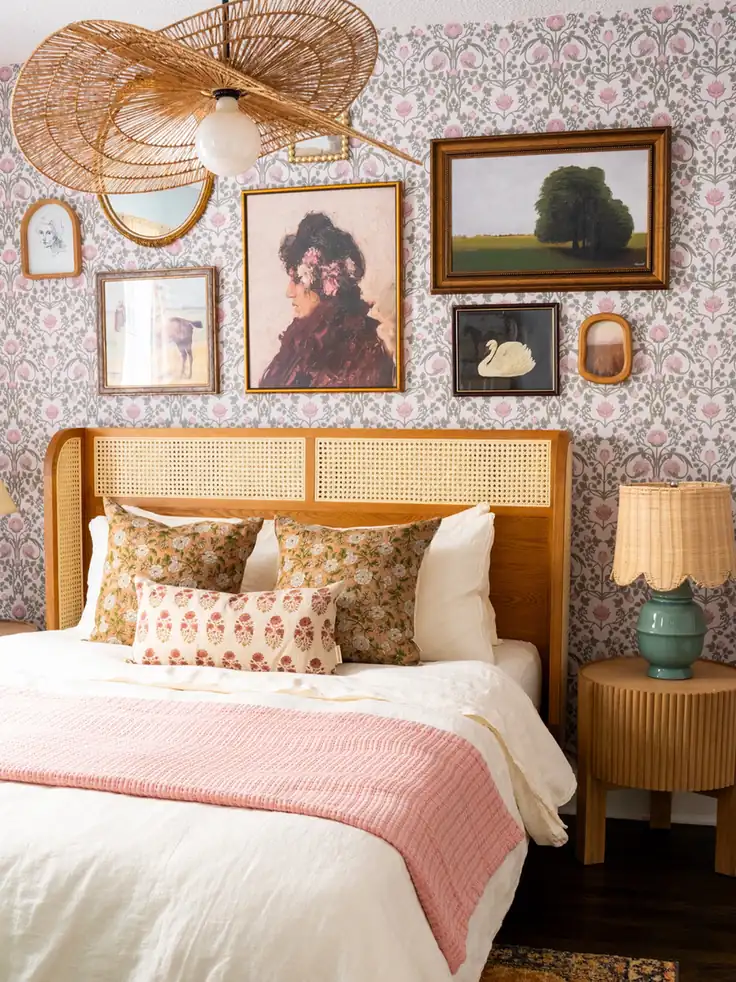
If the bed is the room’s body, one wall is its face, and this cane-headboard room gives that wall the full treatment: a gallery of framed pictures over patterned wallpaper, while every other surface stays quiet. Personality concentrated in one place reads as character. Personality spread over four walls and a ceiling reads as noise.
Renters personalise the wall behind the bed most easily, because the bed hides the bottom half and the wall is what you see from the door. Frames on adhesive strips, a leaning picture ledge on a dresser, removable wallpaper on that one wall, or a single large print: the method matters less than the concentration.
One large piece can replace the whole gallery if hanging many frames feels like homework: a textile, a woven hanging or a big print in a light frame gives the wall its personality in a single decision. The sage room earlier in this guide does it with one round woven mirror, and nobody misses the gallery.
Hang the group so its centre sits at the eye level of someone standing, lower than feels natural, so the gallery belongs to the bed rather than floating above it. Mix frame finishes in no more than two families, and leave one patch of wall inside the group empty; even a gallery needs a breath.
The other walls then get an easy life: a mirror on one, which the next rooms on this site use for light, and nothing at all on the rest. Our mirror decor ideas show how much work one well-placed mirror does. Bare walls are not unfinished walls. They are the silence the one loud wall needs.
Gallery frame families: warm wood and antique gold, with cream mounts. Two families mix calmly; five argue.
Soften the Floor Beside the Bed

The first thing your feet meet in the morning should be softness, and the last thing at night the same. This rustic room dresses its floor the way it dresses its walls, in natural fibres and quiet pattern, with the bed’s white linens keeping the whole composition light. A rug beside or under the bed is the floor’s version of the folded throw: small, soft and entirely about how the room feels to the body in it.
Size it for feet, not for photographs. A runner down the side where you get out, or a larger rug under the lower two thirds of the bed with a margin on both sides: either gives bare feet a warm landing in every season. In a rental, it also mutes footsteps for the neighbours below, which is calm you can hear.
Warm floors have one more friend in this room: the rug should start where the feet land, not where the furniture plan says. Slide it toward your side until the first step of the morning lands fully on it. A rug that begins six inches too far away is a rug that fails twice a day.
Choose a low, tight pile beside a bed; fluffy rugs shed, trip dressing gowns and fight with doors. A pattern with some movement hides the evidence of daily life between washes, and washable is a word worth paying for in a room where morning coffee travels.
If budget is short, one good runner on your own side of the bed beats a cheap rug under all of it. The room is experienced one bare foot at a time.
Bedside floor, sized honestly
Runner on the getting-out side, or a rug under the bed’s lower two thirds with a margin both sides. Low pile, washable, patterned enough to forgive.
Your feet grade the room before your eyes do.
Add Scent and Sound, Quietly
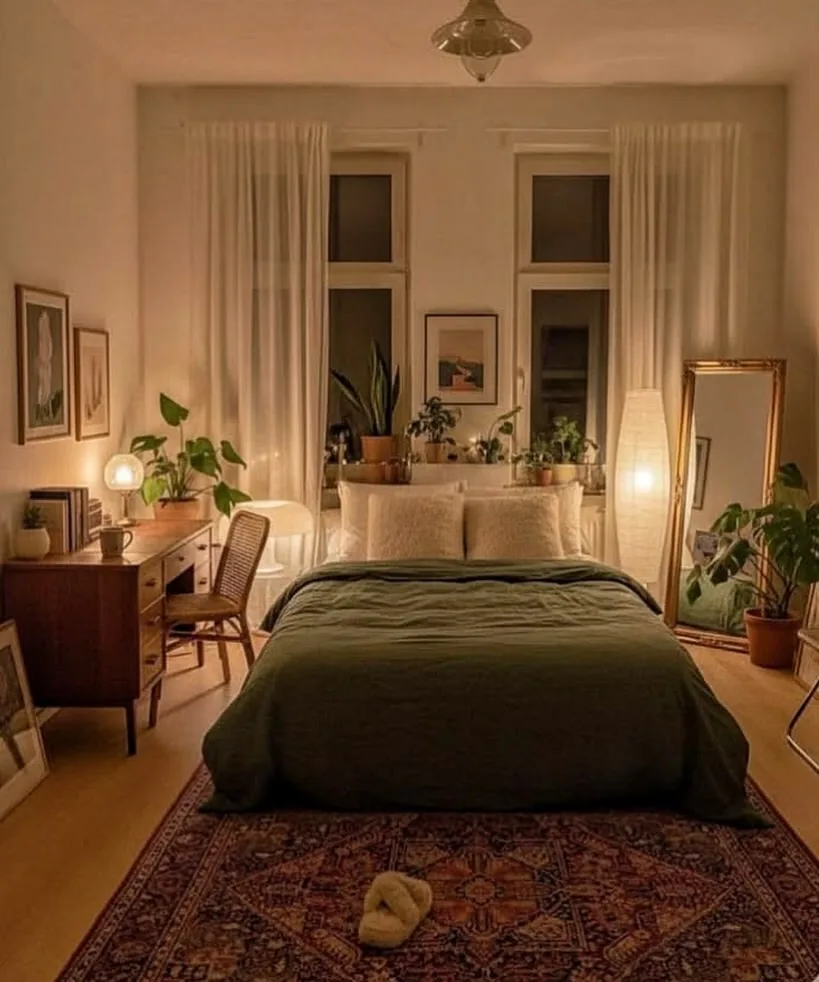
Calm is not only visual. This deep green room at night, plants on the sill and sheers closed against the dark, is a room designed for the senses that remain when the lights go out: the air, the quiet, the faint smell of something pleasant. A bedroom that looks calm but smells of laundry pile and sounds like a corridor is calm in photographs only.
Scent wants the smallest possible hand. A reed diffuser on the dresser or a single candle burned for an hour before bed scents a small room fully; two competing scents are another form of clutter. Keep flames on a stable surface away from curtains and bedding, and never let a candle be the thing you fall asleep watching. Our candle and reed diffuser ideas compare the safe options room by room.
Sound is mostly subtraction: the door that squeaks gets a drop of oil, the rattling blind gets a felt pad, the phone charges in another room or face down in the tray. What is left, rain on the window or a low fan, the brain files as silence.
Air belongs on the checklist too. A bedroom aired for ten minutes in the morning smells like nothing, which is the correct smell for a bedroom. Stale air makes even a tidy room feel used, and no diffuser covers it for long; open the window first, scent second.
Finish the night routine where the room can help: the same low lamp, the same scent, the same order of small actions. Bedrooms feel calm partly by repetition, and the decor’s job is to make that repetition easy to keep.
The senses checklist
One scent, low and single. No flame near fabric, ever. Squeaks and rattles fixed, not forgiven. Phone out of the bed’s orbit. What remains is quiet.
Keep a Small Corner That Is Not for Sleep

A bedroom that is only for sleep and storage can start to feel like a waiting room for the night. This sunlit room suggests the fix, with its dressed shelf of art and plants giving the eye a daytime destination: one small corner or surface that serves waking life, a chair and a lamp for reading, a tiny desk, a shelf styled like a picture you live inside.
Keep the corner small and single-purpose. A reading chair with its own light is the classic, and it rescues the chair from the clothes route by giving it a job with dignity; our reading nook ideas build whole corners on the same principle. A vanity or a writing surface works the same way if it stays edited to its three things.
The corner also gives the room’s personality a second, smaller stage, so the gallery wall does not have to carry everything: the shelf here holds the small art, the plants and the books that the bedside table was forbidden.
Guard the border between the corner and the bed’s calm. Work papers and laptops live in the corner’s drawer or leave the room at night; the corner serves the day, the bed serves the night, and the room holds both without mixing them.
One corner, one job
Chair plus lamp plus one small surface, or a shelf styled as a picture. Work things sleep in the corner’s drawer, never on the bed.
A room with a daytime corner feels lived in. A room without one feels waited in.
5 Bedroom Decor Ideas Mistakes That Make a Bedroom Feel Cluttered
1. Treating every surface as storage. Nightstands, dresser tops and windowsills that hold everything hold nothing well. Give each surface a population limit and let closed storage take the overflow.
2. One bright ceiling light as the whole scheme. It flattens the room and keeps the brain alert. Warm lamps at bed height, layered low, are the difference between a bedroom and a waiting room after dark.
3. A bed made of clashing leftovers. Mismatched bedding in four competing colours makes the biggest object in the room the loudest. One palette, repeated, calms the whole space from the doorway.
4. The chairdrobe. Worn-once clothes piled on a chair are visible clutter with a daily growth rate. Hooks, a lidded basket and a route back to the wardrobe end it in a weekend.
5. Decorating before decluttering. New cushions on a crowded room just raise the crowd’s production values. Count first, store second, and only then decorate what remains.
FAQs About Bedroom Decor Ideas for a Calm Bedroom
What colours make a bedroom feel calm?
Soft, warm tones on the large surfaces: whites with warmth in them, creams, sage and other muted greens, pale wood tones. Calm comes more from limiting the count, two main tones plus one accent repeated around the room, than from any single magic colour. Bold colour can stay if it lives in one place, like the bedding.
How do I make a small bedroom feel less cluttered?
Reduce what is visible. Move storage behind doors and into drawers, claim the under-bed space with labelled boxes, give clothes a route that skips the chair, and set a population limit for every surface, starting with three things on the nightstand. The room does not need to be bigger; it needs fewer things on show.
How can I decorate a rental bedroom without painting or drilling?
Nearly everything in this guide: bedding and throws for colour, a leaning headboard panel or tapestry, adhesive hooks and strips within their ratings, plug-in lamps and fairy lights, curtains on tension or existing rods, and plants. Nothing needs paint, holes or permission, and all of it leaves with you.
How many cushions should a bed have?
Sleeping pillows plus two decorative cushions is the calm count for most beds. More than that becomes a nightly excavation and a morning rebuild. Choose the two in the room’s accent colour and a texture that contrasts with the duvet, and let them be the bed’s jewellery.
What should I keep on my nightstand?
Three things: the lamp, the book you are currently reading, and one small tray for the watch, glasses and phone. Everything else, bottles, spare books, paperwork, belongs in the drawer, the dresser or another room. The limit is what keeps the last view of the day calm.
Where do I start if my bedroom feels chaotic?
Start with the bed, because it is the room. Strip it to one palette, layer it neatly, and clear the floor on both sides. Then run the pillow audit: lie down, look around, and move everything visible that is neither lovely nor needed this week behind a door. Decor comes after both steps, and by then the room usually needs less of it than you feared.
What are the bedroom design trends for 2026?
Bedroom decor ideas in 2026 lean toward layered, lived-in calm: warm wood, woven textures, sage and rust tones, tall headboards and soft low light instead of bright ceiling lights. The look is collected over time, not bought in one trip, with one green plant, a gallery wall and a made bed doing most of the work. Everything a renter can do, nothing that needs permission.
What are the 7 golden rules for bedroom design?
Seven rules cover most of what a calm bedroom needs: put the bed first, because it is the room; count what is visible and keep it low; give every surface a limit; keep the light low, warm and off the ceiling at night; hide the everyday in closed storage; let one wall carry the personality; and keep one small corner that is not for sleep. Follow those and the room stays calm even when life is not.
One Last Thing
A calm bedroom is not bought in one trip or finished in one weekend. It is what remains when the bed is dressed on purpose, the light is low and warm, the colour count is small, and everything else has a door to hide behind. Work in that order and the room starts doing its one job, which is ending the day well. If plants are your next layer, the greenery bedroom ideas are waiting. Count first. Then make it beautiful.

Elora Vania here, founder and Senior Editor of Home Aure. With years of experience in interior styling and home decor, I created this site to bring thoughtful, practical design advice to real homes—helping you create spaces that feel warm, personal, and beautifully lived-in.