
Most boho rooms online look great in a photo and give you nothing to copy. You see a warm room full of plants and woven things, but nobody tells you how many cushions are on that sofa, how big the wall hanging is, or where the light is coming from. So you buy two random items, they do not match anything, and the room still feels plain.
This post works the other way round. Every one of these 25 boho home decor ideas comes from a real room, and each one gives you the working details: sizes, counts, heights, colors and the order to add things. Most ideas also carry a budget level and a renter note, because a boho room should be buildable in a rented apartment with a small budget, not just in a big owned house. Start with the basics, then pick three or four ideas and build your room in layers.

Table of Contents
- Boho Basics: The Five Building Blocks
- 1. Start With One Bold Sofa Color
- 2. Hang One Big Macrame Piece as the Main Wall
- 3. Use a Daybed Sofa for Seating That Sleeps Guests
- 4. Build a Basket Wall in Odd Numbers
- 5. Keep the Base Calm, Then Add Color With Plants
- 6. Layer the Bed Like a Nest
- 7. Warm Up a Bedroom With Rust and Amber
- 8. Dress a Doorway With a Macrame Curtain
- 9. Turn a Narrow Nook Into a Reading Corner
- 10. Build a Work Nook Inside the Greenery
- 11. Frame the TV With Shelves and Plants
- 12. Choose Carved Wood for the Media Console
- 13. Trail Vines Around a Door Frame
- 14. Stack Plant Shelves in a Dead Corner
- 15. Hang Plants at Three Heights
- 16. Lay a Crochet Rug in Pieces
- 17. Let One Rug Carry All the Pattern
- 18. Use a Live-Edge Table as the Centerpiece
- 19. Ground a Big Room With a Flatweave Rug
- 20. Style the Entry With a Mirror and One Hanging
- 21. Plan the Evening Layer: Candles, Lamps and String Lights
- 22. Make a Low Ceiling Feel Intentional
- 23. Fill the Corner Behind the Sofa
- 24. Give the Balcony the Same Rules as a Room
- 25. Build a Vanity Corner From Found Pieces
- 5 Boho Mistakes That Make Rooms Look Messy
- Boho Home Decor Questions, Answered
- Final Thoughts
Boho Basics: The Five Building Blocks
Boho looks free and easy, but the rooms that work all rest on the same five blocks. Get these right and the single ideas further down fall into place fast.
1. A warm base. Walls and big furniture stay in warm neutrals: cream, sand, soft white, light wood. This calm base is what lets patterns and colors pile up without the room turning loud.
2. Natural materials. Rattan, jute, cane, raw wood, clay, cotton and linen. At least three of these should show in every room. Plastic and shiny chrome break the look faster than any wrong color.
3. Layered textiles. Boho is built from cloth more than from furniture: a rug on the floor, a throw on the sofa, cushions in two or three fabrics, something woven on the wall. Each layer is cheap on its own, which is why the style suits small budgets.
4. Plants at more than one height. One plant on the floor, one on a shelf, one hanging or trailing. A single plant looks like an apology. Three heights of green make the room feel alive.
5. Warm light, low down. Table lamps, candles and string lights at sitting height, not one bright ceiling light. Every room in this post that glows is lit from below eye level.
A simple budget order: rug first, textiles second, wall piece third, plants fourth, lights last. That order fixes the room’s feel fastest for the least money.
1. Start With One Bold Sofa Color
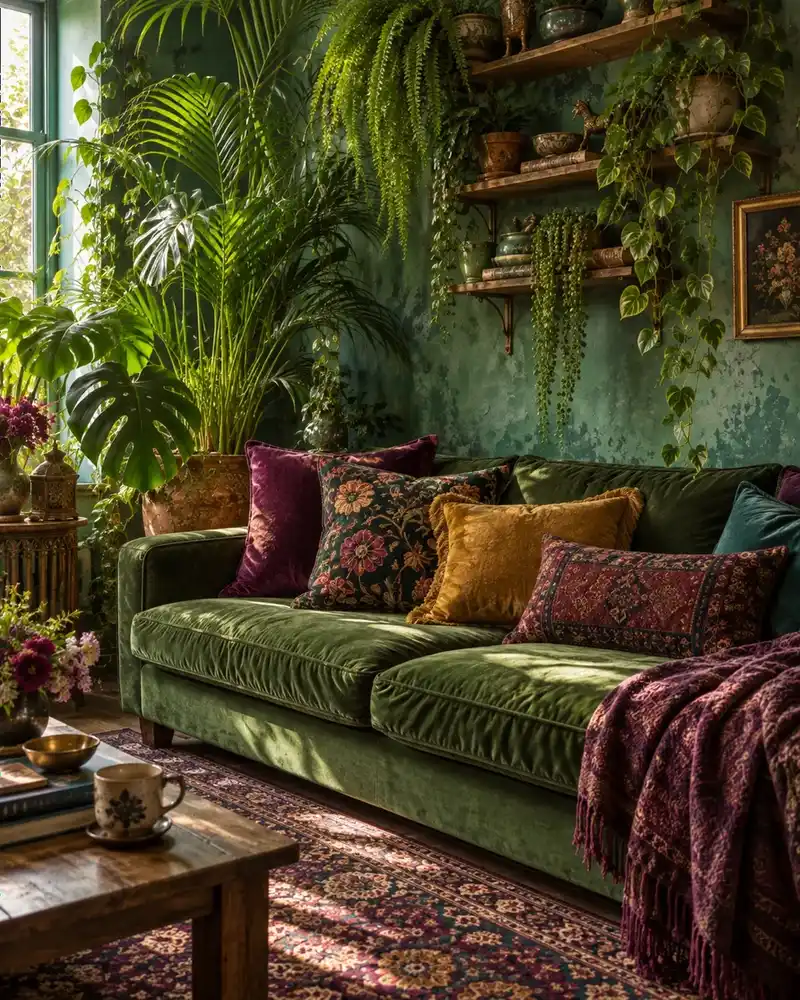
This room does the bravest thing first: the sofa is a deep green velvet, not a safe beige. Around it, everything else can stay relaxed. Floral and mustard cushions pull colors out of the patterned rug. A purple throw hangs over one arm. Plant shelves and a big palm fill the wall behind, so the green sofa sits inside more green and never looks alone.
If a full colored sofa is too big a step, copy the ratio instead of the item. Let one piece carry the strong color, keep the next two pieces in the same color family but softer, and let the rest stay neutral. A colored armchair, a painted sideboard or even a bold rug can play the lead role. What matters is that only one piece shouts. Two shouting pieces start to fight, and the room loses the calm that makes boho feel warm instead of busy.
Cushion count on this sofa: five, in three fabrics (velvet, cotton print, woven). That mix of one smooth, one printed and one rough fabric is the part worth copying exactly.
2. Hang One Big Macrame Piece as the Main Wall

A lot of boho walls fail because the pieces are too small and too many. This room uses one wide macrame hanging, almost the width of the sofa, and lets it be the whole wall. Under it: a plain sectional, a leather pouf, a jute rug and a low wood table. Nothing competes with the hanging, so the room reads calm even with a big pattern of knots above the sofa.
Size is the whole trick. A wall hanging should cover at least two thirds of the sofa’s width. A small one floats and looks lost, and adding more small pieces around it rarely saves it. Hang the rod or branch so the top of the piece sits about 20 to 30 cm above the sofa back. If you rent, a single removable hook at each end of the rod is enough for a cotton piece, since macrame is light.
Cream is the safest color for a first piece. It adds texture without adding a new color to manage, which is why it works over patterned cushions like the ones here. For more pattern-led walls in the same spirit, see our afrohemian living room ideas after this post.
☐ Width: at least 2/3 of the sofa below it
☐ Top edge: 20-30 cm above the sofa back
☐ One piece only, no small frames crowded around it
☐ Cream or natural cotton for a first purchase
☐ Renter fix: two removable hooks, one at each rod end
3. Use a Daybed Sofa for Seating That Sleeps Guests
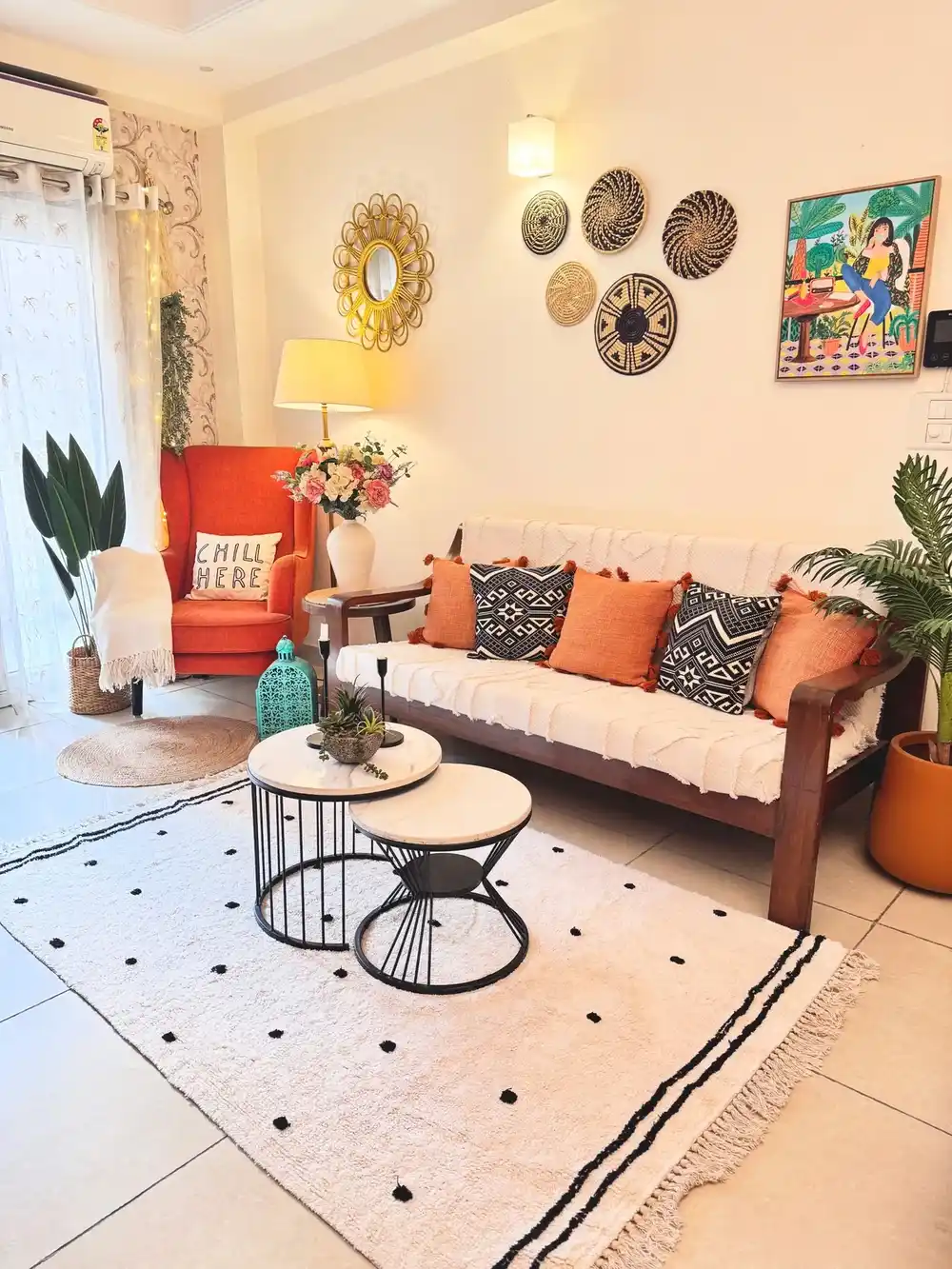
Small homes get a real gift from this idea: a wooden daybed working as the sofa. By day it seats three with a row of orange patterned cushions along the back. By night it is a guest bed with no folding, no air pump and no apology. The woven plates on the wall and the dotted white rug keep it light, and a low round table leaves the walkway clear.
To make a daybed feel like a sofa and not a bed in the wrong room, the back cushions matter most. Use firm cushions, at least 45 cm square, in a row with no gaps. A loose mattress look comes from soft, sliding cushions. A fitted cotton cover in a plain color under the cushions also helps: prints on the cushions, plain under them.
Depth check before buying: a daybed is about 95 to 100 cm deep, deeper than a normal sofa. In a narrow room, pull it fully against the wall and keep the coffee table under 40 cm wide, or skip the table and use a tray on the bed edge like the rooms in magazines do.
1. Daybed frame against the wall, mattress in a plain fitted cover.
2. Firm back cushions, 45 cm or bigger, no gaps.
3. Two patterned cushions in front for color.
4. Slim table or tray only, walkway stays clear.
4. Build a Basket Wall in Odd Numbers

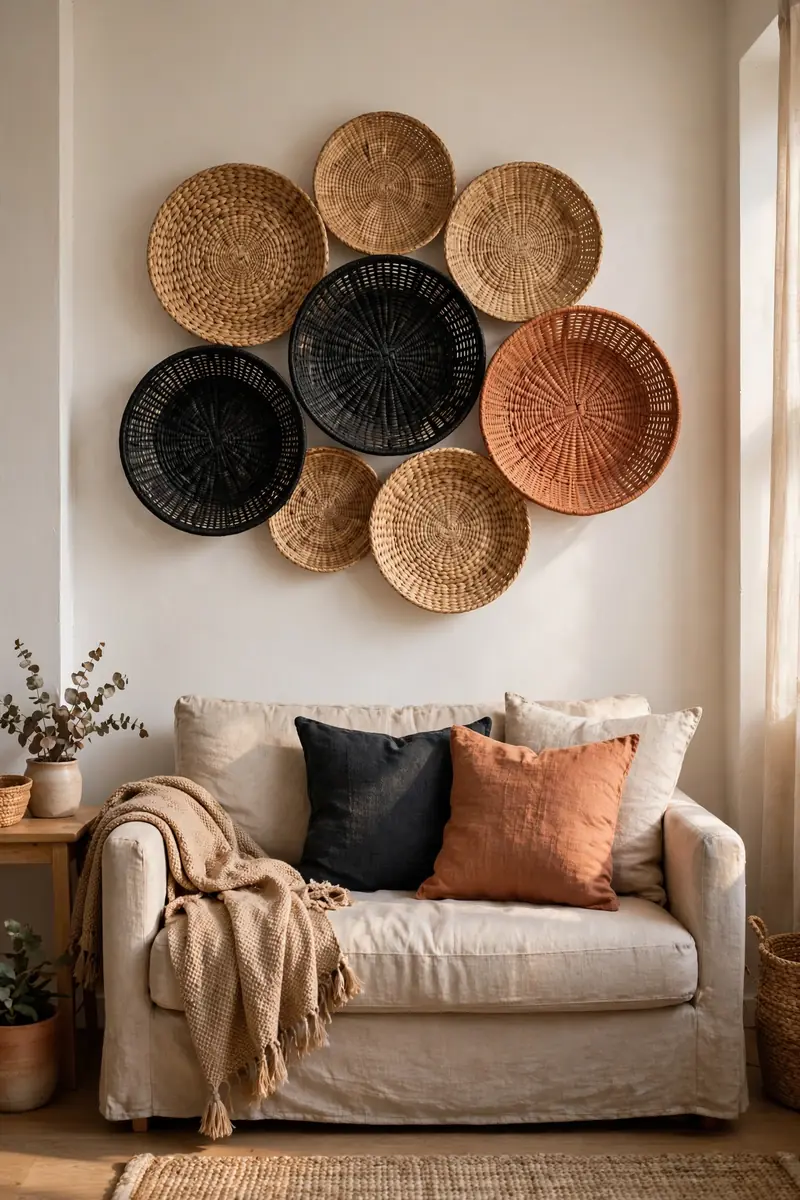
Flat woven baskets are the cheapest wall art in the boho world, often a few dollars each at thrift stores and markets. This room groups them above and beside a green sofa: big ones in the middle, smaller ones stepping out, all in natural tones with one or two dark patterns mixed in. The shelves to the side continue the same wood and weave story.
Odd numbers group better than even ones. Three, five or seven pieces settle into a shape the eye accepts; even groups tend to look like two pairs arguing. Lay the arrangement on the floor first and photograph it. Move pieces until the photo looks right, then hang in that order, starting from the center piece. Spacing of 3 to 6 cm between baskets keeps the group reading as one piece of art instead of scattered plates.
Weight is the renter bonus here: most flat baskets hang from a single small nail or even a removable strip. A whole wall of art with almost no wall damage is hard to beat at this price.
Group 3, 5 or 7 baskets
Plan the shape on the floor first
Mix one or two dark patterns in
Hang one small basket alone
Space them far apart
Match every basket exactly
5. Keep the Base Calm, Then Add Color With Plants

Here is the version of boho for people who fear color. The sofa is white, the table is plain wood, the rug is a soft pattern in beige tones, and the pendant is rattan. All the life comes from plants: on the floor, on the TV console, trailing from shelves. Green becomes the accent color, and green never clashes with wood or cream.
This is also the most rental-safe room in the post. Nothing is painted, nothing is fixed to the walls except light shelves, and every item can move to the next home. If your landlord rules out color on walls and furniture, this layout answers the problem: keep the deposit-safe base, spend on plants and textiles instead.
One warning from this photo: white sofas and daily life are enemies. A washable throw over the seat cushions, like the layered textiles in this room, is not decoration. It is the thing that keeps the sofa white. Choose throws in the same beige family so the protection looks like styling.
| Layer | This Room | Your Swap |
|---|---|---|
| Base | White sofa, wood table | Any plain light furniture |
| Texture | Rattan pendant, woven rug | Jute, cane, seagrass pieces |
| Color | Plants only | Green at 3 heights |
6. Layer the Bed Like a Nest

The bed in this room is built in layers you can count: white sheets, a sage green duvet, a cream knit throw folded across the foot, then pillows in three sizes with one patterned cushion at the front. A rattan headboard gives the wall height, string lights and plants fill the shelves, and a patterned rug softens the floor. Nothing here is costly alone. The order is what makes it look rich.
Copy the order, not the items. Start with the plain base you already own. Add the colored layer (duvet or bedspread) in one calm tone. Fold a textured throw across the bottom third of the bed, not the middle. Finish with the pillow stack: sleeping pillows at the back, two medium cushions, one small patterned one in front as the single print.
For plant lovers, the bedroom version of this layering continues in our greenery bedroom ideas, where the green does even more of the work. In this room the plants stay at the sides, which is the right call for sleep: green in view, but not hanging over the pillows.
7. Warm Up a Bedroom With Rust and Amber

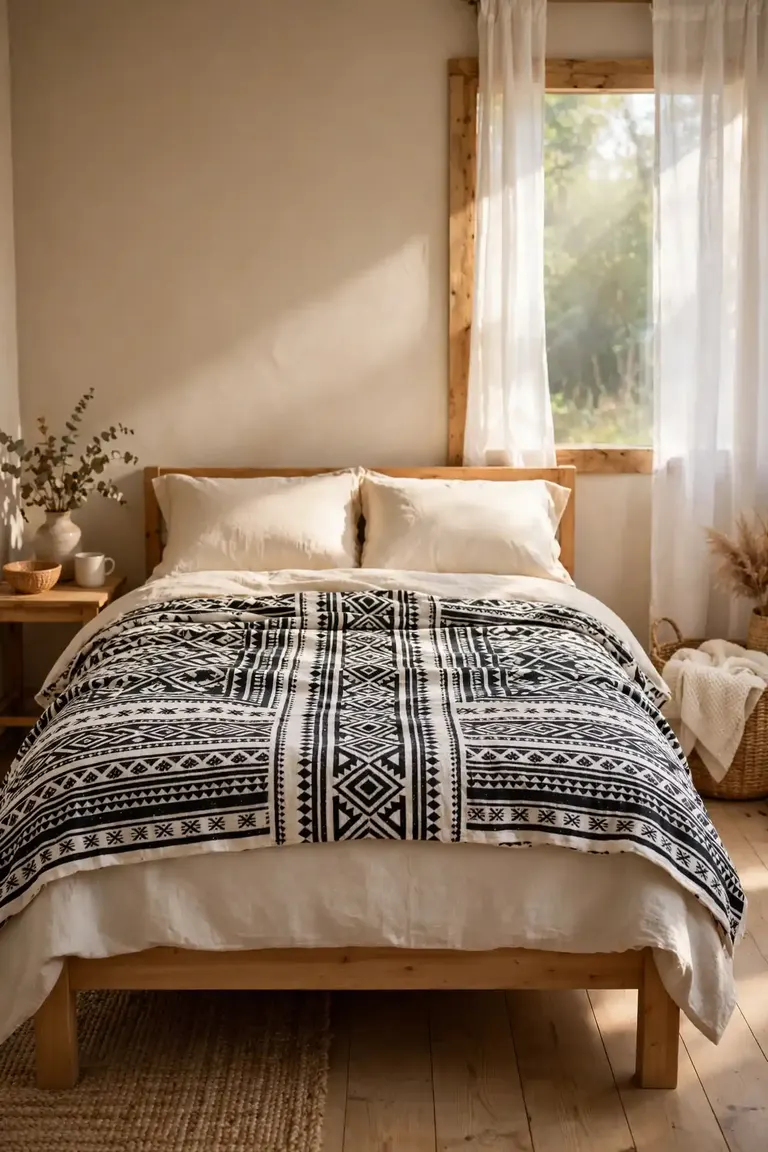
Not every boho bedroom has to be green or cream. This one runs on rust, amber and honey wood. The bedding carries the color in two tones: a deep rust throw over a paler base, with cushions split between plain cream and the same rust. Woven discs and a small macrame piece dress the wall, monstera leaves add the one cool color, and sheer curtains keep the light soft.
The useful rule hiding here is about warm colors in small rooms. A full rust bed in a small bedroom can feel heavy by day. The fix used in this photo is balance: the warm color sits low (bed and floor), while the walls and curtains stay pale. Heat at the bottom, air at the top. The room feels cozy at night and still bright at noon.
Buy order for this look: one rust throw first, live with it for a week, then add the cushion pair if the room still feels cool. Warm colors are strong; adding them in two steps stops you overshooting into a room that feels orange.
More warm, pattern-rich bedroom styling lives in our afrohemian bedroom ideas post, which pairs these tones with deeper prints.
8. Dress a Doorway With a Macrame Curtain

Doors are wasted space in most homes. This doorway wears a deep blue macrame curtain with a lotus design, and it changes the whole feel of walking between rooms. Light and air still pass through the cords. The small shelves beside the door, with tiny plants and pots, finish the frame.
A macrame curtain suits renters for a simple reason: it hangs from a tension rod or the existing curtain hardware, so no drilling and no door removal. It also softens the hard line of a door frame, which matters in boxy modern apartments where every opening is a plain rectangle.
Measure before you buy: the curtain should be at least the full width of the opening, and the length should stop 2 to 3 cm above the floor so the cords do not drag and tangle. Blue is bold; if the room is still new, start with cream. A colored curtain is a big block of color at eye height, so treat it like the 30% layer in the color split from idea 1, not as a small accent.
9. Turn a Narrow Nook Into a Reading Corner
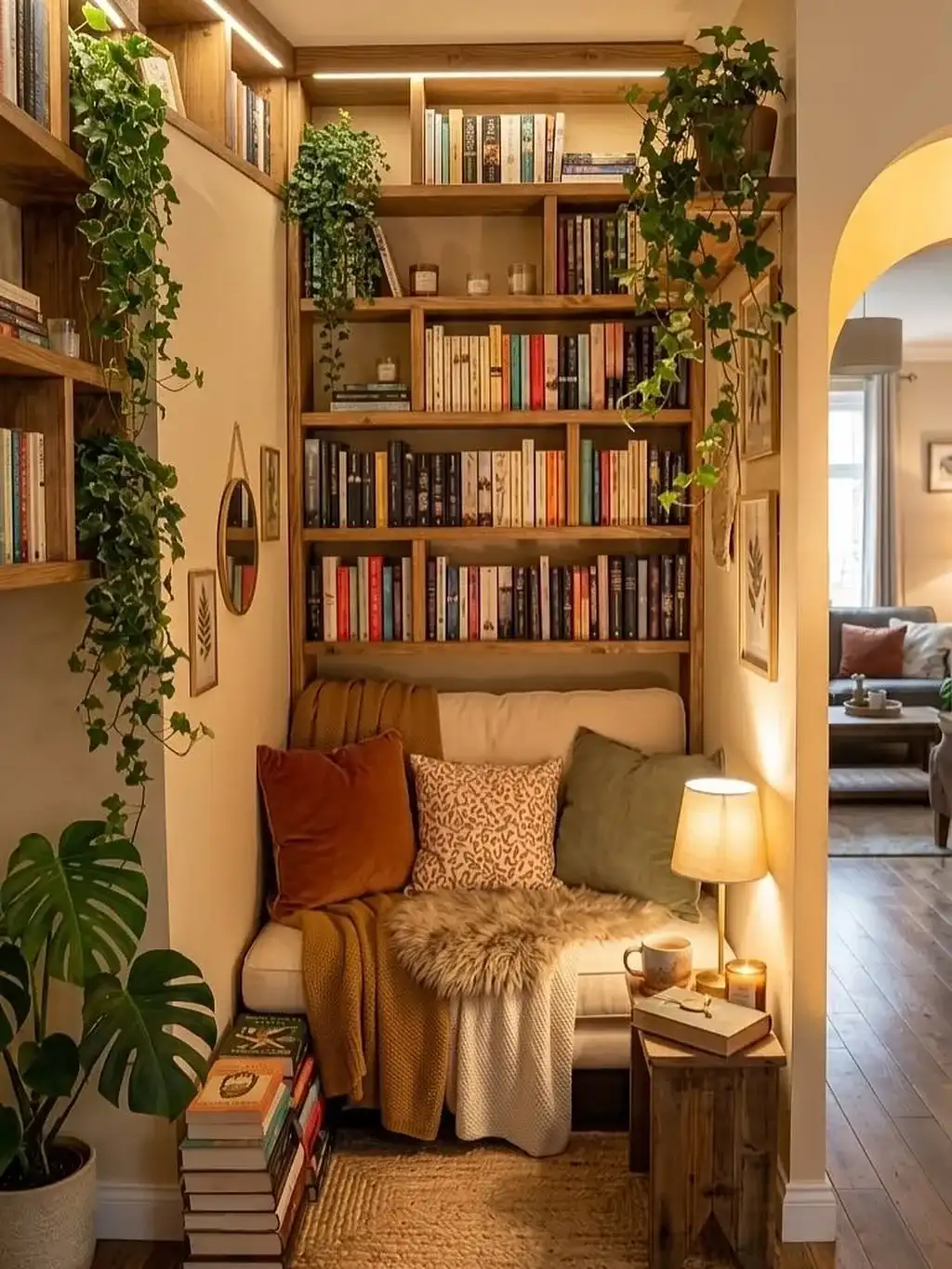
Every home has one awkward narrow space that holds nothing well. This nook turns one into the best seat in the house: a built-in bench with cushions, shelves of books above, vines trailing down the wood, and one warm lamp at sitting height. The whole thing is less than a meter deep, and it works because everything in it serves sitting, reading or light.
Build yours from the seat outward. A firm bench cushion or a folded futon gives the base. Two big cushions against the wall replace a backrest. Then the lamp: warm bulb, shade at eye level when you sit, so the light pools on the book instead of glaring. Shelves or a small book stack finish it.
What to skip: a side table. In a nook this narrow, a mug goes on the windowsill or a small stool that tucks under. The tightness is the charm. The moment you add full furniture, the nook stops feeling like a hiding place and starts feeling like a corridor with a chair in it.
☐ Firm seat cushion or folded futon
☐ Two big back cushions against the wall
☐ Warm lamp, shade at seated eye level
☐ Books within arm’s reach
☐ One trailing plant for softness
10. Build a Work Nook Inside the Greenery

Working from home in a boho home does not need a separate office. This desk sits in a window corner, and the styling treats it like part of the room: plants on the desk edge, plants on the sill, plants hanging above, a cane chair with a cushion, and the laptop closed in the middle of it all. The work zone is clear, but it never looks like an office landed in the house.
The line that keeps this working is the desk surface rule. Plants live on the back third of the desk and on the sill. The front two thirds stay empty for work. Cross that line and the desk becomes a shelf with a laptop problem. A small tray for the daily items (notebook, pen, phone) keeps the border visible.
Light does the rest. A desk facing a window sideways, as here, gives daylight without screen glare. Facing the window directly washes the screen out; back to the window puts your shadow on the desk. Side-on is the seat to pick when you have the choice.
Plants on the back third of the desk only
Sit side-on to the window for clean light
One tray holds all daily work items
11. Frame the TV With Shelves and Plants
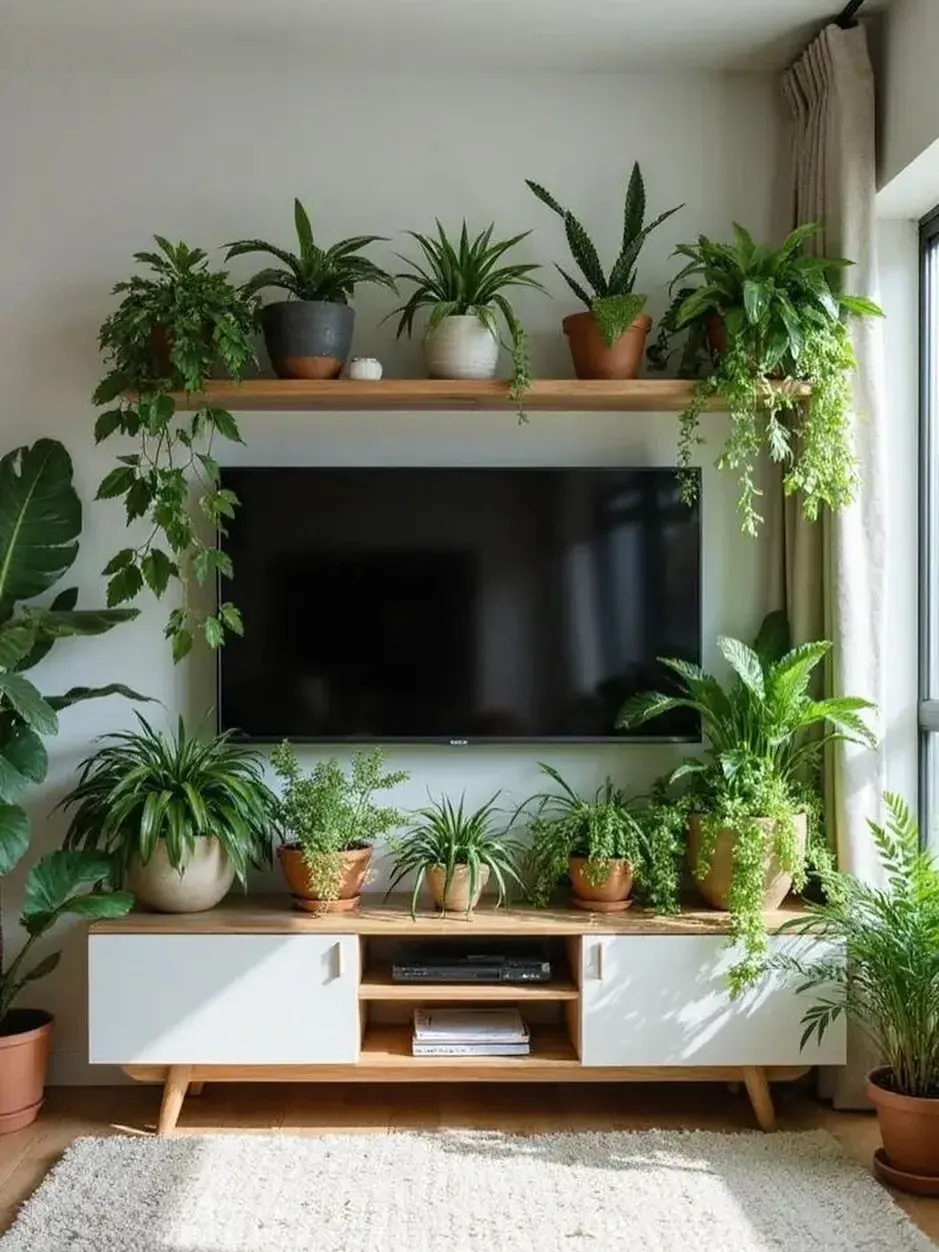
A big black screen fights the boho look harder than any other object. This wall solves it by framing: a shelf of plants runs above the TV, the console below carries more green, and trailing vines soften both side edges. The screen is still there, but the eye reads the whole wall as a garden shelf that happens to hold a TV.
Copy the frame, in this order. First the shelf above, at least 20 cm above the screen so heat and dust stay clear. Plants on it should trail or stay short; nothing tall that blocks the top corners of the picture. Then fill the console surface at both ends, leaving the middle open for the remote and sound bar. Symmetry is not needed. A trailing plant on one side and stacked books on the other looks more natural than matching pairs.
Renters: a picture ledge shelf with two screws holds more than you think, but if drilling is banned, stack the plants on a tall bookcase placed beside the TV instead. The frame effect still works from the side.
Shelf 20 cm above the screen
Trailing plants soften the edges
Keep the console middle clear
Tall plants blocking screen corners
Matching pairs on both sides
Plants on top of the TV itself
12. Choose Carved Wood for the Media Console
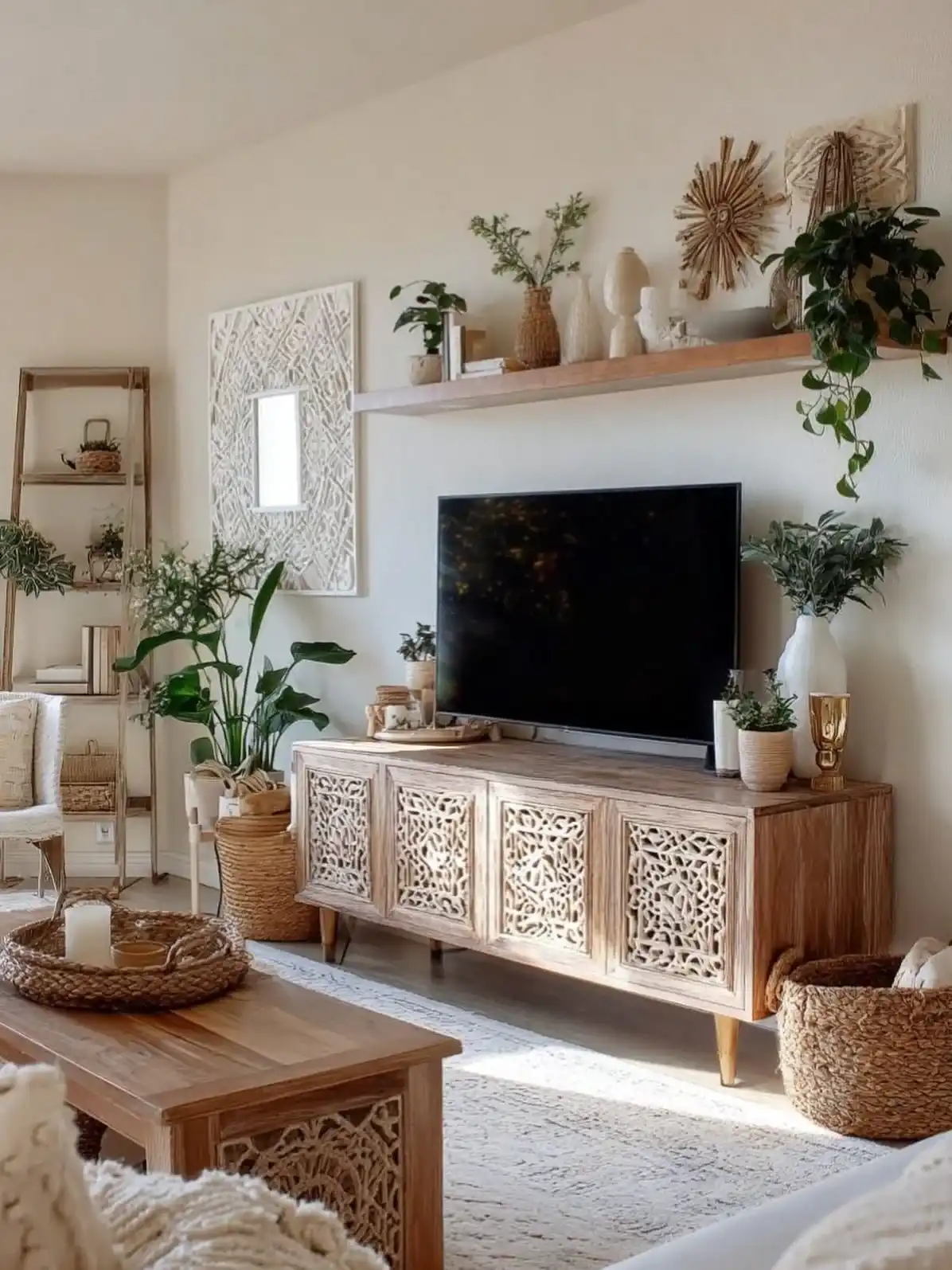
Plain rooms often need one piece with detail, and this room puts it under the TV: a low console with carved doors. The carving does the work that three small decor items would do, so the top stays clean with just plants and a couple of vases. Above, a plain shelf holds the green. Nothing else in the room has pattern at this scale, which is why the console stands out kindly instead of shouting.
Where to find this without paying antique prices: carved-look consoles and sideboards are common in flat-pack and import stores, and second-hand carved doors can be fitted onto a simple box frame by any local carpenter. One detailed piece per room is the limit. Two carved pieces plus patterned textiles tip a room from warm to fussy.
Wood tone note: this console sits in the honey range, lighter than the floor. Mixing wood tones is fine in boho rooms as long as they share warmth. Honey, teak and mango wood blend. Grey-washed or black-stained wood fights them and is better kept out of the same room.
13. Trail Vines Around a Door Frame
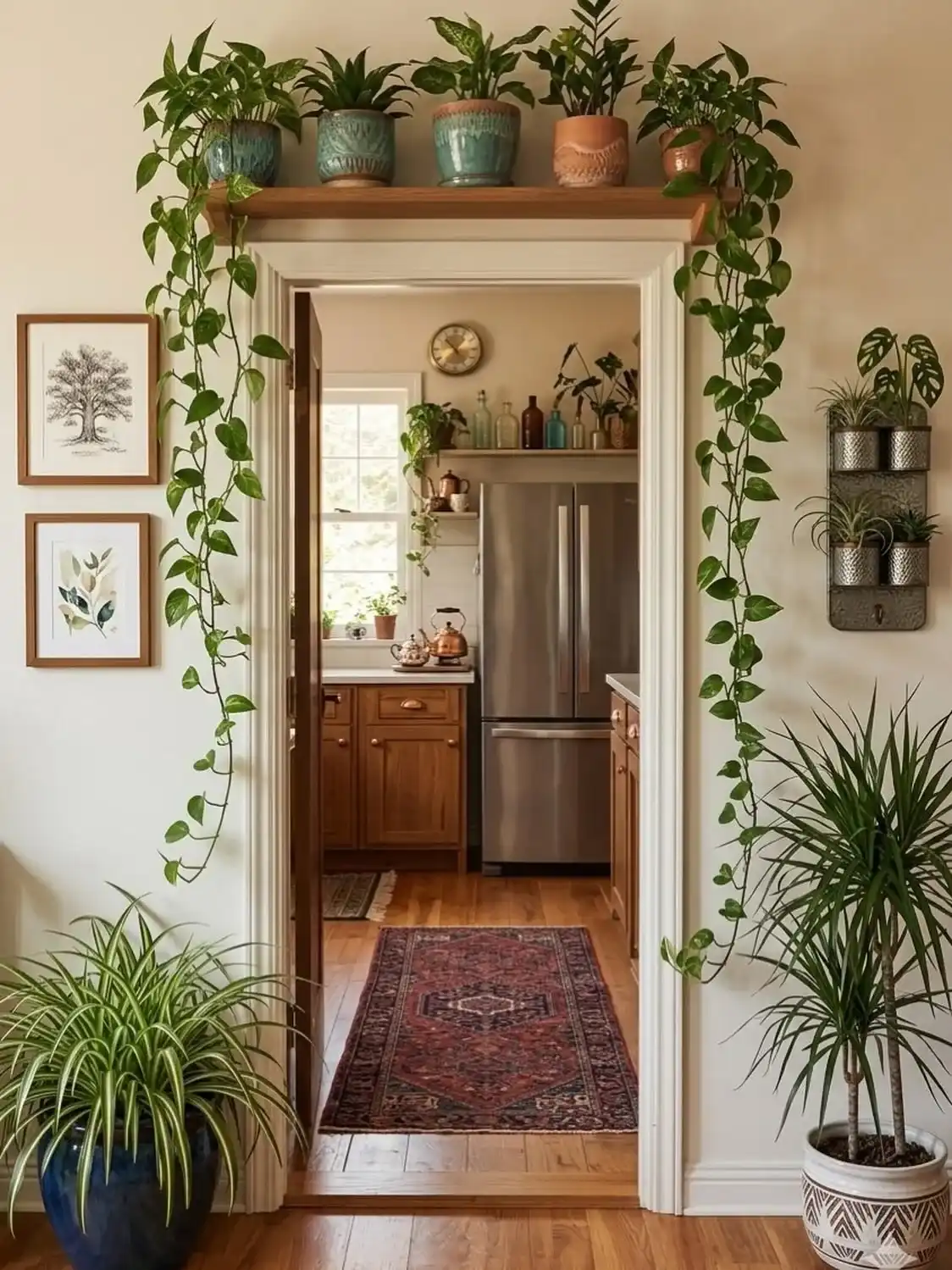
Here the doorway itself becomes the decor. A pothos trails over the top of the frame and down both sides, plants sit on a shelf above the door, and the view through to the kitchen ends in more green. It costs one plant and some patience, and it makes the plainest rental doorway look chosen instead of standard.
Training a vine is simple but slow. Start with a pothos or philodendron, since both root along the stem and forgive mistakes. Fix small clear hooks every 30 to 40 cm along the frame. Lay the stem along them loosely; never pull it tight. As the plant grows, add the new length to the next hook. A stem grows toward light, so the side near the window will fill first. That is fine. Asymmetry suits this look.
Water note: a plant over a door is easy to forget. Put it on the same watering round as your nearest floor plant, and choose the shelf position so a step stool reaches it without stretching over the doorway. If the spot is truly awkward, a good fake vine mixed into a real plant at the base fools everyone and never needs water.
1. Clear hooks every 30-40 cm along the frame.
2. Lay the stem loosely, grow side toward the light.
3. Add new growth to the next hook every few weeks.
14. Stack Plant Shelves in a Dead Corner

The corner behind an armchair is dead space in most living rooms. This one stacks three wood shelves up the wall and fills them with plants, books and small frames, then parks a floor lamp beside the chair. The corner now works three jobs: garden, library and light source. And the chair, which faced the room before, now has a reason to exist in that spot.
Shelf order matters for both looks and plant health. Heaviest pots and books go on the bottom shelf. Trailing plants go on the middle shelf so the stems can fall. The top shelf takes the smallest pots and the tallest stems, since nothing hangs above them. Keep 35 to 45 cm between shelves; less than that and the plants crowd, more and the wall shows through in a way that looks empty rather than airy.
If you are new to plants, fill half the shelves with plants and half with books and objects, like this photo does. A full plant wall is a big watering job. Half and half still reads as a green corner, and you can swap objects for plants as your confidence grows.
🪴 Bottom: heaviest pots + books
🌿 Middle: trailing plants, stems free to fall
🌱 Top: smallest pots, tallest stems
Shelf gap: 35-45 cm between levels
15. Hang Plants at Three Heights

Evening is when this room earns its keep. Plants hang at three different heights over the seating, string lights thread through them, and candles and lamps glow below. The ceiling, normally the emptiest part of a room, becomes part of the styling. In a rental with a plain white ceiling, that is free decor space you were ignoring.
The three heights to copy: hangers at roughly 30 cm, 60 cm and 90 cm below the ceiling. Same-height hangers look like a shop display. Mixed heights look like a garden. Keep every hanger clear of head height over walkways and seats; over a sofa, the lowest leaf should still clear a sitting person’s head by a good margin.
Weight check for renters: a wet hanging plant in a 20 cm pot can weigh 3 to 5 kg. Ceiling hooks must go into a joist or use proper toggle fixings, never plain plaster. Where drilling is banned, hang from a curtain rod end, a tension rod across a window, or a tall shelf edge. The plant does not care what holds it, as long as it holds.
| Hanger | Drop Below Ceiling | Best Plant |
|---|---|---|
| High | ~30 cm | Small trailing pothos |
| Middle | ~60 cm | Fern or spider plant |
| Low | ~90 cm | Long string of pearls (over seating edges only) |
16. Lay a Crochet Rug in Pieces

This floor is not one rug. It is a set of crochet hexagons joined into a rug shape under a daybed dressed in pink and cream. The idea travels well: crochet or braided pieces can cover exactly the floor you have, grow one piece at a time, and shrink for washing in a way a full rug never can. The soft colors here also prove boho is not forced to be brown. Pink, blush and cream do the same job in a lighter mood.
If you crochet, this is a long, pleasant project: one hexagon is an evening’s work, and twenty make a rug. If you do not, ready-made patchwork and joined-jute rugs exist in most home stores. Either way, the pieces need a non-slip mat under them. Loose textile tiles slide on wood floors, and a sliding rug edge is a trip waiting at the door.
Size guide: the rug should pass at least 20 cm beyond the daybed or sofa on the sides you walk on. Under-coverage is the main reason textile rugs look lost. Measure the furniture footprint first, then count pieces.
17. Let One Rug Carry All the Pattern

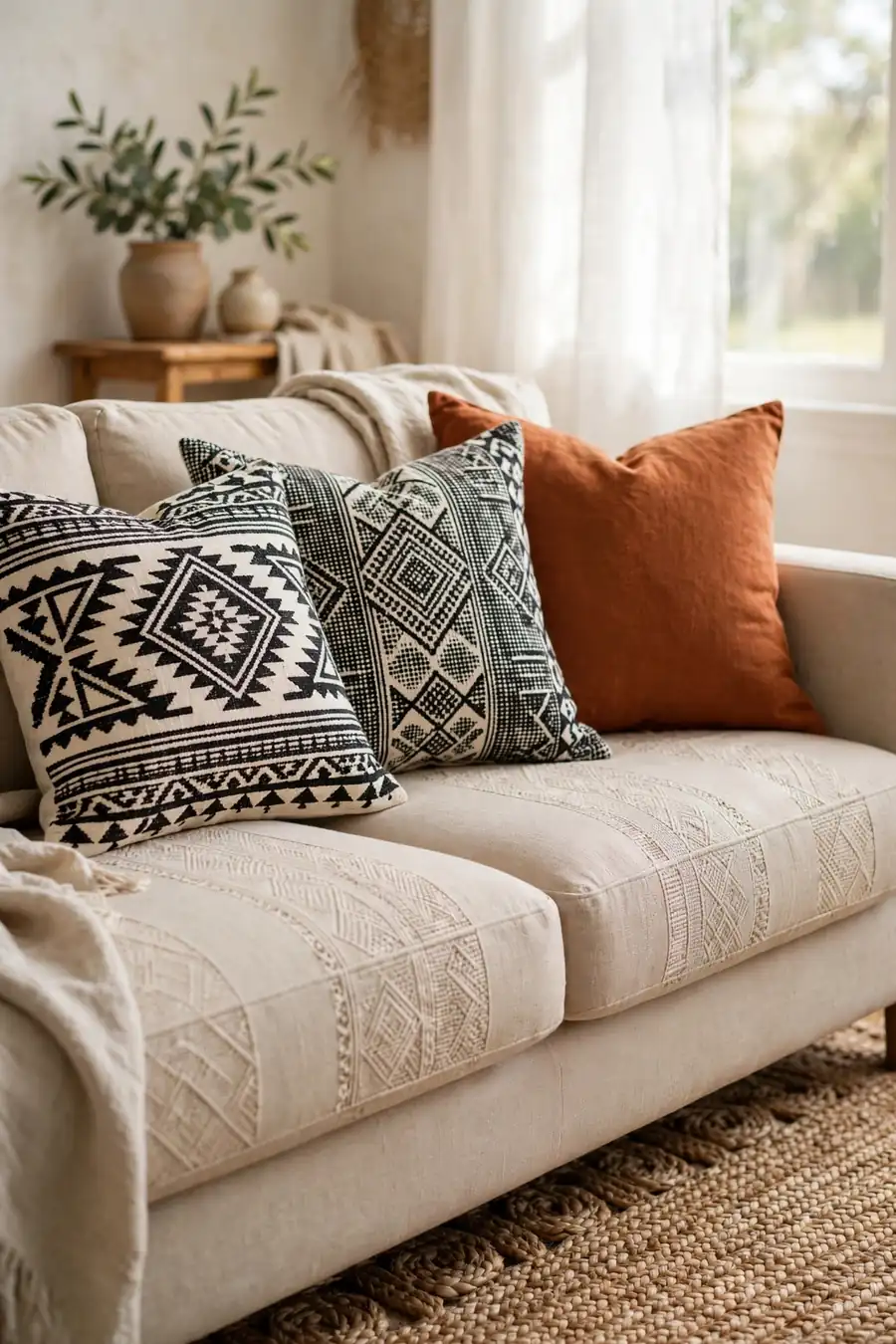
This room shows the safest way to use a strong rug. The sofa is plain grey, the cushions are plain blocks of orange and cream, and the plants are plain green. Only the rug has a full pattern, in the same warm family as the cushions. Because everything else stays quiet, the rug looks like a choice instead of a fight.
The rule travels to any room: pattern needs a budget. One big pattern (rug or bedding or curtains) plus one small pattern (a cushion or a throw) is the safe limit for beginners. This room spends its small pattern on nothing at all, which is also fine, and the plants add movement without pattern.
Matching trick used here: the rug’s border color repeats in the cushions. When you shop, take a photo of your rug (or its product page) and hold cushion covers against it. Two shared colors between rug and cushions is enough to tie them. Three shared colors starts to look matched on purpose, which boho should never look.
| Pattern Size | Use It On | Keep Plain |
|---|---|---|
| Large repeat | Rug or curtains | Sofa, cushions |
| Small print | One or two cushions | Rug in a flat weave |
| None | Fully calm room | Let plants add the movement |
18. Use a Live-Edge Table as the Centerpiece

Open-plan rooms need one object that anchors the sitting area, and here it is a thick slice of tree trunk on legs, used as the coffee table. Around it, everything is light: rattan chairs, a pale sofa, plants on stands. The table’s rough edge and rings bring the outdoors in more honestly than any printed wood effect could.
Real trunk slices are heavy, and that is their one big flaw in rentals. A slice this size can weigh 25 kg or more and needs two people to move. If you move often, look for a live-edge board on a lighter base instead: same wavy edge, half the weight. Either way, seal the top. Unsealed wood drinks coffee rings and keeps them forever. A clear matte sealer keeps the natural look and stops stains.
Styling on top stays minimal: a plant, a small tray, nothing tall. A table this strong is the decoration. Crowding it with objects is like framing a picture and then hanging things on the glass.
19. Ground a Big Room With a Flatweave Rug

Big rooms have the opposite problem to small ones: furniture floats and the room echoes. This space fixes it with one large checked flatweave rug that runs under the sofa and the cane chairs, tying them into a single island. The beams, the carved door and the woven textures above do the decorating; the rug quietly does the joining.
The rule for rug size in big rooms: front legs of every seat on the rug, at minimum. All four legs on is better. A rug that reaches only the coffee table leaves the sofas looking like boats around a pond. Measure your seating group, add 20 cm on each side, and shop that number, not the standard size closest to it.
Flatweave is the right weave at this scale. A thick pile rug in a large size is costly and heavy; flatweave covers the same ground for less money, slides under doors, and suits the boho mix of patterns because its own pattern stays flat and calm, like the soft check here.
☐ Front legs of every seat on the rug (all legs = better)
☐ Seating group size + 20 cm on each side
☐ Flatweave for large sizes and easy cleaning
☐ Pattern stays soft if other pieces are busy
20. Style the Entry With a Mirror and One Hanging

Entryways get the leftover decor in most homes. This one gets a planned trio: a round seagrass mirror, a long raffia hanging beside it, and a low bench with a plant and a lit candle below. Three pieces, one wall, and the first steps into the home already feel warm. The mirror also does a real job, bouncing window light into a space that often has no window of its own.
Why a trio works: the mirror gives height and light, the hanging gives texture, the bench gives a horizontal line and a place for bags and shoes. Remove any one and the wall sags. Add a fourth piece and it starts to clutter. Three is the number to stop at for a small wall.
Sizes: the mirror here is roughly 50 to 60 cm across, big enough to check your face and reflect light, small enough for a narrow hall. Hang its center at about 150 cm from the floor, standard eye height, and let the hanging drop lower than the mirror’s bottom edge so the two overlap in height and feel connected.
Round mirror, 50-60 cm, center at 150 cm height
One long textile or raffia hanging beside it
Bench or shelf below with plant and candle
21. Plan the Evening Layer: Candles, Lamps and String Lights

Boho rooms are judged at night. This living room plans for it: string lights run along the shelves, candles group on the tables, and lamps glow at the ends of the sofa. By day the room is brown, cream and wood. By night it has three layers of light, and the same furniture looks twice as rich.
Build the layers in order of height. Low: candles and lanterns on tables, grouped in threes, never single. Middle: table lamps with warm bulbs (2700K on the box) at sofa ends. High: string lights along a shelf or picture rail, not across the ceiling. Light at three heights wraps a room; light from one ceiling point flattens it.
Safety, plainly: real candles belong on trays, away from throws and plant leaves, and out when you leave the room. The candle clusters in these photos sit on tables and trays for a reason. LED candles now look close enough that using them inside lanterns and near textiles is the smart default, with real flame kept for the coffee table where you can see it.
🕯️ Low: candles in groups of 3, on trays
💡 Middle: table lamps, 2700K warm bulbs
✨ High: string lights along shelves, not the ceiling
22. Make a Low Ceiling Feel Intentional

Attic rooms and low ceilings scare people off, but this room leans in. The seating stays low: a floor-level sofa line, a pouf, a low table. Macrame hangs on the far wall, candles and lanterns sit on the floor and tables, and string lights trace the sloped ceiling line instead of fighting it. Nothing reaches up, so the ceiling never feels like it is pressing down.
The rule: in a low room, decorate the bottom two thirds and leave the top third empty. Tall shelves and high art pull the eye up to the low point. Low furniture, floor cushions and lights at table height keep the eye in the comfortable zone. The slope then reads as cozy architecture, not a flaw.
One caution with sloped ceilings: heat rises into the peak and candles under a low slope need clearance. Keep real flame at least 60 cm from any sloped surface above it, and use LED candles for the spots tucked under the eaves. This photo mixes both, which is the right instinct.
23. Fill the Corner Behind the Sofa

A sofa pushed into a corner leaves a dead triangle behind it. This room fills that corner on purpose: a bookshelf rises beside the sofa, a round wood mirror hangs above, macrame drops down the wall, and string lights thread through trailing leaves. The corner becomes the backdrop the sofa was missing, and the whole seating area looks finished from the doorway.
Start with the tallest piece. The shelf (or a tall plant) takes the corner’s height first. Then the mirror or art at sitting eye level above the sofa back. Then the soft layer: the hanging, the lights, the trailing plant that joins them. Working tall to soft stops you buying small things for a space that needed one big thing.
Mirror note: an irregular round shape like this one softens a corner better than a rectangle. Corners are all hard angles; one round object in the middle of them relaxes the whole spot. That is also why round mirrors appear in the entry idea earlier in this post.
Tallest piece first (shelf or plant)
One round shape against the angles
String lights to join the layers
Start with small ornaments
Push the sofa off the wall to hide the gap
Leave the corner dark at night
24. Give the Balcony the Same Rules as a Room

A balcony is a room with better air, and this one is styled like it: a bench with cushions along the wall, a small table, plants at floor and shelf height, a patterned rug underfoot, and string lights overhead for the evening. Nothing here is special outdoor furniture. It is indoor boho thinking carried outside, which is why it looks like a place to live instead of a place to store a bike.
Outdoor adjustments are few. Cushions and rugs must be outdoor fabric or come inside when rain comes; a storage bench, like the one under the seat here, solves that in one piece. Plants should suit the balcony’s sun: the leafy mix here suits bright shade, while a full-sun balcony needs herbs, succulents and grasses instead.
Renters often skip balconies because the space is small and borrowed. It is also the only outdoor room you fully control. A rug, a bench cushion and three plants can be carried out in one trip and carried in when you move, and they buy you a second living room for half the year.
☐ Bench with outdoor cushions (storage base if possible)
☐ One patterned outdoor rug
☐ Plants at floor, shelf and hanging heights
☐ String lights for the evening layer
☐ Small table for a cup and a book
25. Build a Vanity Corner From Found Pieces
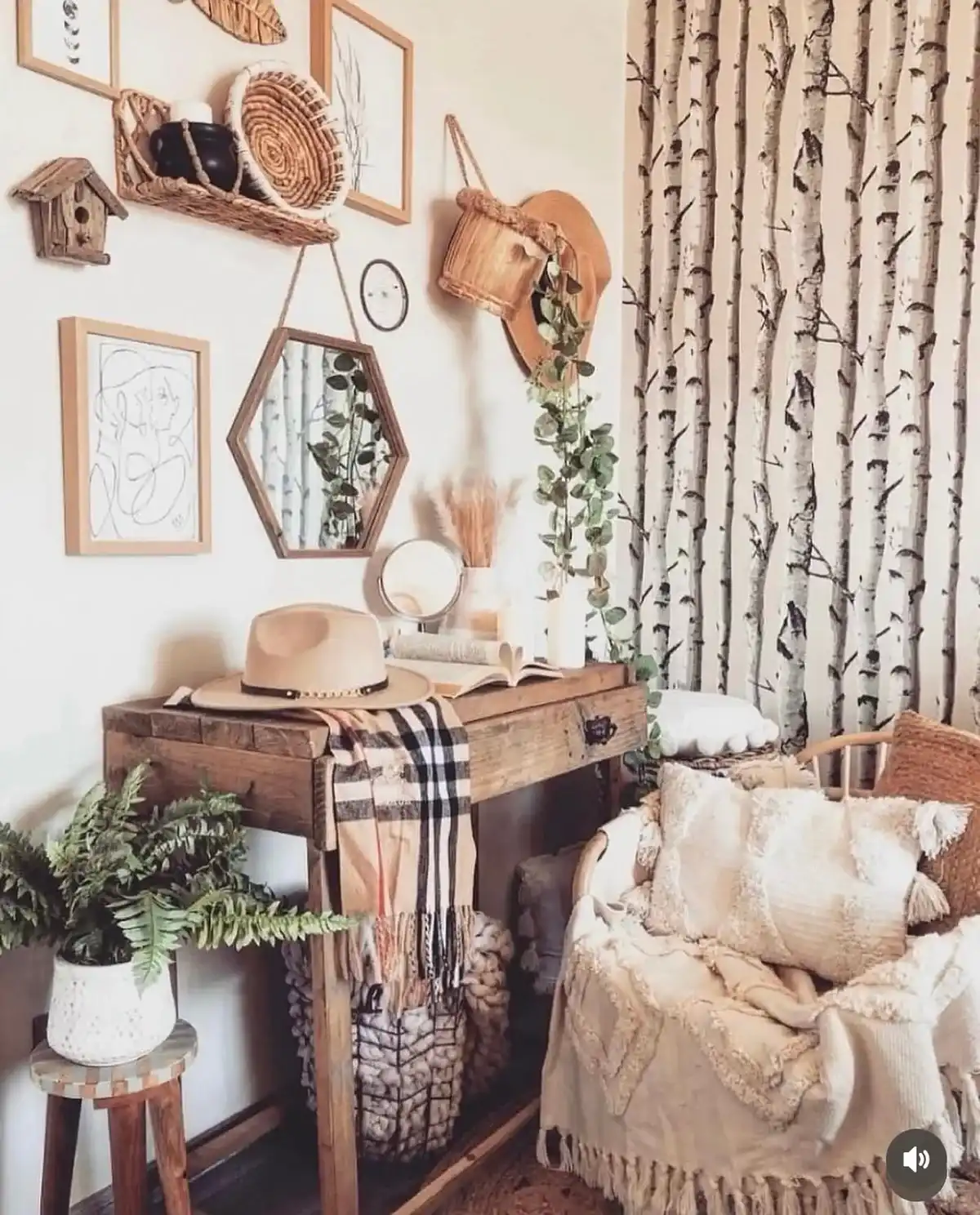
The last idea is the most personal one in the post. This vanity corner is built from found and mixed pieces: a worn wood table, small mirrors and frames at different heights, hanging textiles, a fringed chair cover, hats and baskets on the wall. Nothing matches, and that is the point. Boho at its best is a record of what you have gathered, not a set you bought in one order.
To gather without creating a mess, give the corner one rule: everything in it must be natural material or carry a memory. The mirror from a flea market qualifies twice. The plastic organizer qualifies zero times. A corner built on that rule grows slowly and always looks like you.
Light for a vanity needs one fix: a mirror used for makeup should face daylight or have a lamp in front of you, not behind. In this corner the table sits against the wall with light from the side window, close enough. If your corner is dark, a small warm lamp on the table beats any ceiling light for seeing your face kindly.
5 Boho Mistakes That Make Rooms Look Messy
1. Buying the whole look in one day. Boho is gathered over time. A room bought in one cart has no layers of story, and it shows. Add in the budget order from the basics section: rug, textiles, wall piece, plants, lights.
2. Pattern everywhere at once. A patterned rug, patterned curtains, patterned bedding and patterned cushions in one room cancel each other out. Spend the pattern budget like idea 17 says: one big pattern, one small one, then stop.
3. All beige, no anchor. The all-cream version of boho can slide into bland. Every room needs one anchor: a bold sofa (idea 1), a carved console (idea 12), a trunk table (idea 18) or a deep color on the bed (idea 7).
4. Plants at one height only. A row of pots on one windowsill is not a green room. Floor, shelf and hanging heights (ideas 14 and 15) are what make plants feel like part of the architecture.
5. Ceiling light as the only light. One bright overhead light kills every texture you paid for. The three-height light plan in idea 21 is the cheapest fix in this whole post, and it works the same evening you do it.
Boho Home Decor Questions, Answered
Where should I start if my room is plain and my budget is small?
Start with the rug and textiles. A flatweave rug, two cushion covers and one throw change more of what you see than any single furniture piece, and all three can cost less than one chair. Then add the wall piece, then plants.
How many plants does a boho room actually need?
Three is the working minimum: one floor plant, one on a shelf or table, one hanging or trailing. More is welcome, but three heights matter more than three extra pots at the same level.
Can boho work in a rental with no drilling allowed?
Yes. Macrame hangs from removable hooks, vines train on clear clips, shelves can be bookcases instead of wall boards, and tension rods hold curtains. Ideas 2, 8, 13 and 16 in this post were chosen with renters in mind.
What colors are safe if I am scared of the bold versions?
Run idea 5: cream, sand and light wood as the base, and let plants be the only color. Add one warm accent (rust or mustard) later through a throw you can return or move to another room.
Is boho still in style, or is it fading?
The gathered, natural-material core of boho keeps rolling into newer looks like organic modern and warm minimalism. Rattan, jute, wood and plants have not left a single one of those styles. Buy the materials, not the trend label, and the room keeps working.
How do I keep a boho room from looking messy?
Give every layer a job and keep clear surfaces clear. The console middle stays empty (idea 11), the desk front stays empty (idea 10), and pattern stays on a budget (idea 17). Boho looks relaxed because of what is left out, not just what is added.
Final Thoughts
A good boho room is not bought. It is built in layers, in the order this post follows: a calm base, natural materials, textiles, one wall that matters, plants at three heights, and light that glows low in the evening. Pick three ideas that fit your room, live with them for a month, then add the next layer. That slow build is exactly why these boho home decor ideas keep working long after faster trends have moved on.
For evenings at home, a boho room pairs well with scent, and our candle and reed diffuser ideas post shows 25 ways to layer fragrance the same slow way.

Sophoronia is a Senior Home Decor Writer at Home Aure, where she writes about thoughtful decorating, cozy interiors, small-space solutions, and practical ways to make a home feel more personal. Her work focuses on approachable ideas that balance beauty with everyday living. Through Home Aure, she explores room styling, decor trends, color, texture, and simple updates that can bring more character and warmth to a space.